


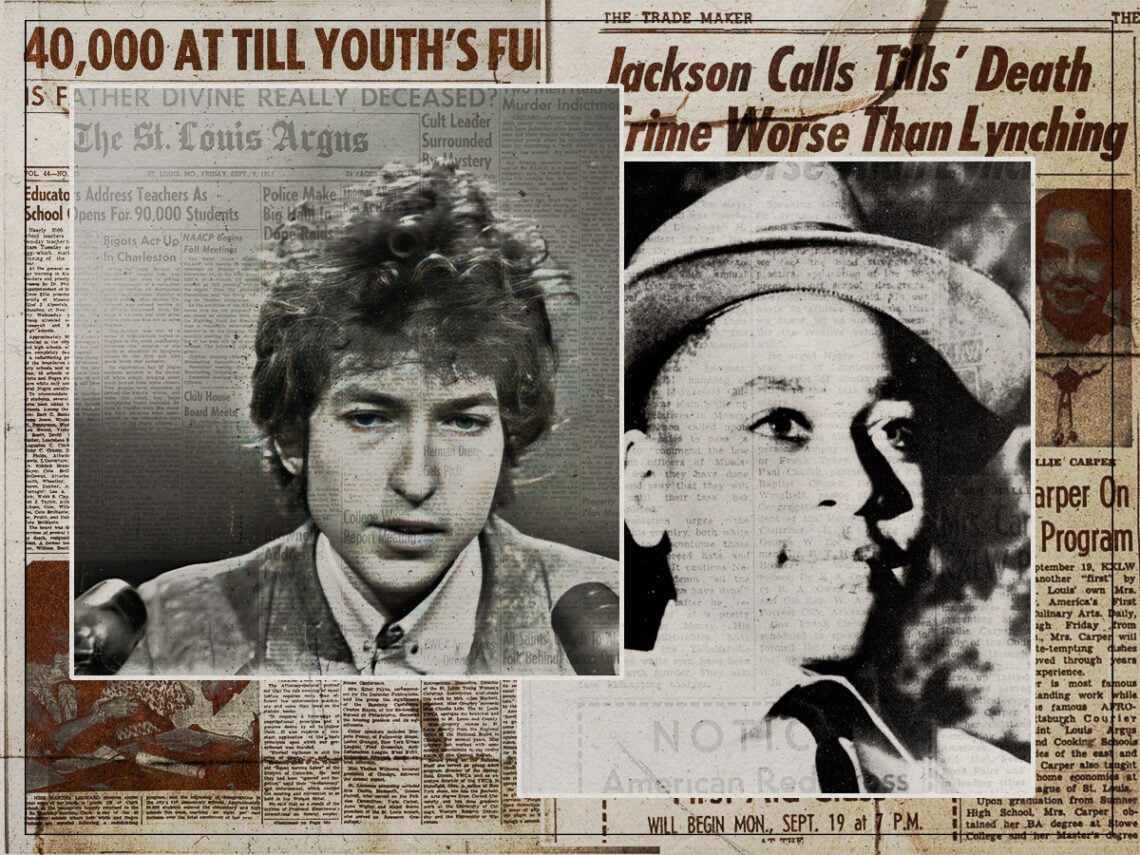
Emmett Till: the murder that shocked Bob Dylan into political action

Bob Dylan once said, “Songs, to me, were more important than just light entertainment”. A huge believer that art should stand for something more important, the version of Dylan that burst onto the scene in the 1960s was a political player.
In 1962, especially, Dylan seemed to dedicate his entire year to writing only political songs. First, the 21-year-old folk musician penned ‘Ballad for a Friend’, a song about poverty, injustice and death.
But the second song of his socially engaged writing season dealt with a famous death and a devastating act of racism. From his room in New York’s Greenwich Village, living with all the other creative vagabonds trying to make it, Dylan turned his pen to an event that happened back in 1955.
“This boy’s dreadful tragedy I can still remember well,” Dylan sings in the first verse of ‘The Death Of Emmett Till’. Reflecting on his own childhood in the intense racism and segregation of 1950s America and the continuation of racial discrimination long into the ‘60s and still into today, Dylan turned his pen to the issues.
Focussed on one event in particular, the song recounts the story of Emmett Till. Born and raised in Chicago, which isn’t too far from Dylan’s Minnesota childhood home, Till visited family in Mississippi in the summer of 1955. During his holiday, the 14-year-old was accused of offending a white woman, Carolyn Bryant, in her family’s grocery store. In reaction, her racist family abducted, tortured and murdered the young boy.
Till’s family held an open casket funeral after their son’s body was recovered from a river. His mother didn’t want what had happened to her son to go unnoticed or unseen. She said: “There was just no way I could describe what was in that box. No way. And I just wanted the world to see.”
A photo of the family looking over their son’s mutilated body was selected by Time magazine as one of the 100 most influential photos of all time, saying, “For almost a century, African Americans were lynched with regularity and impunity. Now, thanks to a mother’s determination to expose the barbarousness of the crime, the public could no longer pretend to ignore what they couldn’t see.”
The trial of Emmett Till’s murderers spoke to the horrendous institutional racism that gripped America. The two witnesses to Till’s death were needlessly jailed by the Sheriff to keep them from testifying, hotels refused Black visitors to make it harder for Till’s family and legal councils to manage the trial, and the jury was made up entirely of white people, who were allowed to drink during the trial.
Till’s murderers, Roy Bryant and J. W. Milam, were found not guilty. Later, in 1956, while protected against double jeopardy, meaning they couldn’t be tried again, the pair sold a story in which they admit to the murder to Look Magazine for $4,000.
The devastating story of Emmett Till’s horrific murder is seen as a catalyst for the next phase of the civil rights movement as groups turned to more active protest. Later the same year, the Montgomery bus boycotts began, which would last for a year. Leaders like Martin Luther King and Malcolm X began calling for direct action against segregation and racism. However, it was only in 2022 that the President of the United States, Joe Biden, signed the Emmett Till Antilynching Act, defining lynching as a federal hate crime and increasing the maximum penalty to 30 years imprisonment for several hate crime offences.
For Bob Dylan, who was 15, almost the same age as Till, at the time of the event, the event stuck with him. Recounting the unjust tale, littered with his own memories of hearing about the trial, Dylan’s 1962 track ‘The Death Of Emmett Till’ is without a doubt one of his most stark and straightforwardly political songs.
In the final verses, he puts it all quite plainly. Singing about the need to speak out against injustice and the evil of institutional racism, the song goes:
“If you can’t speak out against this kind of thing, a crime that’s so unjust,
Your eyes are filled with dead men’s dirt, your mind is filled with dust.
Your arms and legs they must be in shackles and chains, and your blood it must refuse to flow,
For you let this human race fall down so God-awful low!”
The song was only played live once in 1962 and didn’t get released until his Bootleg Series began in the 1990s. As part of his Witmark demos, written between 1962 and 1964, the track sits amongst some of his most political and critical songs, penned during a period of intense interest in protest culture.

Never Miss A Tale
The Far Out Bob Dylan Newsletter
All the latest stories about Bob Dylan from the independent voice of culture.
Straight to your inbox.