


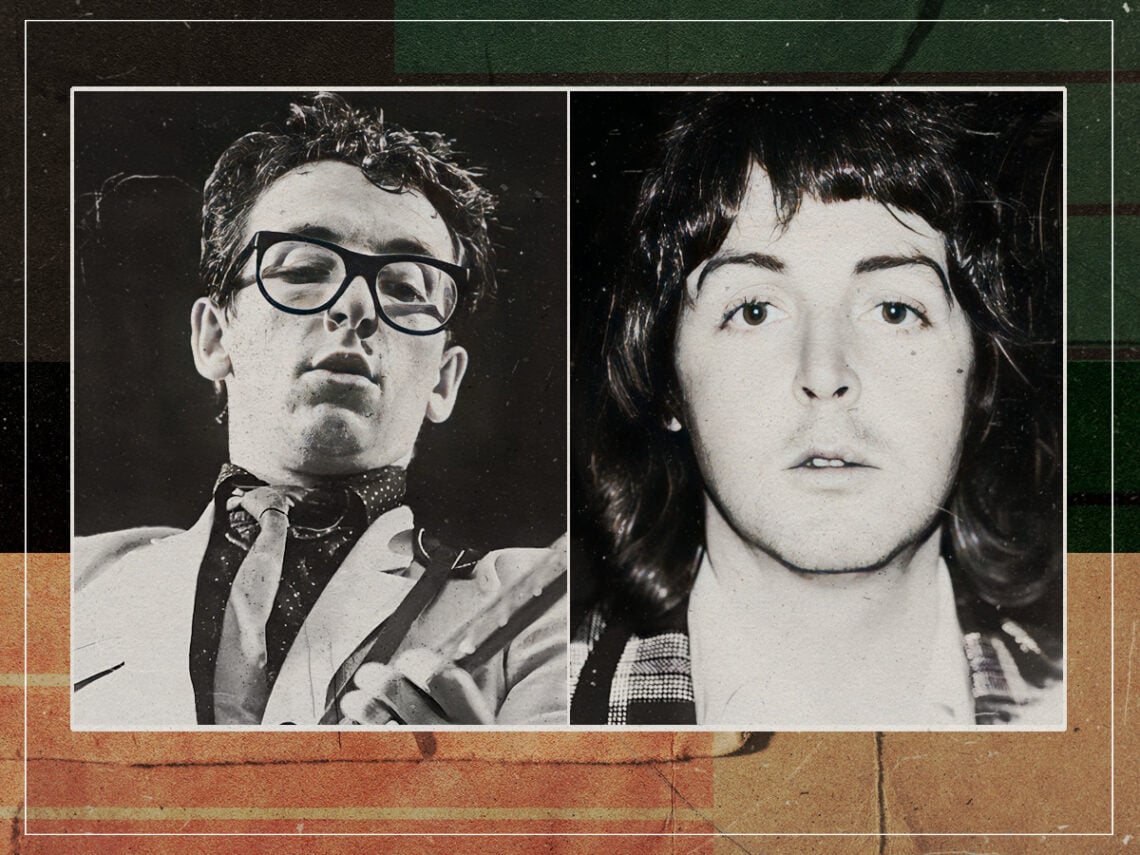
‘Veronica’: Elvis Costello and Paul McCartney’s sequel to ‘Eleanor Rigby’

“He’s thought to be Mr Sunny,” Elvis Costello once said of Paul McCartney, “But he’s got his dark moments, and I like that and really encouraged it.”
In 1987, a 33-year-old Costello and a 45-year-old McCartney started writing songs together. The rationale was simply that the two admired one another’s work, but both men were probably also seeking out a spark after a bit of a mid-80s career slump. Elvis’ prior album, 1986’s Blood and Chocolate, was his first not to enter the top 15 in the UK charts and was also received with a lukewarm reaction by most critics. It was a similar story for Sir Paul (who wasn’t actually a Sir yet), as his own 1986 solo record, Press to Play, was a career-worst seller. Around the same time, Macca was getting razzed in the press over his falling out with Michael Jackson and ongoing feuds with George and Ringo. It was time to get back to basics.
For Costello, who didn’t seem too intimidated about collaborating with a Beatle, the goal wasn’t so much to mine a melody out of the master but to see if he could bring out some of those aforementioned “dark moments” that had always been an under-appreciated part of McCartney’s best work.
“When I’d got the call to say Paul wanted me to write some songs with him for his next record, I didn’t know what to expect,” Costello wrote in his 2015 memoir, Unfaithful Music and Disappearing Ink. “But as his last co-written hit had been with Michael Jackson, I wondered whether I should be taking some dancing lessons. I’d brought an early draft of ‘Veronica’ that you would have recognized, but we immediately got to work putting a better flow into the chorus and shifting the bridge into making that part of the song seem more like a dream.”
‘Veronica’ was a very personal song to Costello, inspired by the experience of seeing his own grandmother going through the devastating challenges of Alzheimer’s disease. It’s not the sort of song that everyone would think to bring to a first meeting with Paul McCartney, but then again, if you had to think of pop music’s greatest character study of a sad and lonely old woman, just about anybody at that point would have picked ‘Eleanor Rigby’—one of the showcases of McCartney’s darker side.
As they worked on the track, ‘Veronica’ became much more of an up-tempo pop song than ‘Rigby’, but its themes certainly struck a similar chord with listeners.
“Veronica sits in her favourite chair
and she sits very quiet and still
And they call her a name that they never get right
and if they don’t then nobody else will“.
The image of an elderly Veronica, robbed of her memories and the “devilish look” she once had in her eyes, certainly feels like a companion portrait to poor Eleanor Rigby, who “Lives in a dream / Waits at the window / Wearing the face that she keeps in a jar by the door / Who is it for?”
When ‘Veronica’ finally appeared on Costello’s album Spike in 1989, it provided Elvis with a much-needed hit single and his highest-charting song ever in America. A big factor in its success was the accompanying music video, directed by John Hillcoat and Evan English, which depicts Veronica in a nursing home as Costello tries to connect with her. At the beginning of the video, Costello delivers a spoken-word monologue that isn’t part of the track on Spike.
“I remember her in this place,” he says. “Sometimes she was happy. She’d say, ‘So and so said such and such,’ and she’d talk about who knows what. One minute you’d be here and the next minute it would be 40 years later. So you’d just sit there and bounce around the years with her.”
‘Veronica’ was the biggest success of the Costello-McCartney partnership, but Paul didn’t go home empty-handed. He scored a hit of his own in 1989 with the single ‘My Brave Face’—co-written with Costello. It would be McCartney’s last top 40 hit in the US until another collaboration, 2014’s ‘Only One’ with Kanye West.
