


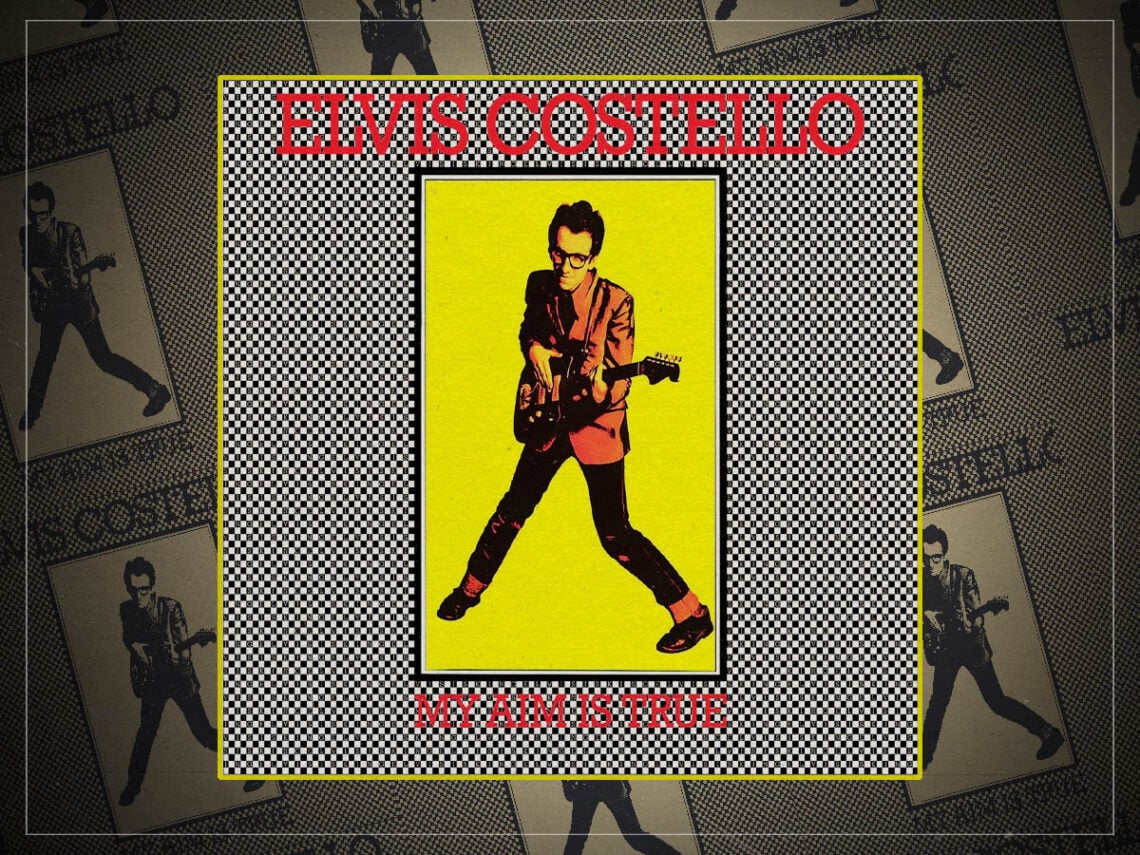
Elvis Costello – ‘My Aim Is True’

Anger is an energy, and back in the mid-1970s, that energy sought to disrupt and destroy the very fabric of the mainstream music industry. Disenfranchised by the self-aggrandising rock stars appearing on Top of the Pops week after week, a new generation of artists emerged. Driven by anger, innovation, and an unwavering DIY ethos, this blossoming scene was eventually christened ‘punk’, but that restrictive genre tag somewhat alienates one of the era’s angriest young men in Elvis Costello.
At the peak of the punk explosion in the UK, in 1977, Costello burst onto the scene with My Aim Is True, an album which captured the prevailing attitudes of the period, along with introducing audiences to his unique power as a songwriter. Released via Stiff Records, the independent record label which consistently drove the punk scene forward, the album is contextually inseparable from the world of safety pins, gobbing, and spikey hair. In virtually every other respect, though, Costello elevates himself above the rest of the musical landscape.
Even in his pigeon-toed stance on the album’s cover, Costello doesn’t look anything like a punk rocker. Thick-rimmed spectacles and a retro suit didn’t exactly fit in with the Vivienne Westwood-styled Sex Pistols, and the music contained on the album only expands on those disparities.
Sure, the songwriter is clearly indebted to the attitude and energy of the punk scene, but the album reflects so much more than that. Pub rock, rockabilly, R&B, and even pop are all well-represented over the course of the album, perhaps owing to Costello’s country-rock backing band Clover, who never really suited the songwriter’s sensibilities, but added intriguing new layers to the debut album.
The album’s opening track, ‘Welcome To The Working Week’, encapsulates the genre-defying quality of My Aim Is True expertly. With rough and ready production, courtesy of Nick Lowe, a blink-and-you’ll-miss-it runtime, and that boldly risque opening line “Now that your picture’s in the paper being rhythmically admired,” the track immediately establishes Costello apart from everybody else, as well as establishing the prevailing themes of anger, working class alienation, and social realism which continue throughout the album.
In that regard, side two’s ‘Less Than Zero’ is undoubtedly the album’s stand-out track. A moody melody backs the songwriter’s visceral anger as he rallies against Oswald Mosley, the former leader of the British Union of Fascists. Costello wrote the track after seeing an unrepentant Mosley interviewed on the BBC, but the track worked equally well in reflecting and rebelling against the rampant rise of fascism and far-right hate groups, both during the late 1970s and, depressingly, in the modern day, too.
Costello doesn’t give the audience much time to properly analyse this profound take on the enduring presence of fascism in British society, instead launching into the retro rock and roll-styled ‘Mystery Shoes’, the energy of which is befitting of the songwriter’s satirical stage name. Over the course of the album, he seems to dart sporadically from angry, politically-charged anthems to upbeat pop and rock triumphs without taking a breath.
As such, the 12 tracks which make up the album (including the closer, ‘Watching The Detectives’, although it was not included on the first UK pressing) fly by in an instant. That is not necessarily a criticism of the album. Indeed, a great deal of those early punk albums boasted sub-30-minute runtimes, but Costello’s My Aim Is True does tend to require a little more contemplation. His profound songwriting talents, which would go on to prove themselves time and time again over the subsequent decades, are such that there is so much more to discover once you properly dig into the lyrics.
Arguably, My Aim Is True was later eclipsed by records like This Year’s Model or Imperial Bedroom in terms of the songwriting, but the 1977 debut still reigns supreme in terms of impact.
Costello expertly toed the line between adopting familiar sounds and being unlike anything anybody had heard before. His socially conscious, politically charged songwriting always seemed to hold more weight than many of his punk peers, and the accessible mix of sounds included on My Aim Is True got that message to audiences right across the world. In that sense, it is inarguably among the most important, groundbreaking releases of that period.

Never Miss A Beat
The Far Out Punk Newsletter
All the latest Punk content from the independent voice of culture.
Straight to your inbox.