


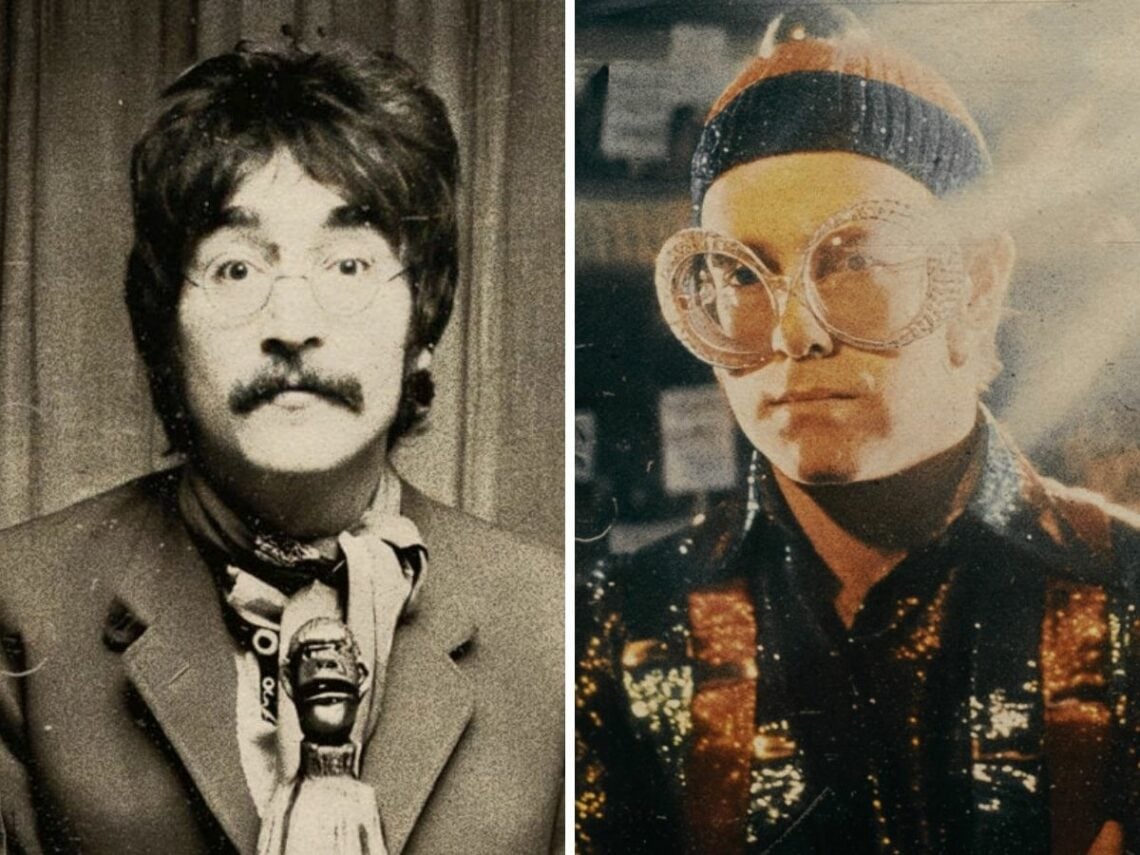
The heartwarming story of how Elton John gave John Lennon his first-ever number one

It was David Bowie who defined the influence of John Lennon when he said: “I just thought he was the very best of what could be done with rock ‘n’ roll”. Bowie would soon find that this extended beyond his grasp of music. Eventually, Lennon would offer him some advice. “I said, ‘You know, I hate this manager that I’ve got; how do I get a new manager?’” the ‘Life on Mars’ singer recalled.
“He said, ‘Stop right there. No management. You don’t need management,’” Bowie continued. As ever, ‘The Clever One’ was staunchly individual—and that individualism made a massive mark on society at large. It was his belief that good music shines through—you don’t have to overcomplicate things, and that applied to his political messaging that has since been largely picked apart.
However, he was surely onto something when he hailed the strength of simplicity. And he also proved it is a difficult thing to remain clear on when things suddenly go awry.
You see, in not much more than a handful of years, The Beatles changed the world. When the news broke on April 10th, 1970, that the musical force who turned the monochrome world multicoloured had suddenly blown a fuse, the mourning took to the streets. “Nobody will ever replace The Beatles,” one fan remarked, “It’s just one Beatles group. We grew up with them. They started when they were younger and we were younger, and they belong to us in a way. There could never be another Beatles, never!”
In the time that followed afterwards, it became clear to the adoring masses in mourning that the hope of a resurrection was a pipedream. Not long after that, thoughts turned to the rather more exciting realm of what they would each turn out in a solo capacity. For the individual band members, however, this anticipation quickly became a pressurised competition. And poor old Lennon was losing.
By 1974, Paul McCartney had scored three number-one hits in the US, George Harrison and Ringo Starr had two apiece, but Lennon was yet to top the tree. You’d love to say that such a vapid thing barely registered, but you know full well that egos were itching, and Lennon wanted to join the chart party. In truth, his lack of commercial success could be pinned to his rather more avant-garde stylings, but it didn’t stop the lack of a hit from sticking in his craw.
Thus, when Elton John entered the studio to assist Lennon with ‘Whatever Gets You Thru the Night’, he wagered that they would achieve that elusive number one spot. Lennon was quick to shake hands on the deal. In exchange for his assistance with the track, Elton John levied that if they got it to number one, then Lennon would have to make an appearance at his Madison Square Garden show for Thanksgiving in 1974. Suddenly, the bid to break the former Beatles’ duct was on for both parties.

By the time the concert came around, Lennon walked onto the stage with a beaming smile on his face and prideful number one tucked away in his baggy trousers. Tragically, however, this would prove to be the last time Lennon appeared live on stage. It was Thanksgiving Day in 1974 and six years later, with potential show beckoning, he was killed outside of his New York home.
However, the celebratory evening where he appeared alongside Elton proved to be a seismic night in more ways than one for him, as the Thanksgiving show also marked the end of his ‘Lost Weekend’ period whereby he endured a tumultuous 18-month separation from Yoko Ono. During the highs and lows of this period, Lennon took to watching TV in an almost William S Burroughs-like word-cutting fashion as he flicked through the stations, extracting little segments and weaving them into tunes.
His personal assistant, and occasional lover, May Pang, told the Radio Times that this is how his debut solo chart-topper came about. “At night he [John Lennon] loved to channel-surf, and he would pick up phrases from all the shows,” she recalled.
“One time, he was watching Reverend Ike, a famous black evangelist, who was saying, ‘Let me tell you guys, it doesn’t matter, it’s whatever gets you through the night.’ John loved it and said, ‘I’ve got to write it down or I’ll forget it.’ He always kept a pad and pen by the bed,” she continued. “That was the beginning of ‘Whatever Gets You Thru The Night’.” And just like that, Lennon had a hit that people could relate to.
As such, the song represents a moment of reflection and a celebration of friendship. As Lennon would recall of Elton John’s involvement: “I was fiddling about one night and Elton John walked in with Tony King of Apple — you know, we’re all good friends — and the next minute Elton said, ‘Say, can I put a bit of piano on that?’ I said, ‘Sure, love it!’ He zapped in. I was amazed at his ability: I knew him, but I’d never seen him play.”
With adulation, Lennon continued: “A fine musician, great piano player. I was really pleasantly surprised at the way he could get in on such a loose track and add to it and keep up with the rhythm changes — obviously, because it doesn’t keep the same rhythm… And then he sang with me. We had a great time.”
This sense of fun returning to performing is what made the song soar, and although it might not be as much of a zenith in terms of quality as it was commercially, it certainly offered up a depth of contentment for Lennon after a long lost weekend.
As Elton John said when looking back on this period: “That was the kind of wonderful two or three-year whirlwind romance we had, and it was such an important thing in my life, Sean,” he honestly reflected. “It just really helped me. It gave me so much confidence. Your dad was as kind and as generous and sweet, and we just hit it off immediately.” In this chart-topping anthem, that really shines through.
