


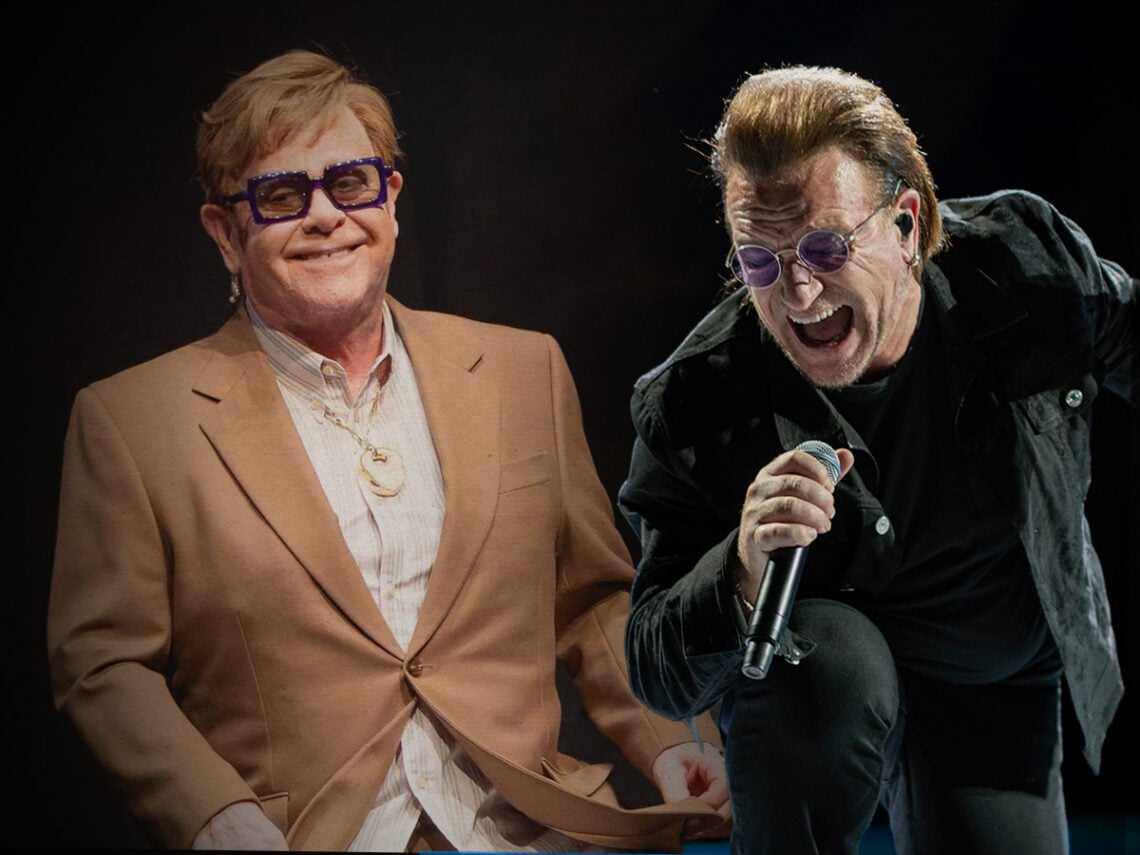
The band Elton John and Bono compared to Bob Dylan and The Beatles combined

The 1960s unfurled with more highs and lows than a ski jumper’s average day on the slopes. Presidents were being assassinated, prompting unprecedented waves of despair – man was heading to the moon, providing hope for a radical future.
In the mire of this manic energy stood two immovable forces manoeuvring the zeitgeist on their whims: when the world looks back on the ‘60s and all it entailed, it’ll be Bob Dylan and The Beatles who they remember.
Yet, only a decade down the line, that ‘hope for a radical future’ was faltering in a wave of miners’ strikes, Cold War continuation, and economic decline, leaving little but ‘unprecedented despair’. The days when the Fab Four could pull a generation up by the bootstraps seemed bygone, as The Stranglers aptly bemoaned, “No more heroes anymore”.
However, it was the vitality of one of their peers that made movements seem possible again. From the ashes, as the Sex Pistols were fizzling out, The Clash did their utmost to sustain the notion of a rock ‘n’ roll revolution in swaggering style.
In 2003, a year on from the tragic early death of the band’s visionary leader, Joe Strummer, the disparate forces of Elton John and Bono got together to discuss the artist’s impression on their lives as musicians and people. The odd couple is proving just how widespread and pervasive the seismic waves of Strummer and co truly were.

The lead singer of U2 and the Rocketman himself may not be your first picks for artists influenced by Strummer and The Clash, but such was his powerful range that it infected all those who came into contact with him with an unstoppable fire for creativity and cause. The discussion was first published in Epitaph and sees John and Bono open up about the effect Joe had on their lives.
Elton begins proceedings with a mournful introductory tone, “So, Bono. As you know, this is the first anniversary of Joe Strummer’s death. To mark the occasion, I wanted to take a moment to talk with you about the huge importance of his work, which was very political and experimental,” suggesting too that they discuss Streetcore, the record Joe was in the middle of making at the time of his death. Elton continues, “I once heard you say that were it not for The Clash, there would never have been a U2. What did Joe and his work mean to you?”

Bono, whose band U2 came about in the summer of punk in ’76 and saw them initially take on a post-punk sound until the beckoning allure of stadium rock became too much. He clearly held Joe in the highest esteem, “Well, without exaggeration, the Clash were the first rock n roll band that we ever saw perform. It was in 1977, in Dublin, on the Clash’s Get Out of Control tour-in fact, we wrote a tune called ‘Out of Control’ after seeing that show.”
It arrived at just the right time. “I was 17 at the time,” Bono continues, “and I remember being frightened because there was a lot of aggression at the gate. But I was also elated.” That’s the general recollection of everyone who has ever been to a Clash: they would grab you by the lapels and shake you like a second-hand Skoda going over a cattle-grid until the shock wore off and you would be euphorically shaking of your own accord.
Bono continues to elaborate on the moment he came face to face with punk, “I was in awe at the sight of their clothes, they were wearing militant guerrilla-style, art-attack gear, and there was an atmosphere in the crowd that felt like something was going to happen, like somebody could die or a revolution could start. It was one of those nights that just turn your world upside down.”
It’s a powerful image and one which has us wanting more. Luckily, investigative journalist extraordinaire, Elton John was on hand to push for more aksing Bono what Strummer was like back then. “Joe seemed to be singing from a different place-the kind of place that I suppose Bob Dylan sings from, or John Lennon sang from. He was part town crier and part storyteller. The Sex Pistols were punk, and I loved them because of the sort of Richard III character that John Lydon was playing, and just the sheer noise of the guitars; but what the Clash did was more like roots music.”
That’s the point of The Clash right there, in a nutshell, delivered by one of the biggest-selling rock artists of all time. The Clash were the kernel of truth in every corny punk reference; they were an amalgamation of the streets and everyone knew it. Even Bono, “They were a garage band, but they were also fucking around with reggae, rockabilly, and bluegrass. Joe just put all these different ideologies into the blender.”
As the ‘60s dream had long since faded, The Clash took up the revolutionary blue-collar spirit of Bob and The Beatles and revitalised it in a thrilling new way. They were a cool gang with the Fab Four’s same ‘pick your favourite member appeal’. But they poured in the same sagacious wit and wisdom that made Dylan such an important icon.
Elton adds to the conversation, “They also dabbled in old-fashioned American pop, with songs like “Should I Stay or Should I Go” on Combat Rock [1982]. You can hear the reggae roots of that song, and then suddenly it turns into this great pop song.” All of this, made them a force. Rather than blunting them into a mishmash amalgamation, they had a devil-may-care charm, celebrating the best of culture in one leathery flourish.
Strummer’s ability to make authentic rock music but still manage to convey a political message without appearing contrived was crucial. It entwined them with the times, with Elton saying, “There was always something to take away from Joe’s lyrics. He was always trying to raise awareness of what was going on in the world, both socially and politically.”
It’s a notion that Bono agrees with. Pointing to the band’s 1980 album Sandinista he says that without the record he would never have learned about or travelled to revolutionary Nicaragua. He concludes, “Those were the kind of doors that the Clash and Joe, in particular, opened up for me, and there were worlds behind them.”
Vitally, Bono and Elton even compared Joe to some legendary artists, and with good reason too. “Joe had that rare quality that two other singers we’ve lost in the last year-Nina Simone and Johnny Cash-both had: Whatever he sang affected you because it was just so raw,” Elton states.
Attention is then turned to Joe’s last album before his death, in fact, the album he was in the middle of recording when he passed away. Elton says, “On Streetcore, Joe sounds more at peace with himself. While he is still kind of prickly, he also sounds happy in his own way.”
It’s a sentiment that Bono painfully agrees to, “It makes me so sad, but I think you’re right. You want to believe that there were more peaks, but it does seem like he had arrived at some place in his life. It is infuriating to realise that the most maddening of clichés has come to be true, which is that Streetcore, Joe’s last record, is probably his best.”
Source: Epitaph
