


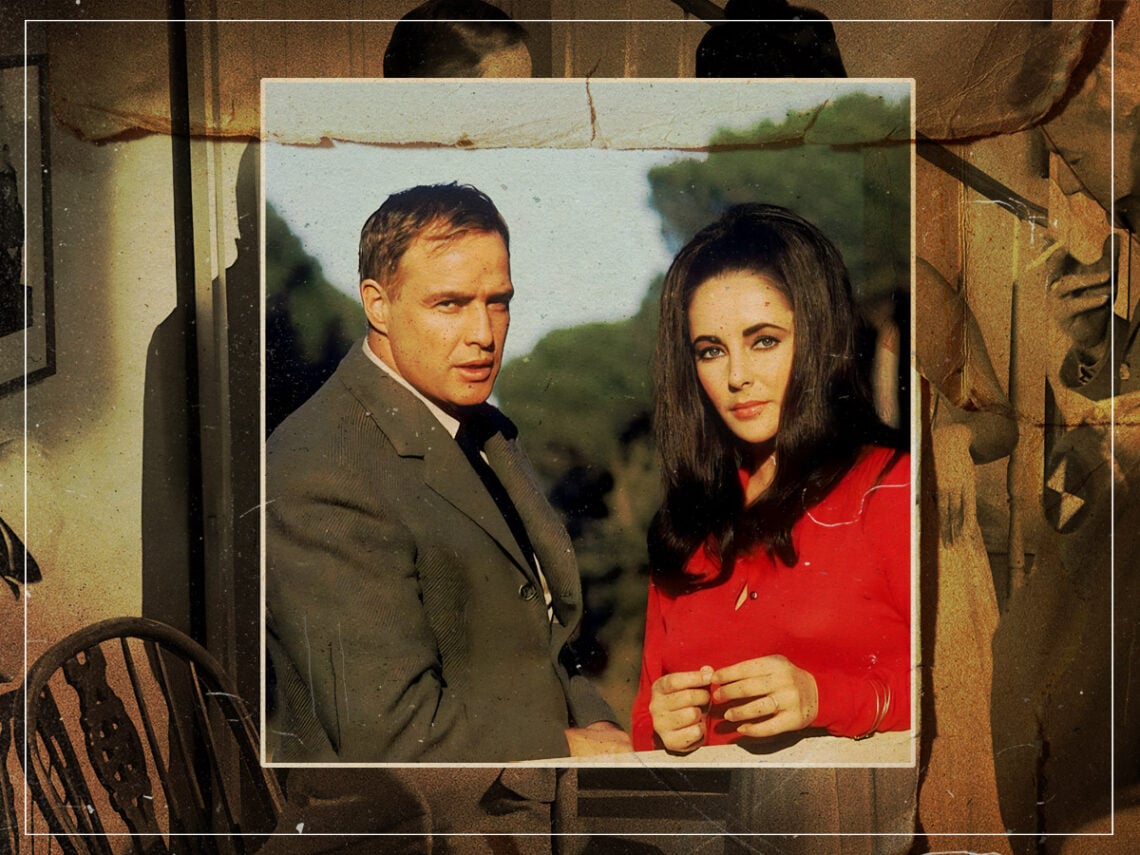
Elizabeth Taylor, Marlon Brando and a golden tint: The voyeuristic movie of repressed sexuality

One thing Elizabeth Taylor and Marlon Brando had in common, beyond being among the biggest stars and most gifted performers of their generation, is that the latter years of their respective careers found them in the headlines more regularly for their off-camera eccentricities than their on-screen talents.
The pair maintained a firm friendship for decades, which initially began when Brando grew close with Taylor and Richard Burton in the 1960s. From there, they ended up having Michael Jackson as a shared acquaintance they were known to spend a lot of time with, which gave rise to the famous urban legend claiming the unlikely trio took a road trip in the immediate aftermath of 9/11.
Despite travelling in many of the same circles and spending the same period standing under the spotlight of celebrities, Taylor and Brando only ever appeared in one movie together. When they did, it was fittingly helmed by one of cinema’s greatest-ever directors, even if the star who revolutionised the medium of acting was far from the first choice.
Two-time Academy Award-winning directorial legend John Huston took the reins on the 1967 adaptation of Carson McCullers’ novel Reflections in a Golden Eye, which Taylor only agreed to star in when Montgomery Clift cast opposite her as the male lead. Unfortunately, he died before the start of production, and after it was knocked back by both Burton and Lee Marvin, Brando stepped into the breach.
Set at an Army base in the late 1940s, Brando led the line as Major Weldon Penderton, with Taylor as his wife Leonora. Placing six key characters at its core, the sexually charged drama dabbles in notions of human perversion in its many forms, unfolding episodically to inform each point of view.
Taylor’s Leonora is having an affair with her husband’s superior officer; Brando’s character harbours an intense fascination with a younger man that borders on obsession with violence, murder, sex, repressed feelings of both heterosexual and homosexual lust, adultery, infidelity, and tragedy being folded into an interconnected series of vignettes designed to shine a light on several subjects that were borderline taboo in mainstream American cinema at the time.
Furthering the artistic approach that bordered on experimental, Reflections in a Golden Eye lived up to its title by being released with every scene tinted by a gold filter, with only certain aspects of select scenes allowed to stand out among the singular colour scheme. Designed to invoke the feeling that the world is a stage and the façade of everyday life can often be little more than a carefully curated illusion, the tint is a reference to a drawing of a peacock seen in the film that reflects the world through its huge, golden peepers.
It was an ambitious undertaking given that Reflections in a Golden Eye featured two major stars, a unique aesthetic approach, a loosely-structured narrative, and some salacious thematic undercurrents hinging on the notion of sexual repression, voyeurism, and the unflappable nature of how amorous people can get when trapped in a location where inhibitions and suspicions are allowed to run free. In the end, though, it was more of a nobly-intentioned misfire than an earth-shattering revolution that threw off Hollywood’s sexual shackles to any great degree.
