


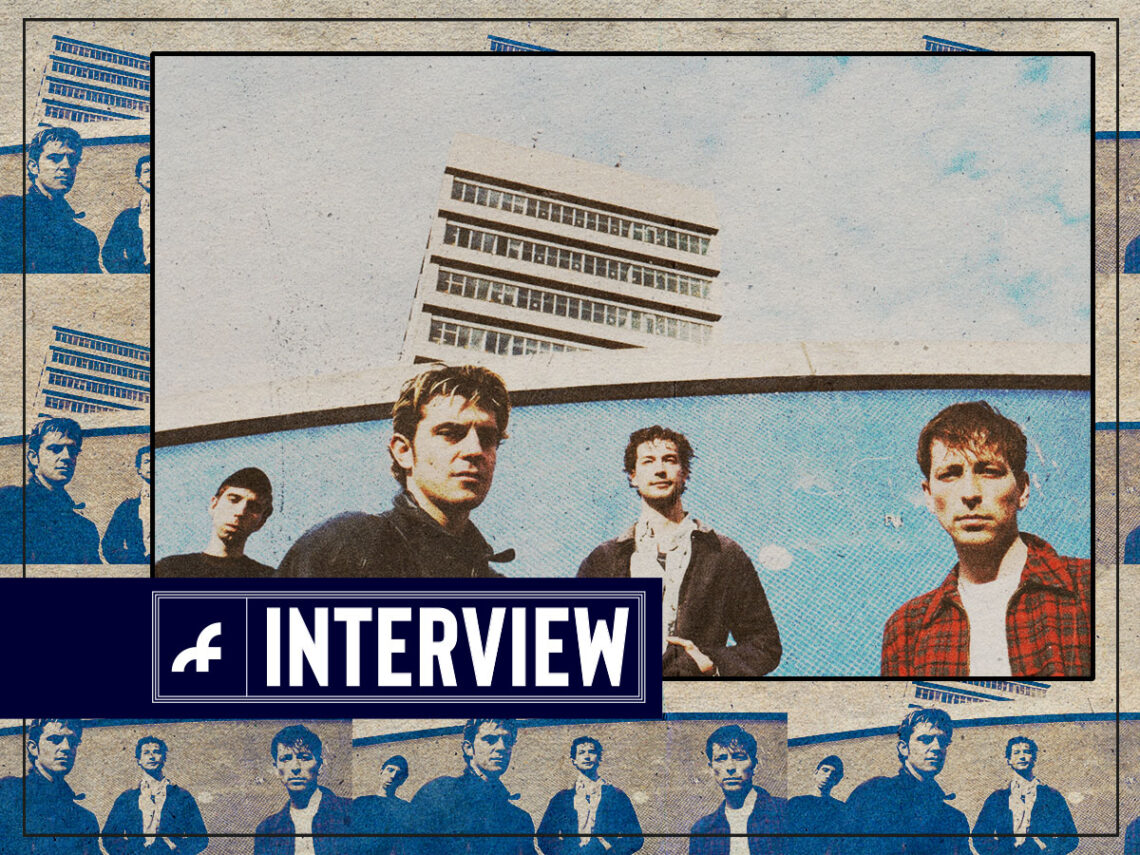
Egyptian Blue discuss Lithuanian jail festivals, the curse of Leeds, and their debut album

Fresh off the back of festival season and just two months away from the release of their debut album, A Living Commodity, Egyptian Blue find themselves standing on a precipice. The Essex-born band have been in this position before – their 2019 EP ‘Collateral Damage’ took Radio 6 fans by storm, but, like the rest of the world, the band were stopped in their tracks when the pandemic hit.
When the chaos subsided, Egyptian Blue returned with a renewed sense of purpose. They accompanied Foals on tour across the UK and Europe and played a set at Glastonbury (courtesy of IDLES), all while constructing their full-length debut. But before A Living Commodity hits streaming platforms and record stores in October, Egyptian Blue are making the most of the calm before the storm.
When singer and guitarist Leith Ambrose joins our video call, he’s backlit by blinding sunlight. The co-frontman is sipping a pool-side Coca-Cola in a Marbella villa, catching as many rays as possible before the album cycle begins. Andy Buss, who doubles as the band’s frontman with Ambrose, joins me from closer to home in Brighton, Egyptian Blue’s adopted city and the place that allowed them to really hone their sound.
Their characteristically angular guitar sound remains on A Living Commodity, but there’s a clear maturation from their early work. Buss himself dubs it a “large progression” from their previous work, with more complexity, more emotion and “intricacies that we hadn’t explored before”.
Though Egyptian Blue exist inescapably within the modern post-punk revival, the band had no eye on any of their contemporaries while penning A Living Commodity. Rather, they were focused on what felt good. As Ambrose explains it, their process was simply: “What makes us feel good when we’re in a room together?”
They may not be concerned with their post-punk peers, but one track on the record does pay homage to post-punk of the past. Upcoming single ‘Skin’ features a guitar line that was inspired by Ambrose’s obsession with ‘Metal Box’ and PiL guitarist Keith Levene, who he suggests “kind of doesn’t play guitar. He makes it sound like a metallic thing as opposed to anything else”.
But Egyptian Blue are more preoccupied with their own past than anyone else’s. The new record has been a long time coming and, accordingly, collates songs from throughout their first few years as a band. Some of their early tracks, including ‘Nylon Wire’ and ‘To Be Felt’, have been reworked for the record, a nod to their past and a statement of how far they’ve come.
A Living Commodity also features a glimpse into Egyptian Blue’s future – the title track, Buss notes, was originally intended for a future album: “It was meant to be the song that we write the next album around, so it’s sort of like a stepping stone. I think it’s a development in character, as well, from what we’ve had before. We saw it as the future.” Ambrose agrees, suggesting that “it became very apparent that it was a good way to close off a timeframe and a period and era of the band.”
Though the titular single was intended for a future album, the album name, A Living Commodity, was always set in stone. During a post-practice conversation between the co-frontmen, Ambrose flippantly used the phrase and, since then, “It’s always been A Living Commodity”. It’s a comment on how people in the entertainment industry are increasingly treated as assets rather than humans, but Ambrose thinks it has “a lot more depth to it”, though he refrained from explaining why.
This hesitance to share too much of the meaning behind the record permeates our conversation. Rather than maintaining their claim over the music, Buss and Ambrose seem more than happy to hand it over to audiences for them to paste their own meaning onto it. Buss argues: “Music should be ambiguous, to do with perspective and each person’s take on it. I guess a lot of the songs that I listened to, and they made me feel something, it’s probably not the same feeling that the songwriter had.”
Ambrose concurs, suggesting that the beauty of music derives from that dissonance: “And then you feel like you have an affinity with them because you think it’s the same thing, but in reality, it’s probably not. But that’s beautiful.”
The record lends itself to this open interpretation – it’s emotive without being self-indulgent. It’s sonically accessible, too, a more authentic sound than many of the abrasive, jazz-inspired artists that now permeate the genre. Part of this sound is down to the band’s collaboration with Brighton-based producer, mix engineer, and multi-instrumentalist Theo Verney.
Verney has become increasingly important in burgeoning indie scenes, working with the likes of English Teacher and Lime Garden, but Egyptian Blue knew him long before he became a big name. As Buss recalls it, he first met Verney at one of his own shows where he was dressed as Pablo Escobar. Ambrose recalls that he did a tour with Metz in Europe, though his claim is full of uncertainty: “Maybe it’s not true. Maybe it’s just a ruse – he lies to trap us.”
At some point, the band caught wind that Verney had ventured into producing and were promised that he was “very adept” – he wasn’t. Consequently, Verney and Egyptian Blue grew together sonically, as Buss shares: “We’ve watched him develop, and we’ve always talked about an album with him… We just conjoined our minds, basically. I spoke everything that I was thinking to him, and he tries to process it and dial it in.”

Ambrose suggests that Verney’s early presence around the band was vital to the success of the record: “I think the interesting thing about us working with him on this record is that he’s seen the initial inception of the band… I think it’s healthy.”
While Verney was helping them hone their sound on record, Egyptian Blue divided their attention between the studio and live performance. They’re now comfortable playing the entire record onstage, with the exception of one song – ‘Apparent Cause’. Ambrose bluntly puts this down to “technicalities”.
‘Apparent Cause’ is one of the most striking moments on A Living Commodity. Ethereal and cathartic, it’s a welcome change from the abrasive guitars that once permeated their sound. Buss wrote the track alone in just three minutes and recorded it on his own: “I don’t think anyone knows it. I’m not even sure I know it. I wrote it by accident.”
Though ‘Apparent Cause’ has been absent from their setlist, the band have enjoyed using live shows to gauge responses to the rest of their new material. Ambrose suggests that it feels way more “visceral” than before: “It feels like some of the songs have this depth of emotion on there that are just completely newfound territory,” he says. “Seeing people’s faces is kind of an interesting one.”
Earlier this year, the band took the new record on a tour of Europe, heading to stages across France and Luxembourg. Overseas, Ambrose suggests, the album’s title felt less apt – rather than being treated like a living commodity, the band were greeted by excited audiences and three-course dinners from promoters, a stark contrast to the current, cutthroat touring landscape of the UK. Ambrose brings it back to the title himself, stating, “Maybe that rolls back to the idea of being a living commodity. In the UK, you certainly feel like one.”
He also suggests that part of the increased European enthusiasm stems from UK audiences being spoiled for choice: “If you’re in London, then you can see a different band every day. You could see about 50 bands every day if you wanted to. If you’ve got really good diary management, which I probably don’t.”
Nonetheless, they maintain their love for playing in their home country. They recently took to the stage alongside Royal Blood at Brighton’s On The Beach. It marked a homecoming for the band, who now rarely play their home city, but Buss was most excited about the convenience of the show: “It’s quite a special thing to play five minutes from my house.” As Egyptian Blue have gotten bigger, so have their stages. While it’s a demonstration of their success, it has come with an increased disconnect from crowds.
Egyptian Blue’s sound is far more suited to dark and dingy basements, venues they feel much more at home in – as Buss shares, “I think the intimacy of playing in sweaty basement clubs is so much more powerful to us.” Ambrose is equally enthusiastic about the visceral, hectic feeling that packed-out shows give, recalling a time they saw a young Fontaines D.C. in Brighton’s The Prince Albert.
Buss reminisces, “We saw Fontaines D.C. there, and it’s like a 100-cap venue. We just went on a whim because we lived about one minute walk from there, and it was unbelievable. So good.” Between the shaking floor and sweaty crowd, Ambrose recalls, “It was kinda like, who are this band? They’ve got something going on here…”
The band named The Prince Albert and the Lexington as some of their favourite basement club venues before posing the question back to me. My answer is, unquestionably, the Brudenell Social Club, which sparks some unfortunate tales of Leeds trips gone wrong.
Their last visit to the northern city, it turns out, was marked by chaos – when they travelled to Leeds to support The Murder Capital at Leeds Irish Centre, a car breakdown caused them to miss their soundcheck. The band were forced to line-check in front of a sold-out audience at one of their biggest shows thus far. “It was horrible,” recalls Buss. Ambrose, ever the optimist it seems, recalls it being a great experience, though he adds that their van seems to break down every time they’re near Leeds – Buss concludes that it’s a tainted place.
Equally tainted, though in a completely different way, is the most recent venue they played – an old jail in Lithuania, which Ambrose dubs one of his favourite festival experiences: “Our dressing room was cells. It was an ex-Soviet prison. And we got took around solitary confinement. So I mean, that was a very special experience.”
Nevertheless, the duo, understandably, find it hard to top Glastonbury, noting, “Every festival tends to have something special about it. I mean, you just learn it when you’re there. And you know, whether it’s beautiful or whatever it is, you know, some of them have amazing lineups, and you just don’t know what to do with yourself. But I find it hard to run away from Glastonbury.”
Buss hopes to make the lineup of Pitchfork Festival in Chicago one day, while Ambrose’s dream stage is the mountain-side Fuji Rock in Japan. They also give a nod to their hometown festival, Latitude in Suffolk, which seems entirely achievable for Egyptian Blue in the present. Their love for Latitude stems from nostalgia rather than career aspirations – the band used to attend every year to see Wild Beasts. Buss notes that it holds “a very dear place in our heart and our childhoods… It would mean a lot to us.”
As our conversation comes to a close, I ask the Egyptian Blue boys for their album of the year so far (though I’m sure it will be A Living Commodity come October). They’re a little unprepared to answer – it’s only August, after all – and take some time to consider the year’s releases so far. Eventually, Ambrose shouts out his friend Flypaper’s upcoming new EP, which he describes as having “Elliott Smith vibes”, while Buss struggles to pronounce bdrmm, a band who have, similarly, found a home in dark, sweaty basements and Radio 6 playlists.
But with A Living Commodity, Egyptian Blue look to move beyond that constraint. Between faster and fuller reworkings of old material, the understated ethereality of ‘Apparent Cause’ and the excited futurism of ‘A Living Commodity’, their debut record sets Egyptian Blue apart. A Living Commodity is a nod to the past and a statement against the workings of the industry. It’s a demonstration of their progress so far, as well as an acceleration of it. For now, though, they’re savouring their brief time away from living commodification.
