


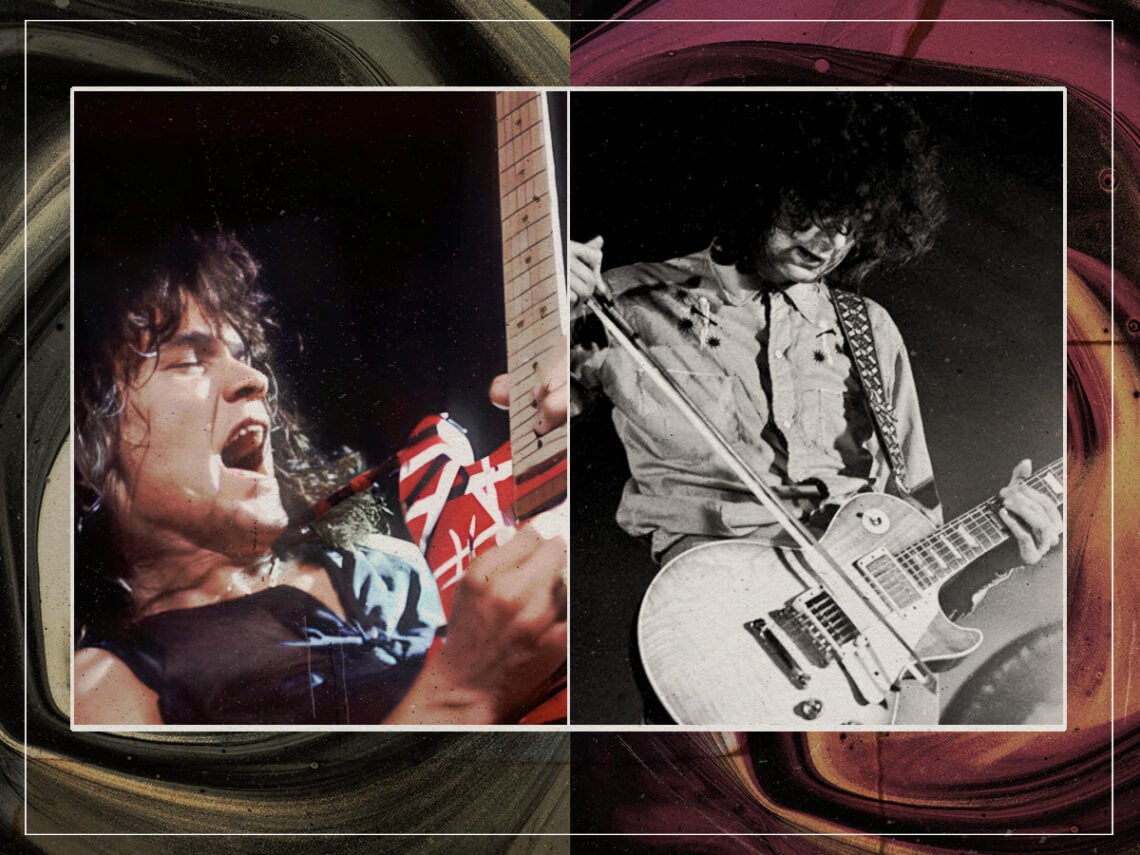
“He plays like he’s got a broken hand”: Why Eddie Van Halen thought he was out of Jimmy Page’s league

Few artists in history have had as much praise heaped upon them as Jimmy Page.
The curly-haired Led Zeppelin occultist has been lauded by the likes of Ritchie Blackmore, who crowned him “way ahead of most guitar players”, and he very rarely lauds anyone, Alex Lifeson, who said he loved “everything he represented”, and even the usually cynically disparaging Keith Richards, who called him a “brilliant player” despite dismissing his band.
When most of these peers consider Page’s playing, they revere the fresh sense of decadence he brought to the instrument when Led Zeppelin roared to the fore. While the aforementioned Richards and Pete Townshend might have thought that the band were a little too weighed down with heaviness to ever take off, others would take the inverse approach and appraise them as some sort of paradoxical soaring juggernaut. They soared like a feather and stung like a ton of bricks.
With his orchestral approach to guitar playing, Page was pivotal to the band achieving this riveting juxtaposition. He turned floral Johann Bach pieces into heavy metal in a manner that forecasted a new future for rock ‘n’ roll when the ways of the 1960s finally began to falter. With this new outlook, he would inspire the next generation of musicians.
Musicians like Paul Stanley. The Kiss guitarist would later say, “Jimmy Page, to me, is the consummate guitarist. He’s Beethoven. He paints with music in a way that’s just so stellar.” Hence, the double meaning behind the modern tag of ‘classic rock’ that Zeppelin helped to launch. He’s not just a master of the six-string, he’s a composer, too. That outlook inspired a generation.

Why did Eddie Van Halen bash Jimmy Page?
However, as is the natural progression of music, these youngsters raised on the ‘Stairway to Heaven’ sound would later attempt to get busy with their own advancements in guitar playing. That was evident to anyone with ears when Eddie Van Halen’s distinctive sound first rattled aural canals with the release of his band’s self-titled debut album in 1978.
His searing hammer-on and soloing approach was a shot in the arm in every which way and instantly announced Eddie Van Halen as a virtuoso. The shirtless strummer was in a league of his own, evidenced by Steve Vai, who famously quipped, “Only an idiot competes with Eddie Van Halen.” He came along as the ‘70s were coming to a close and dragged the guitar into a glitzy new era.
At this stage, even Page was agreeing that guitar playing had moved on. While ‘feel’ and ‘class’ were still up for debate, there was no doubt that the ‘technical proficiency’ of Eddie eclipsed that of just about everything that had come before. “I can’t do that,” Page told Guitar Show. “They’re stretching the horizons and everything,” he said of Van Halen’s new blitzkrieg advancement, “Eddie Van Halen has got an amazing technique with all this sort of hammering on and everything.”
Many thought that because Van Halen’s second album was dubbed Van Halen II, mimicking the titling method that Led Zeppelin had previously employed, Eddie had to be a fan of the band and that the praise would be mutual. Well, as it happens, he thought their studio work was fine and dandy but agreed that Page could barely tie his bootlaces in a live capacity.
Over the years, the late guitarist cited ‘Whole Lotta Love’ among his favourite songs and even said that he stole the tapping style that would become his signature sound from ‘Heartbreaker’. However, he also said, “I never saw him play well live. He’s very sloppy.”
He scathingly added, “He plays like he’s got a broken hand and he’s two years old. But if you put out a good album and play like a two-year-old live. What’s the purpose?” At least somewhere in that slander he did say ‘good album’.
Indeed, that question was all the more pertinent in the 1980s when Van Halen were truly roaring their way to the forefront of rock ‘n’ roll. Studio advancements had reached a pinnacle whereby many rock fans were thinking that things were actually looking dystopian on that front, so they rallied against the synthesised status quo of studio synthetics and hungered for the real thing at raucous live shows. Few guitarists could provide them as faithfully as Eddie Van Halen. Their concerts were a whirlwind of energy and musical mastery that eviscerated the apathy of the era.
This prompted Page’s likes to call him “the real deal”, and countless fans waited for hours just to get to the front row as the live experience began to change. Ironically, this would lead to many classic musicians citing the polar opposite of the backhanded take Eddie Van Halen had on Page.
Robert Plant said he was “embarrassed” to have inspired the leather-panted pomposity of what became of heavy metal, and while Page praised the proficiency of many of the bands, he still maintained that they weren’t a patch on the class of Django Reinhardt. Decorum and propriety were still favoured by these older stalwarts of the genre who emerged before punk backstabbing and state of the art perming equipment.

Never Miss A Beat
The Far Out Led Zeppelin Newsletter
All the latest stories about Led Zeppelin from the independent voice of culture.
Straight to your inbox.