


‘Eat the Rich’: The 10 best anti-capitalist movies

Let’s (satirically) propose that every parasite who earns over £75,000 a year should be put into a bubbling hot tub with high walls. We’ll give them champagne (actually prosecco), then slowly pipe in a playlist that includes the likes of Muse, Mumford and Sons and Elbow and see them awkwardly dance as the temperature slowly increases, unknowingly boiling to the tune of ‘One Day Like This’. Then, the meaty broth will be mixed into a warming stew created by Gino D’Acampo, and the exquisite meal will be sent to struggling families across the country.
Sure, the vision is a little sadistic, and we’re not sure the likes of Rishi Sunak, Piers Morgan and Andrew Tate would taste that nice at all, but don’t blame us for conjuring it up, blame French philosopher Jean-Jacques Rousseau. “When the people shall have nothing more to eat, they will eat the rich,” Rousseau’s political slogan read. The phrase was popularised during the French Revolution of the late 18th century, providing a rallying cry for the proletariat.
Many centuries later and the slogan associated with class conflict and anti-capitalism has re-emerged, with ‘Eat the Rich’ movies becoming particularly prevalent in 2019 with the release of mainstream hits Joker, Ready or Not, Knives Out and the Palme d’Or and ‘Best Picture’ winner Parasite. The trend has continued with the recent release of movies like Triangle of Sadness, The Menu, and Glass Onion: A Knives Out Mystery. This broth of socialist cinema suggests that the appetite for rich-eating movies is only growing.
Looking at movies that deconstruct the greed of modern capitalism, as well as satirical films that playfully call for social change, tuck in your napkin and take a look at the ten best ‘Eat the Rich’ movies below.
The 10 best anti-capitalist movies:
10. Bacurau (Kleber Mendonça Filho, Juliano Dornelles, 2019)
Brazilian filmmakers Juliano Dornelles and Kleber Mendonça Filho bring this strange tale of unhinged violence erupting from a small fictional village to the forefront of the contemporary Western genre. As sinister acts of violence and intimidation from foreign tourists terrorise an isolated Brazilian community, the film tells the story of the residents who begin to mobilise and defend their town and culture.
A clear allegory to anti-capitalism, Bacurau draws from historical and sociopolitical concerns about the current Brazilian landscape to illustrate the conflict between the country’s working and upper classes. And he does it in a stark style.
9. Weekend (Jean-Luc Godard, 1967)
A smash-and-grab filmmaker of the 1960s, Jean-Luc Godard ended his significant decade-long reign in arthouse cinema almost as quickly as he’d started it, creating one of his finest films in the form of 1967’s Weekend. Colourful and politically charged, the director’s quirky flick followed a Parisian couple who leave on a weekend trip across the French countryside to collect an inheritance, only to witness the greed and over-consumption of the bourgeoisie.
Whilst crammed with innovative cinematic techniques, the film is best known for its eccentric take on modern capitalism, using surrealism to pick apart its absurdity and expose its disparity. The whole thing is a fitting comic farce.
8. Shoplifters (Hirokazu Koreeda, 2018)
Hirokazu Koreeda thrilled critics in 2018 with his Palme d’Or-winning drama Shoplifters, starring Sakura Ando, Lily Franky and Jyo Kairi. The story follows Osamu (Franky) and ‘adopted’ son Shota (Kairi), who come across an abandoned child whilst on their way home from a successful shoplifting session. This chance encounter sparks a fateful series of events.
The film is a Dickensian drama about finding hope in poverty that questions the immorality of modern capitalism. A charming crowd-pleaser on the surface, Koreeda’s film is also an ode to the warm generosity inherent in humanity that works opposingly to the heartless sociopolitical structures of contemporary life.
7. The Discreet Charm Of The Bourgeoisie (Luis Buñuel, 1972)
A favourite of fellow ‘Eat the Rich’ satirist Ruben Östlund, The Discreet Charm Of The Bourgeoisie from the director and surrealist Luis Buñuel, is a classic of 1970s filmmaking. The first of three movies on this list where food takes a starring role, Buñuel’s film tells the story of six middle-class people whose dinner is consistently interrupted in increasingly bizarre and dreamlike ways.
With Fernando Rey, Delphine Seyrig and Bulle Ogier, The Discreet Charm Of The Bourgeoisie is a classic parody of the absurdity of modern life. Staying with the characters as their middle-class lives are slowly dissected, Buñuel makes for a surprisingly entertaining watch.
6. They Shoot Horses, Don’t They? (Sydney Pollack, 1969)
Based on the remarkable real-life ‘thrill’ of the ‘last person standing dance marathon’, Sydney Pollack’s Oscar-nominated drama They Shoot Horses, Don’t They? is a thoroughly enjoyable and politically important film. Following the lives of several contestants as they each vie for success in the gruelling competition that sees the winner walk away with $1,500 in silver dollars.
With the facade of an entertaining event, this bleak allegorical film set in depression-era LA saw Jane Fonda lead the mighty ensemble cast to nine Oscar nominations, including ‘Best Director’ and ‘Best Actress’. A provocative piece of cinema, Pollack exposes the barbaric nature of contemporary capitalism.
5. La Grande Bouffe (Marco Ferreri, 1973)
Released just one year after Luis Buñuel’s The Discreet Charm Of The Bourgeoisie, La Grande Bouffe is the second film on our list that takes the concept of ‘Eat the Rich’ far too literally. Telling the story of a group of men who retreat to a villa in the French countryside and vow to eat themselves to death, Marco Ferreri’s film is a pretty direct satire of consumerism and the ceaseless greed of the bourgeoisie.
Nominated for a Palme d’Or at the time, La Grande Bouffe walked away from the Cannes Film Festival with a FIPRESCI Prize, as well as a cinematic legacy of being one of the greatest social satires of all time. It remains as stylish as it is uncompromising.
4. Triangle of Sadness (Ruben Östlund, 2022)
The latest movie from the jester of contemporary cinema, Ruben Östlund, Triangle of Sadness tells the story of a luxury yacht packed with super-rich guests who each fall victim to their own hubris. Starring Harris Dickinson, Woody Harrelson, and the late Charlbi Dean, Triangle of Sadness may be the director’s most playful piece of cinema, utilising several unique tools to tell his rampantly enjoyable story.
Successfully lampooning the folly of contemporary culture with wit, drama and plenty of bombastic chaos, Östlund’s film is a worthy addition to his glittering filmography. He has certainly established himself as a director who doesn’t pull any punches.
3. Modern Times (Charlie Chaplin, 1936)
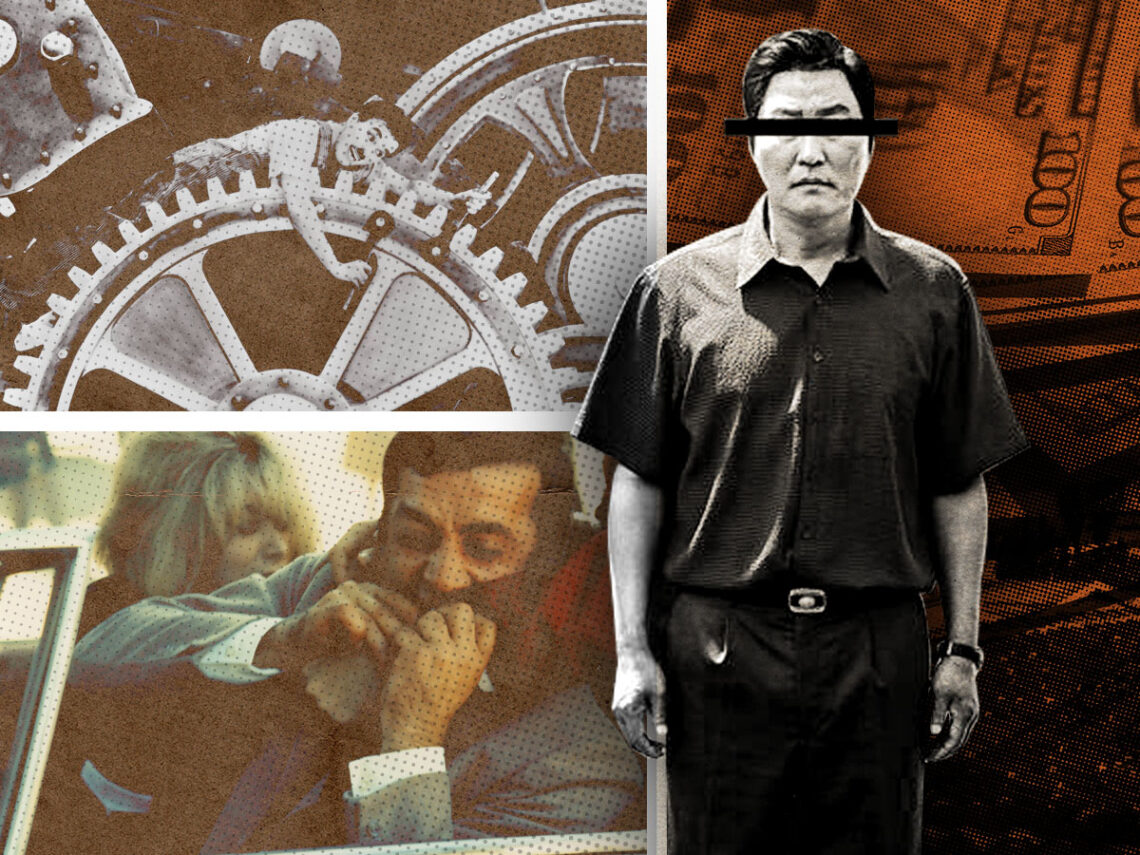
No doubt one of the most influential actors and filmmakers of early Hollywood cinema, the silent era star Charlie Chaplin had a prophetic outlook on the distant future. His masterpiece, 1936’s Modern Times, demonstrates this attitude perfectly, telling the story of a man who struggles to adapt to the modern innovations of industrial society alongside a young, homeless woman. Familiarly hilarious, it’s the anti-capitalist sentiment of Modern Times that makes the movie so unforgettable.
Being forced into an industrial production line, Chaplin’s tramp becomes another cog in the capitalist machine before the screenwriter and director turns the system on its head and uses it as a playground for absurd humour and profound insight.
2. The Cook, the Thief, His Wife & Her Lover (Peter Greenaway, 1989)
We’ve talked a lot about the role of food and gorging one’s face on this list, with Marco Ferreri’s La Grande Bouffe and Luis Buñuel’s The Discreet Charm Of The Bourgeoisie being two movies that deconstruct modern capitalism with a squirt of whipped cream. Peter Greenaway’s satire The Cook, the Thief, His Wife & Her Lover may be the best of such movies, however, taking the ‘Eat the Rich’ slogan to new levels of literality.
Taking place at Le Hollandais gourmet restaurant, a venue that is regularly filled with decadence and gluttony, Greenaway’s story tells the tale of the cook, a thief, his wife and her lover who turn the placid eatery chaotic. Excellently breaking down the structures of power that keep the rich in control and the working class compliant, Greenaway’s superb ‘Eat the Rich’ satire is too often swept under the rug.
1. Parasite (Bong Joon-ho, 2019)
The first foreign film ever to win ‘Best Picture’, Bong Joon-ho’s Parasite is truly a contemporary classic, harnessing the attention of audiences and critics across the world with its thrilling core concept and execution. Though its central story is certainly gripping, the real power of Joon-ho’s tale is in its sociopolitical pertinence, exploiting a group of characters who parasitically live off each other in a toxic symbiotic relationship.
Sparking a modern interest in South Korean drama, no doubt the success of Parasite in 2019 would lead to Netflix’s monumentally successful series Squid Game released in 2021. Dabbling with themes of class warfare and the disruption of the social order, Bong Joon-ho deals with several urgent topics with a compelling approach to drama and a subtle layering of subtext. It’s a fascinating ride of moral ambiguity.
