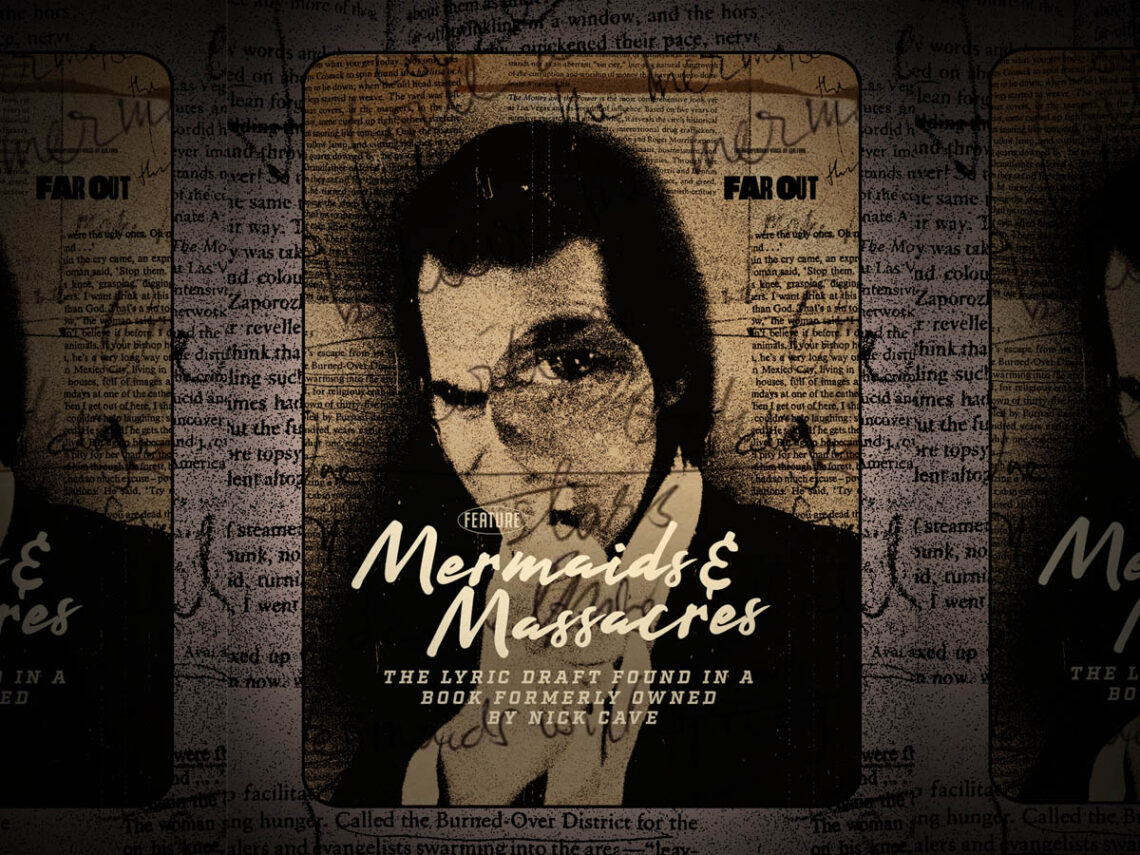
Mermaids and massacres: Lyric drafts found in a book formerly owned by Nick Cave

As I draw the chair to write my first article in several months, the haunting shrieks of Nick Cave and Rowland S Howard’s shrill guitar work shake the windows and rattle the walls.
I have just dropped the needle on Junkyard, the second and final studio album attributed to Cave’s first significant musical ensemble, The Birthday Party. The creeping chaos of ‘She’s Hit’ is somewhat distracting, but what a way to spend a Sunday afternoon!
Listening to this early classic, it is immediately apparent just how far the Australian artist has come. From his early cult success on the experimental fringes of post-punk, Cave has honed his craft to become widely revered in the pantheon of songwriting legends as the leader of the Bad Seeds, adjacent to his immortal idols, Leonard Cohen and Bob Dylan.
Like Cohen and Dylan, Cave has brooded invariably over religion, philosophy, human suffering, sex, drugs and rock ‘n’ roll. Though he consistently relies on gritty themes, steeped in ecclesiastical critique and psychological chaos, that track his tortuous journey of artistic maturity, fame, addiction, recovery and mourning, these five decades of creative output have been anything but monotonous. The path from ‘Big-Jesus-Trash-Can’ to ‘Wild God’ is toe-curlingly personal, yet, as Cave’s expansive library, recently donated to rabid hordes at the Oxfam Bookshop in Hove, betrays, a rich, alimentative diet of poetry and prose actively guided his artistic footprint every step of the way.
Somewhere in the humid heart of July, Cave announced that approximately 2,000 books from his personal collection were to appear on the shelves of a small charity shop in Hove. I live in East Brighton, but happened to be visiting West Hove, just a few streets from the bookshop, when Google targeted me with the news. My pessimistic disposition immediately checked this geographical fortune, convincing me there would be nothing left when I arrived, so why bother? However, when I called ahead to save my legs, the genial store manager, also a keen Cave fanatic, informed me that, after a frenetic first 48 hours, the second batch of books from the collection had only just arrived.

I think the phrase “shit off a shovel” aptly describes my journey to the store that afternoon. Perspiring profusely in the doorway, I was surprised to find the place virtually empty. The manager ushered me towards a few scant shelves, plundered by the masses—a sorry sight redeemed by two beguiling carrier bags. Given free rein, I sifted through the new arrivals to find literary classics such as Herman Melville’s Moby Dick and Aldous Huxley’s Brave New World, spine-to-spine with obscure theological and philosophical studies and musical biographies.
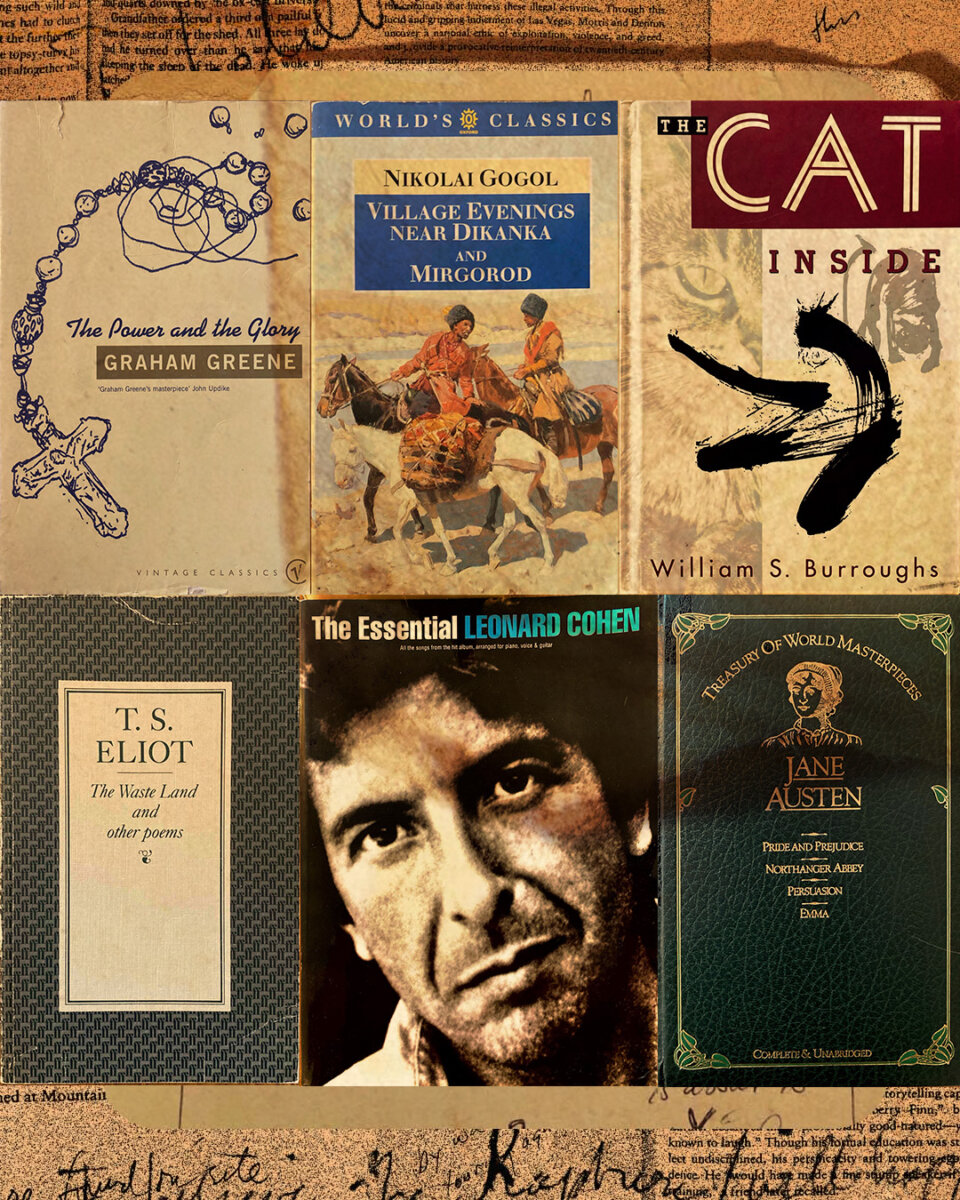
Spoilt for choice, I began to compile some of the books I have had on my to-read list for some time, including Graham Greene’s The Power and the Glory and TS Eliot’s The Waste Land. I also found a non-fiction book entitled American Massacre, which likely wouldn’t have come home with me were it not for a series of scribbles and underlined sections throughout the text.
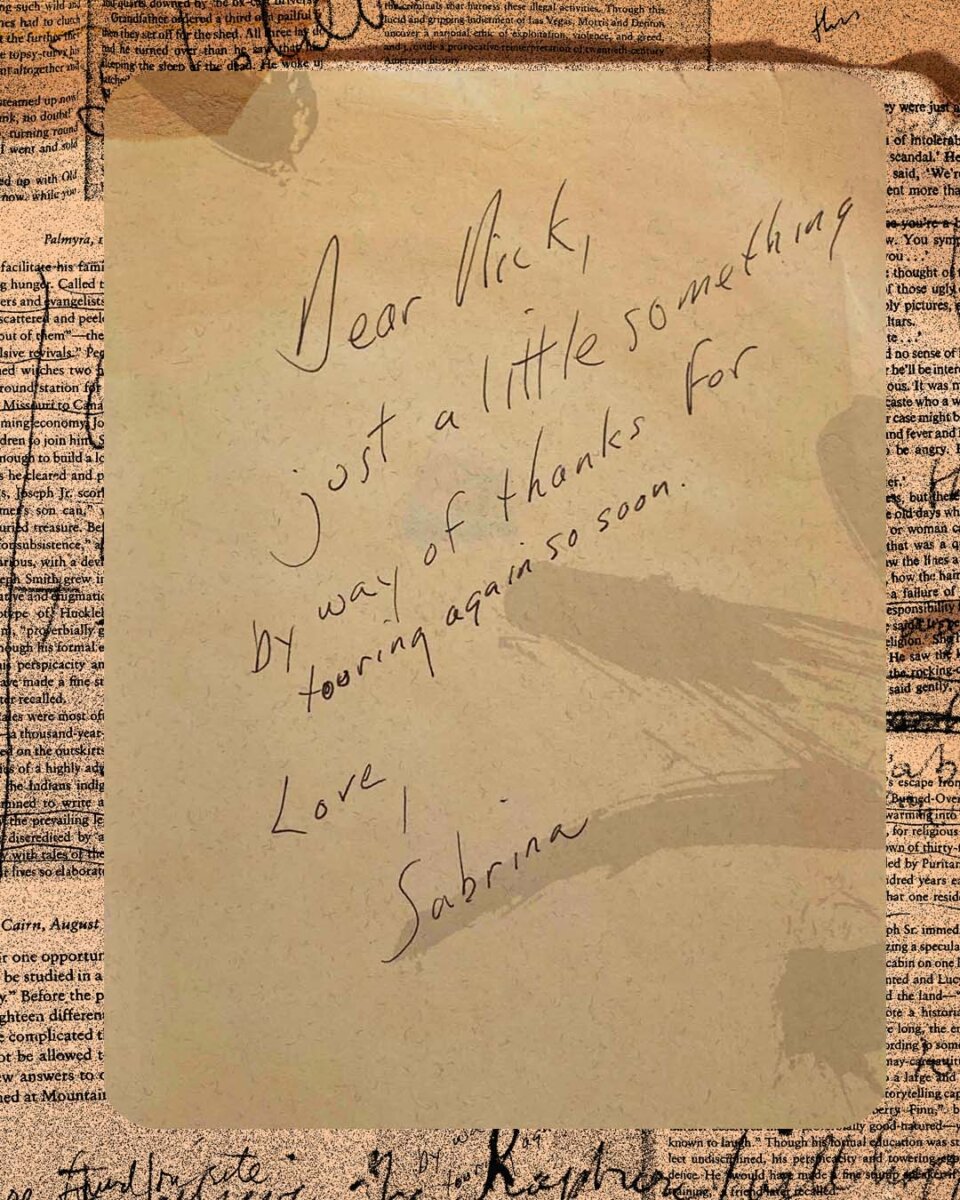
Later that day, marvelling at my modest haul at home, I was content to have some physical tokens of attachment to an artist I had admired for many years. Only one of the books, a copy of William S Burroughs’ The Cat Inside, had a direct identifier of its former owner. On the first page, a note to the recipient read: “Dear Nick, just a little something by way of thanks for touring again so soon. Love, Sabrina”.
I have no idea who Sabrina is; perhaps she was a member of Nick’s entourage, a devoted fan or, indeed, the icon of the hour, Sabrina Carpenter. Who knows? That wasn’t rhetorical—I actually want to know. So if you’re reading this, Mr Cave, please enlighten me.
As I sat ruminating over the elusive Sabrina, I thumbed through The Power and the Glory to notice faint pencil marks underlining several lines and phrases. Cave has previously revealed his adoration for Greene’s oft-ecclesiastically inclined work. A former fellow Brightonian, he also no doubt enjoyed Brighton Rock with a similar nuance of intimacy as I did a couple of years ago. At first, I couldn’t be sure that Cave was the pencil-wielding reader, nor could I confirm that he had read this exact copy, given that I found two within his collection.
Fortunately, the fog began to clear when I examined the underlined sections with a more scrupulous eye. Much to my excitement, and my partner’s irritation as she sat trying to have a peaceful evening, the highlighted words “in the whole abandoned star” appear in a new guise in Cave’s 2004 song ‘Spell’, where the line, “Upon this wild abandoned star”, is repeated at the end of the first and final verses.
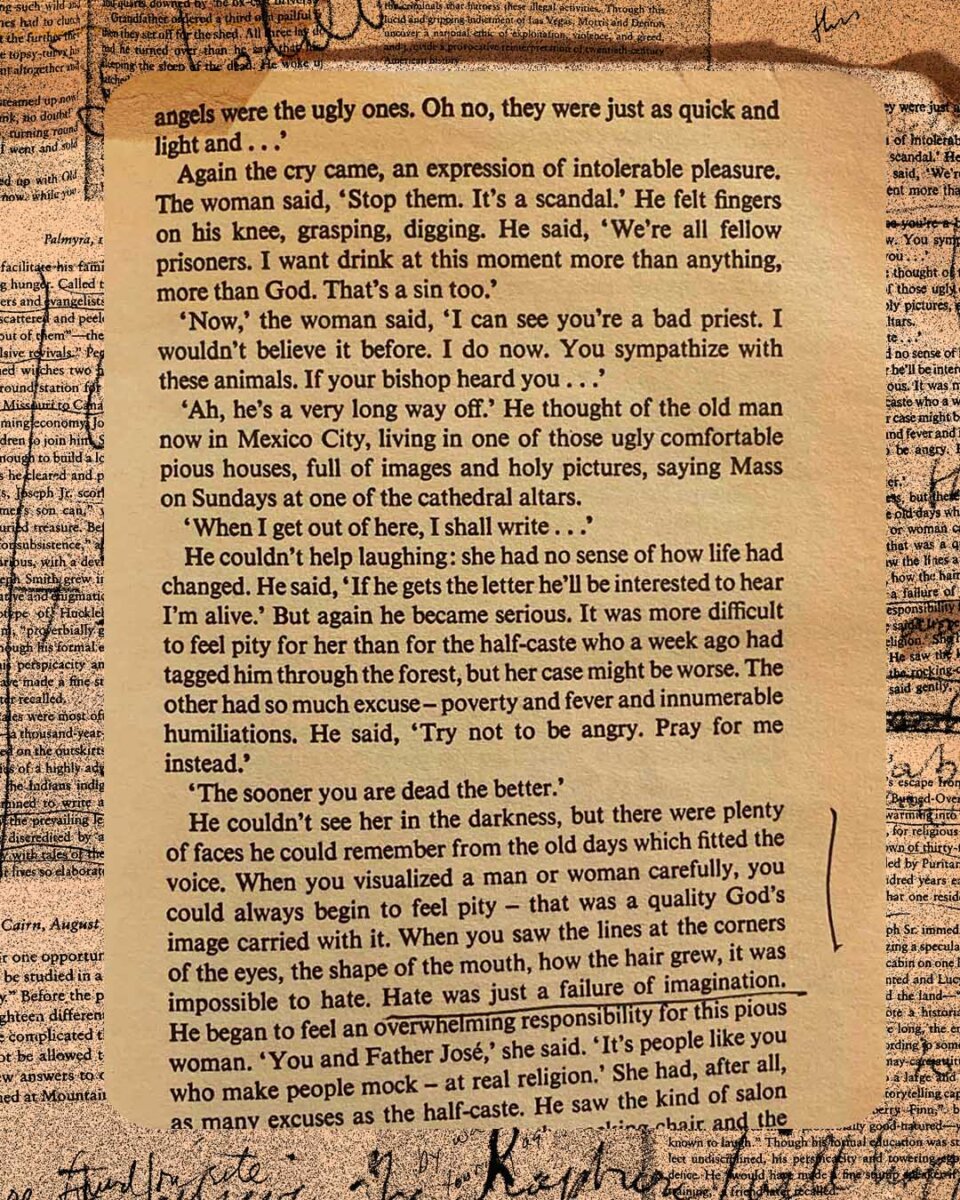
In Goldfinger, Ian Fleming wrote, “Once is happenstance. Twice is coincidence. Three times is enemy action”. In my book, twice is sufficient to dismiss coincidence. Therefore, conflagration at the petrol station describes the extent of my elation to discover another link between The Power and the Glory and Cave’s Abattoir Blues/The Lyre of Orpheus era. This time, I found the underlined sentence, “Hate was just a failure of imagination”, to bear all too uncanny a resemblance to a lyric in the ‘Nature Boy’ B-side ‘She’s Leaving You’: “She keeps saying, ‘Hate is just some kind of failure of the imagination’”.
Agent 007, we have enemy action.
Finding no further lyrical links in the 1940 novel, yet redoubled in my page-flicking zest, all eyes shifted to a book comprising two of Nikolai Gogol’s early short story collections: Village Evenings Near Dikanka and Mirgorod. Of the 12 short stories compiled, only one lay victim to Cave’s pencil: The Lost Dispatch (more widely translated as The Lost Letter). Cave may be a “stranger to kindness”, but he’s no stranger to a mixture of dark humour and daemonic revelry; a comic tale of a Cossack’s hellish adventure, having dealt with the devil, The Lost Dispatch fits Nick the stripper like a glove.
Familiar underlining is rife throughout the text, with some of the phrases seemingly torn straight from Cave’s more visceral and rambunctious early work. Alas, after searching the most likely lines and lyrical sentences, I could find no direct parallels between Gogol’s short story and Cave’s lyrical canon. Still, I can’t help feeling this literary experience informed an unreleased song or a published idea that subsequently developed beyond tangibility: perhaps the crawling devil in 1993’s ‘Loverman’ began life as Gogol’s “pig-faced men”. Only one man knows.
If my story thus far has served to whet your appetite or inspire a deep slumber, I am pleased to say I saved the best till last. The beef wellington among the trimmings arrived in the unsuspecting form of Sally Denton’s American Massacre, a historical dissection of the Mountain Meadows Massacre, 1857. It came as no surprise that such a book should find its way into Cave’s library, with its grotesque, religious, Wild West aura complementing the songwriter’s fascination with all things macabre and his longstanding association with the Southern Gothic tradition. Instinctively, I felt the book could have inspired one of the Murder Ballads, but as a 2003 publication, the likelihood of the book’s role in shaping an album seven years its senior was very slim.
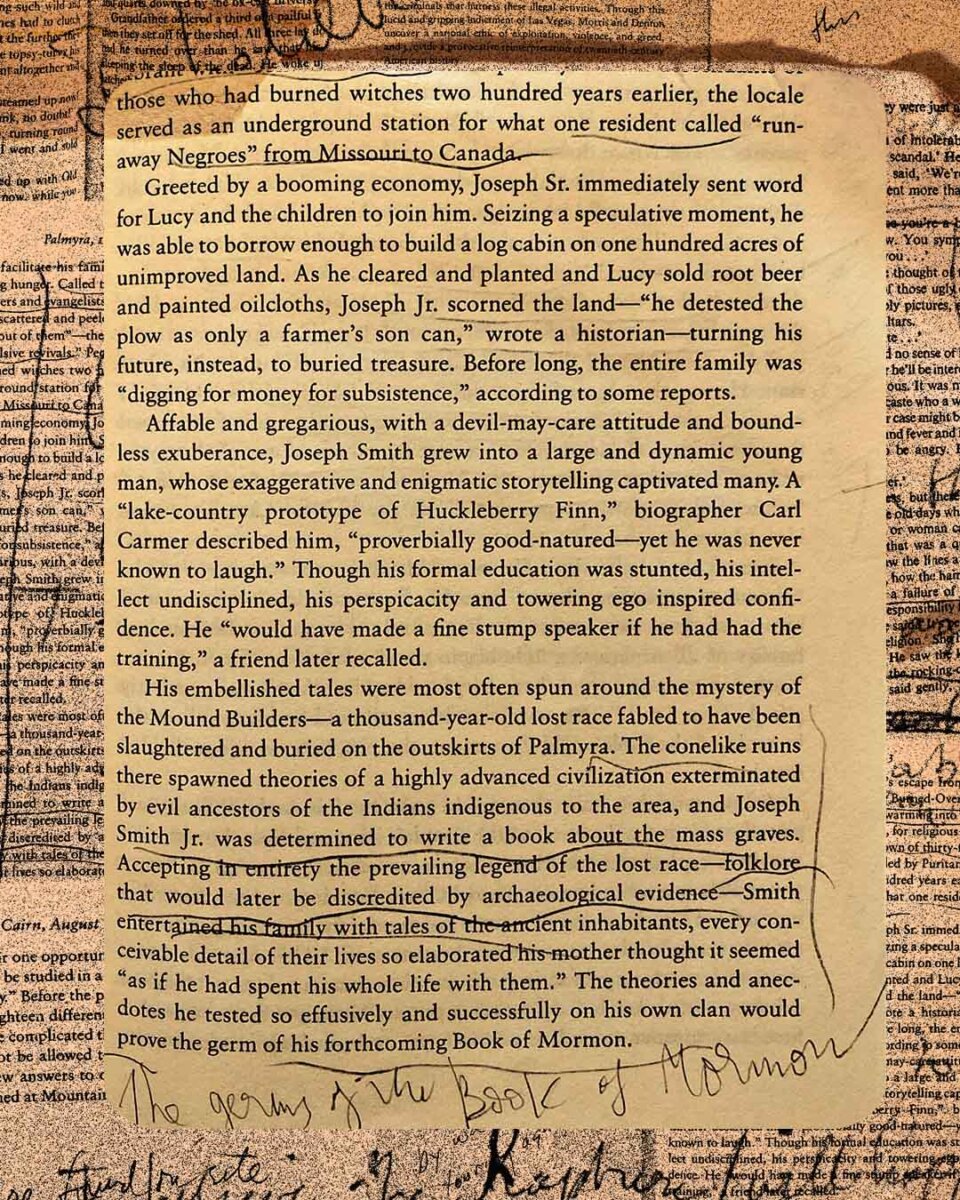
Cave patently enjoyed his research into the Mountain Meadows Massacre. This time, the underlined sections were so extensive that it proved far too onerous a task to Google each phrase and sentence in search of lyrical significance; besides, non-fictional discourse generally isn’t quite so conducive to lyrical inspiration as it is to more general, thematic influence.
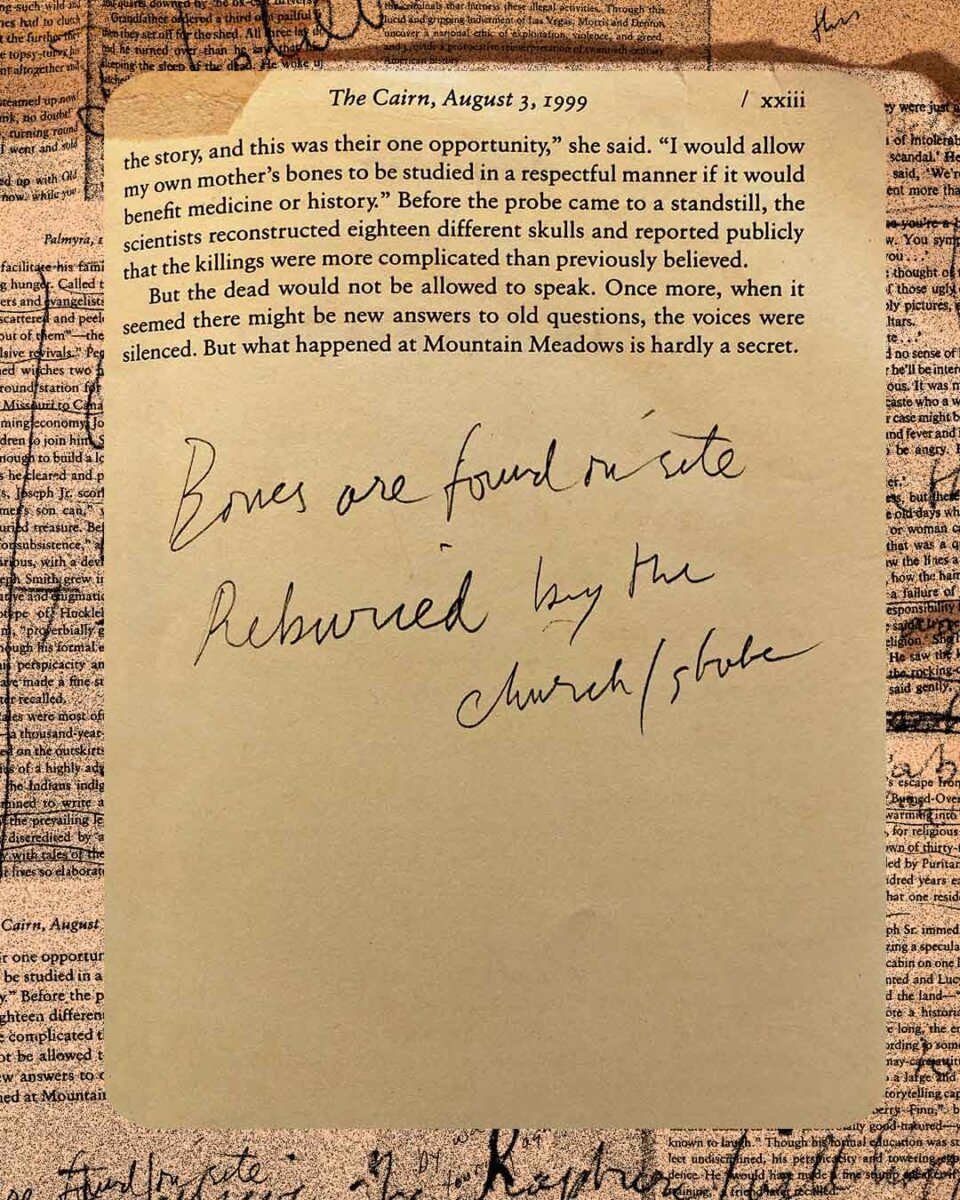
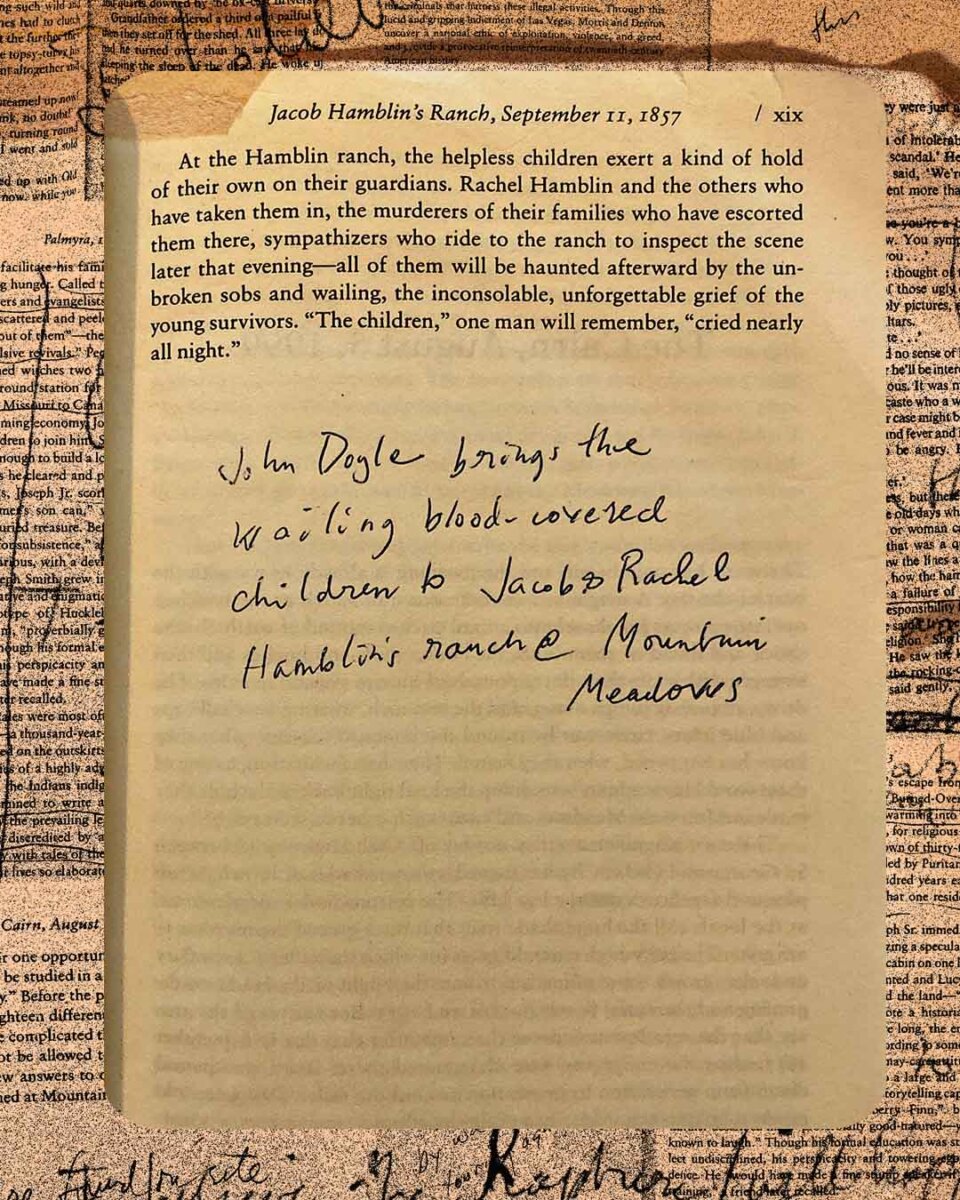
As seen in the scans below, Cave’s pencil strokes accompany several brief notes, reinforcing the notion that his research chiefly concerned the socioreligious motivations involved in the massacre, during which Mormon militia and a group of Paiute Indians murdered upwards of 120 emigrants from a wagon train. It was the tragic climax of a long-suffered dispute between Mormon leader Brigham Young and the federal government.
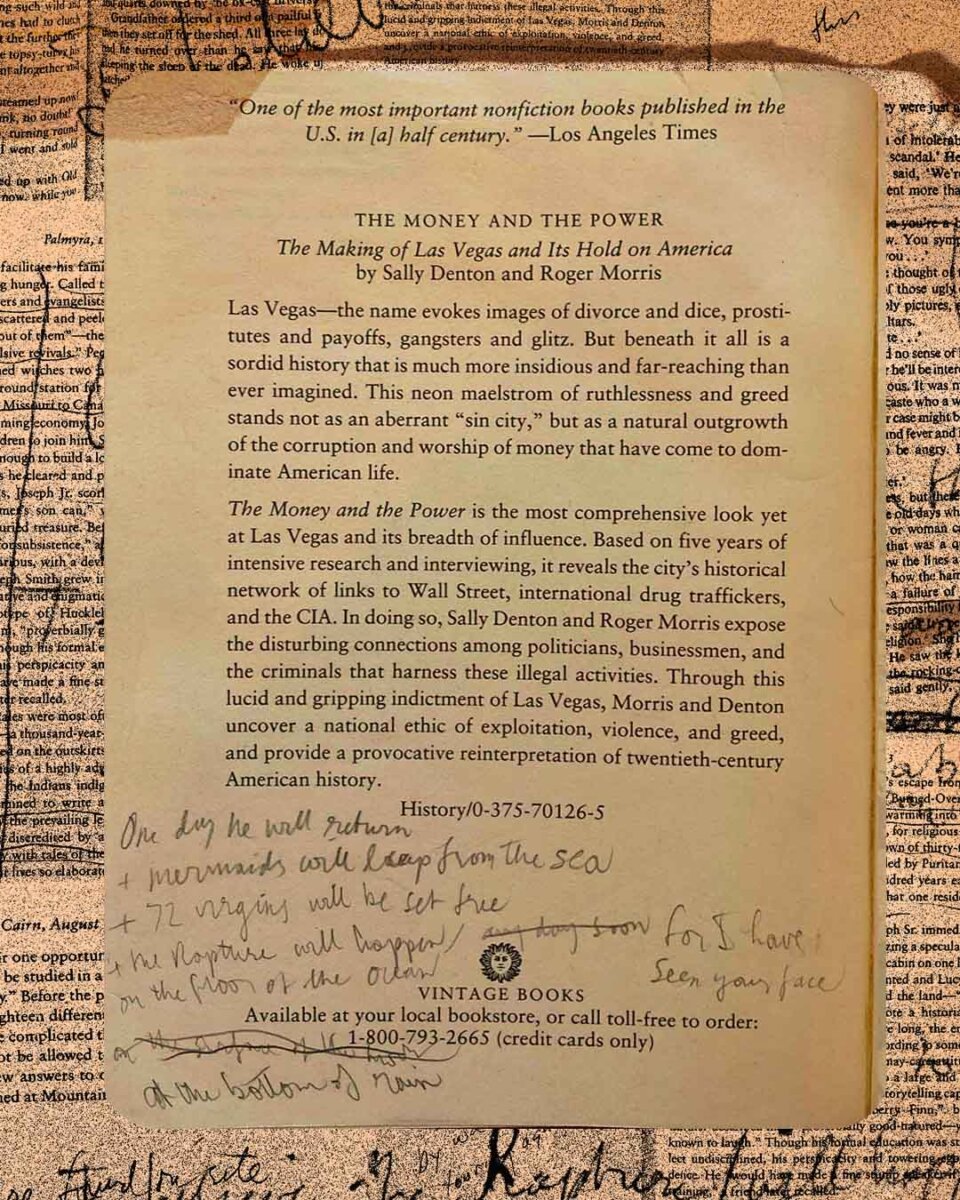
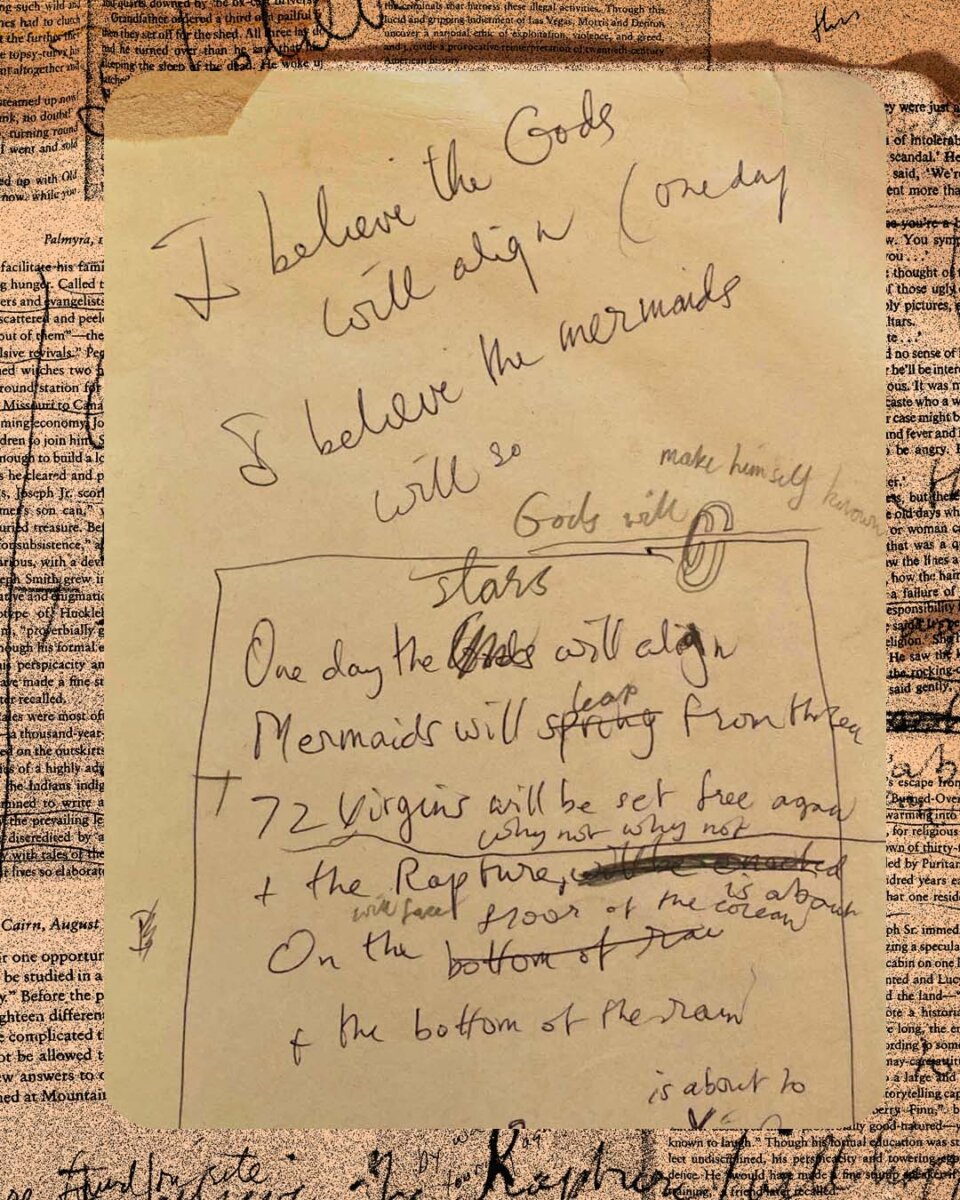
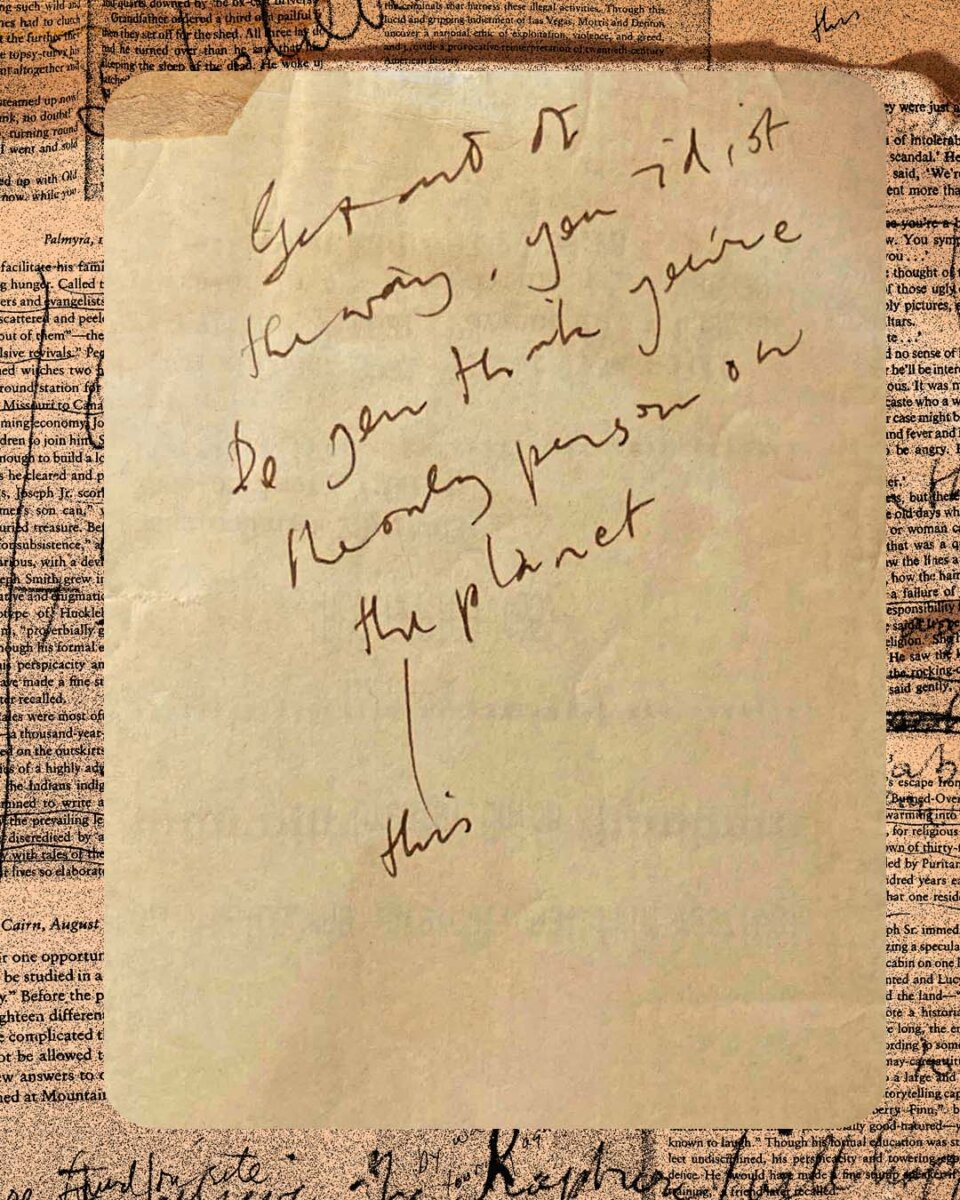
Although I never managed to divine a concise relationship between the songwriter’s research into the massacre and his artistic output, I soon discovered some additional, eyebrow-raising notes, just inside the book’s back cover. At first glance, words like “God” and “rapture” seemed consistent with prior notes, before “ocean” and “mermaids” swept me far from the landlocked state of Utah. The penny finally dropped when I saw “72 virgins” followed by “Why not? Why Not?” Unmistakably, I sat before an early, if not the first, draft of ‘Mermaids’, the third single from Cave’s 2013 album Push the Sky Away.
Cave has previously described the lyrics in ‘Mermaids’ as “a sort of spiritual collapse”. He continued to postulate that the “mermaids are myths and products of our imaginations, and it’s about going somewhere that is separate from the world and being saved by our imaginations… it’s a respite from the world”.
While American Massacre is unlikely to have conjured the image of oceans and mythical creatures, it is not inconceivable that the book influenced the song’s spiritual and religious themes. In this early draft, the lyric, “One day he will return/And Mermaids will be released from the sea/And 72 virgins will be set free,” could be an attempt to draw parallels between the Prophet Muhammad and his counterpart in The Church of Jesus Christ of Latter-day Saints, Joseph Smith: both of whom have been criticised, particularly from a modern Western perspective, for their polygamous practices and attitudes toward women. Conversely, Denton’s book could simply have provided a handy place for jotting down a nascent idea on the road with limited bearing on the genesis of ‘Mermaids’.
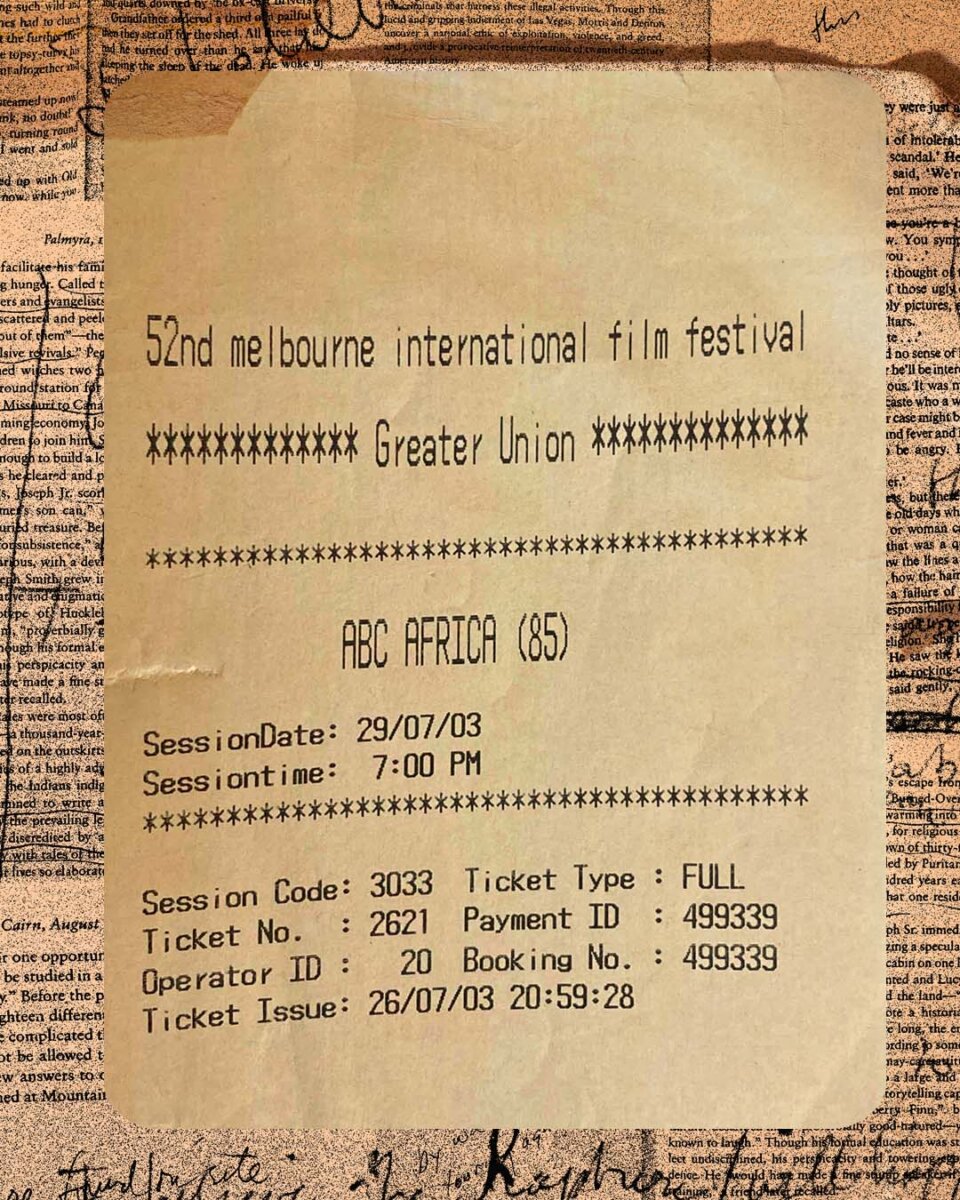
Below are a few scans from the books I purchased from Cave’s collection, including a curious newspaper clipping and a receipt-cum-bookmark with a comically insolent note scribbled on the back. If you have any thoughts on any of the above-discussed material, procured some similarly interesting material from the Oxfam collection, or, indeed, are Nick Cave himself, please don’t hesitate to get in touch and help us navigate the captivating labyrinth that is Cave’s creative thumbprint.