


Dystopian fan worship in the underrated British satire ‘Privilege’

These days, it seems to be completely normal for people to engage in parasocial relationships with their favourite artists. By forging a fabricated sense of closeness with a complete stranger, fans often come to feel as though they’ve found someone between a friend and a god, blindly worshipping the ground they walk upon. You can get devoted fans of a certain musician to do anything when they take their word as gospel, whether that’s who to vote for or what to believe in.
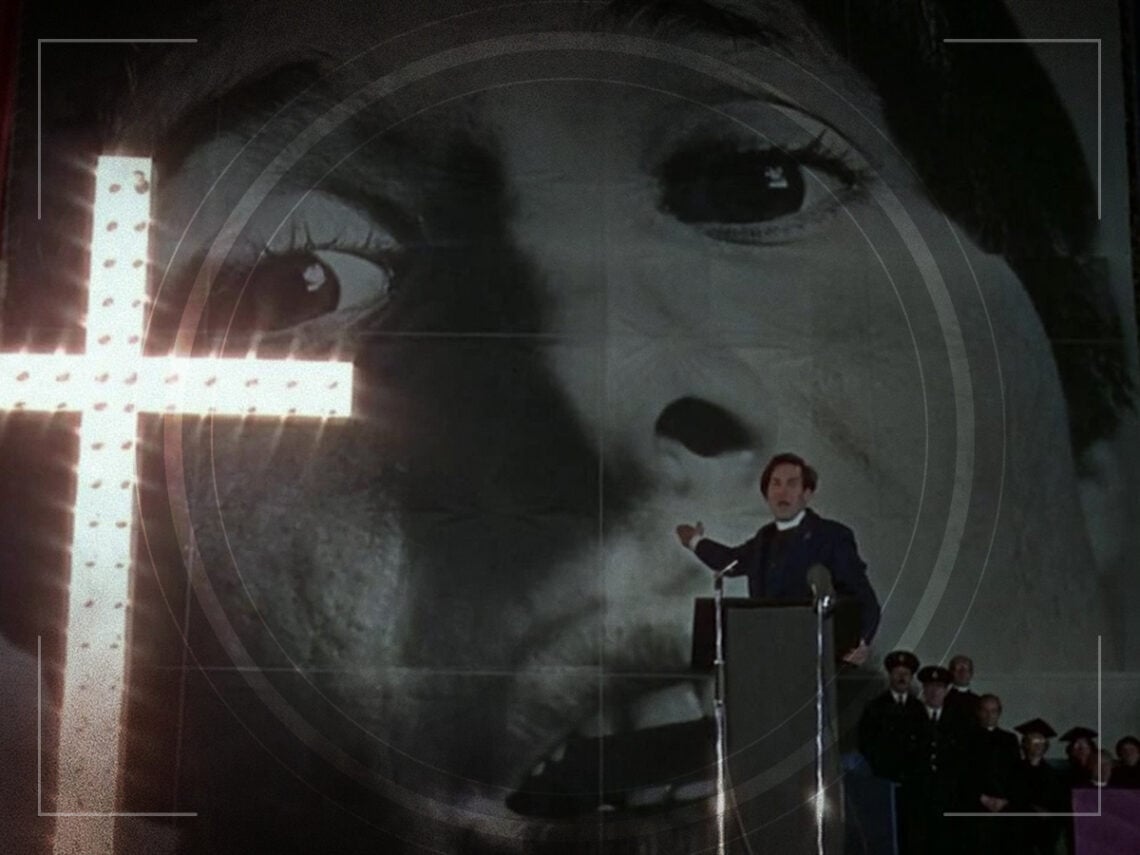
In the controversial 1967 movie Privilege, directed by Peter Watkins, we see just how far propaganda can go, with pop sensation Stephen Shorter, played by Paul Jones, used as a puppet by the British government. It’s a distinctively Orwellian idea, but it’s one that—at least on screen—feels incredibly ahead of its time. It makes sense that the film emerged not long after the buzz of Beatlemania, with the narrative certainly taking inspiration from the intense fan worship that defined much of the swinging sixties.
Hitting screens just over 20 years after the end of World War II, the film sees a coalition government form between the country’s two main parties, although in real life, Britain was under Labour rule for the first time in many years. The country was in the midst of a musical and cultural revolution, with art, fashion, and politics all progressing towards a more open-minded and experimental state of being. Young people were doing drugs and advocating for freedom, nuclear disarmament, a call to the end of all war, and increased rights for marginalised communities; yet, many others felt that this optimism and cultural craze was simply not going to last forever.
Privilege is a cynical film, concerned with confronting the harsh reality of living in a world where global conflict and totalitarianism aren’t as distant an idea as you’d like to believe. The Vietnam War was ongoing, and racism, sexism, and homophobia were still very much prevalent, with governments across the world failing their people. You only have to look at Ken Loach’s film Cathy Come Home, released the year prior, to see how Britain was struggling with widespread issues like homelessness and poverty during this era. Thus, Privilege acknowledges that this period of hopefulness and ‘peace and love’ espoused by many was actually unrealistic and, ultimately, unsustainable.
The film highlights how far a government will go to placate the masses in the hopes of preventing political action and resistance. The requirements of Shorter’s job get increasingly ridiculous, leaving him incredibly disillusioned and angry and ultimately causing his demise as Britain’s biggest celebrity. Yet, the government pushes him as far as they physically can, even turning him into a figure akin to a religious leader to increase church attendance across the country. The film questions if celebrities can be much more than mere puppets, forcing viewers to think before they blindly give in to the worship of famous individuals.
When a rally is held to honour Shorter, the film takes an even darker turn, with Nazi-like outfits and salutes signalling the evil lurking underneath the government’s control of his character. Yet, his influence becomes so strong that he is able to sell anything and start any trend he chooses—and people fall for it, fawning over him and buying anything he is associated with in the hopes of getting closer to his beauty, his genius and his mystique.
The film was hugely controversial when it was released, and it was withdrawn from many cinemas after widespread outrage. Evidently, many audiences weren’t ready to be met with such a nihilistic film that encouraged suspicion in a time of cultural optimism otherwise championed by swinging London. Privilege isn’t a perfect movie, but it’s a fascinating time capsule of an era that was rapidly changing, leading people to question how celebrity and politics would continue to intertwine, and how easy it really is for the average person to get swept up in consumerism and fan worship.
