


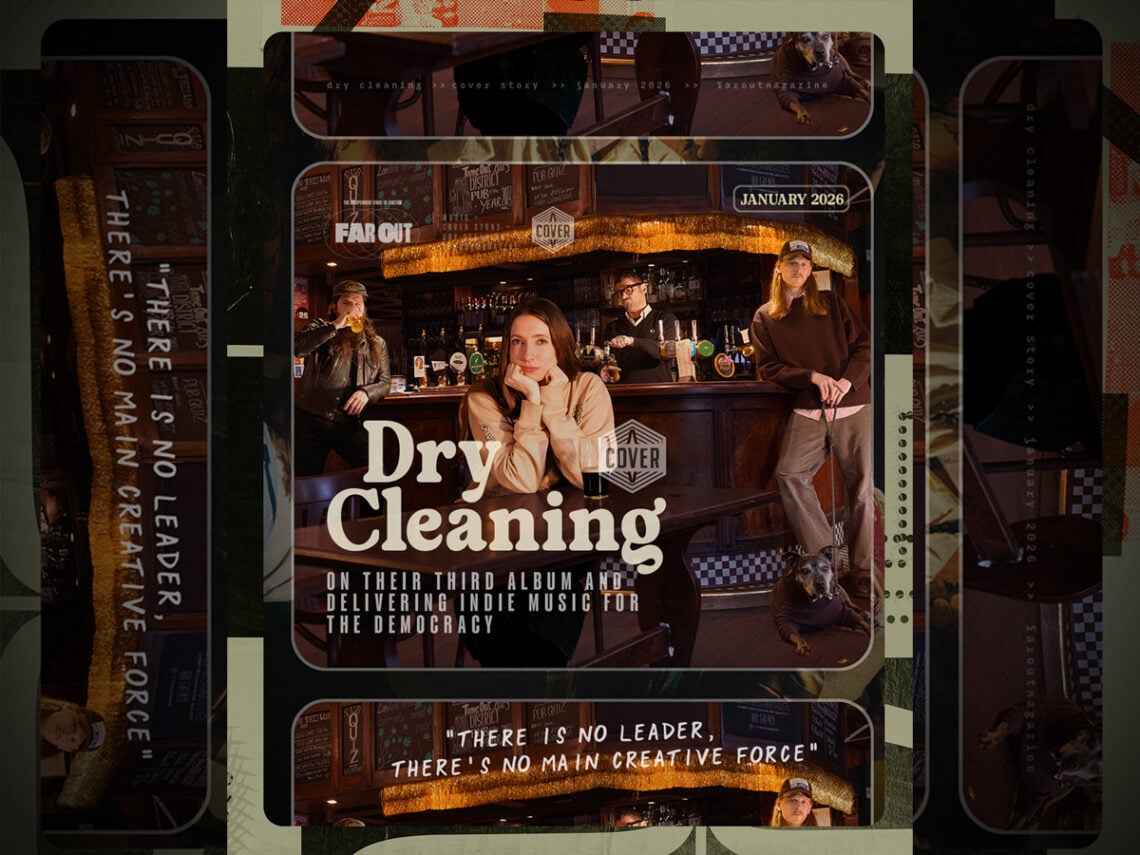
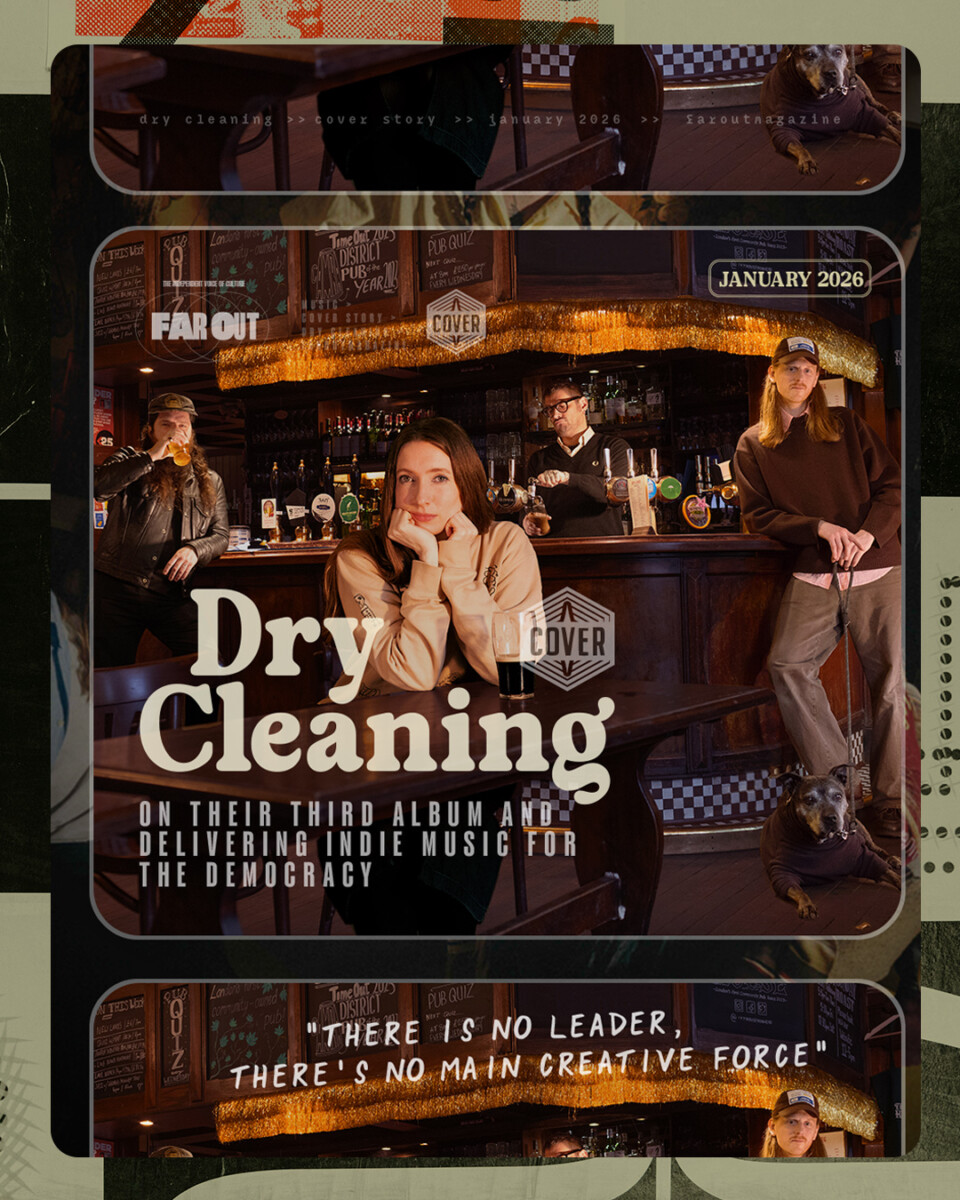
Dry Cleaning on their third album and delivering indie music for the democracy: “There is no leader, there’s no main creative force”

If you scroll into any of the uninformed social media rabbit holes available, you’ll likely find a disgruntled boomer lamenting the state of the modern music scene. Fuelled by a fire lit by legends of yesteryear, they will likely claim that there are no bands out there anymore and that the spirit of forming the next great one has ceased to exist.
The argument goes that streaming royalty pittance hasn’t scared the collectives away, but rather a cultural insistence on the individual, where art fuelled by capitalism doesn’t care about democracy. But a rebellion exists, buoyed by the true idea that music is best when shared by a community. Now, as we turn the corner into a new year and face an unknown future, an album has presented itself as a fitting soundtrack for that.
Dry Cleaning’s entire career to date was built on a democratic legacy, and their upcoming third album, Secret Love, is no different. Built with the careful craftsmanship of four musicians harbouring a distinctly unique voice, while similarly working in unison, it is an unfiltered celebration of how the creation of bands are very much still desired, and that democracy is at the heart of music.
“There is no leader, there’s no main creative force,” guitarist Tom Dowse proudly tells me about the band. But that unspoken agreement brings with it a dichotomy. Of course, an egoless approach to bandmaking would seemingly open the door for regular collaborators, but then again, only ones with the right disposition. The atmosphere of this uniquely egalitarian outfit is built upon a very shared sense of trust that not everyone is in tune with.
“I think when we first started the process, we did wonder if we’d need a producer,” Dowse continued. “I mean, we’d go to a couple of studios without anyone guiding the ship, and it became very apparent very quickly because I think with four strong voices, you do need someone to captain that ship.”
Enter, Cate Le Bon. Early hesitations over whether a producer was needed were quickly squashed when the mercurial Welsh musician manned the ship, so to speak, for her lucid musical spirit seamlessly blended into this collaborative unit. After all, this is a band who communicate on some sort of spiritual, unspoken level.
“I can be playing for half an hour, we may have been setting up, jamming away, and no one takes with anything, and you just have to be like, that’s just how it is,” Dowse explained. “You can sometimes bring something to the practice, and you’re sort of playing it, but you never actually say ‘this is my idea!’ So you start playing it, and if someone else notices, that’s a good sign.”
Le Bon speaks that language. Rarely seen communicating with the wider world outside of her music, she seeks comfort in the abstract communication that Dowse claims fuels the creative fires of the band, and so, for Dry Cleaning, she was the perfect guardian.
He explained, “The way she talks, the language she uses for things is kind of really, really good for a producer who really gets you. She doesn’t talk in this really sort of dry, technical way, even though she’s got an ear for that. She sort of holds that. She separates that from you when she talks to you”.
“Cate’s not the kind of person who’s like, ‘that’s not working’. She’s the kind of person that lays the challenge at your door and motivates you to go and find the answer.”
Tom Dowse on working with Cate Le Bon
So how did those challenges manifest themselves to a band who feel somewhat safe in the world of their own creation? Under what mission statement can these democratic four-piece unite under a new vision?
Dowse answered, “When we were doing ‘Cruise Ship Designer’, she said, ‘When I come and see you live, when I imagined myself coming to see you like this, it’s this song you’re playing,’ and that’s such a cool, interesting way of describing or motivating someone to buy in. This is what I see,” adding, “She’s thinking about the listener’s journey, and that’s not always essentially what you’re doing in your writing.”
Secret Love is home to a myriad of textures, ideas and crucially moods. Buried in the depths of writing an album like this certainly comes with an emotional attachment a producer would have had to help harness, but it was important that Dry Cleaning followed their nose and went to the depths of their own feelings.
Le Bon can help translate those ideas to the audience, sure, but the music and ideas had to be all of them. After all, that is what had pulled Dry Cleaning to a clear point of unique success after their first two albums – their ability to steadfastly trust themselves and the nuance they provide in the music industry.
In what many would describe as a swathe of spoken word indie, Dry Cleaning have always stuck to their own guns, their own pace and crucially, their own style. Led by Florence Shaw, the band never tries to be anyone else and on Secret Love, that shines through stronger than it ever has. It’s what has allowed for a myriad of moods to be explored in a sonic whistle stop tour of sorts – the emotions may consistently vary, but the voice from within is consistent.
“There are some songs that are really tender and kind of intended to be quite, moving, I suppose,” Shaw explains. “And then some songs that are sort of quiet and some have a silly energy to them, like intentionally so, and then some songs that are quite uncomfortable and aggressive, and maybe like with some violent kind of lyrics. It’s not a plan, it kind of just happens.”
Shaw’s quiet bravery in that regard inspires the rest of the band, following her into the breaches of artistic purity. Whether it’s emotion or ambition, the song comes first, and the intra-band trust will naturally follow. As I prod at the core of how that sentiment manifests and Shaw humbly eludes it, Dowse interjects like a faithful bandmate, gushing over her ability where she won’t.
On Shaw, he says, “It isn’t easy, I think, to be a vocalist in a band, especially the way Flo does it,” adding, “But she doesn’t think of anything other than making the song the best it can be, you know what I mean? And so, yeah, it’s great to see that really, it makes you want to do your best as the band should.”
The uninitiated may think Dowse is talking nonsense. Traditions have told us that talking is the easy part, whereas singing, well, that’s reserved for the musical elite. But on all of Dry Cleaning’s music and most especially, Secret Love, Shaw challenges that idea at every turn. Her voice is like the mouse, the angular cat of instrumentation is trying to catch. Racing round corners with a sharp sense of character, humour and storytelling that makes all of the band’s music compellingly elusive.
But there is an intelligence in how she goes about it, also. On the surface, she is a spoken word performer, trusting the deep intention of her voice to allow herself to follow whatever peculiar landscape her lyrics draw out, but on the odd occasion, it rises above the surface and floats into a brief vibrato. Take ‘Cruise Ship Designer’ for example, her voice lifts for the chorus line “striking while the iron’s hot” in a manner that conducts the instrumentation around her in that aforementioned, telepathic way. The band might profess that there is no leader, but in this quiet democracy, she sounds like a guiding light.
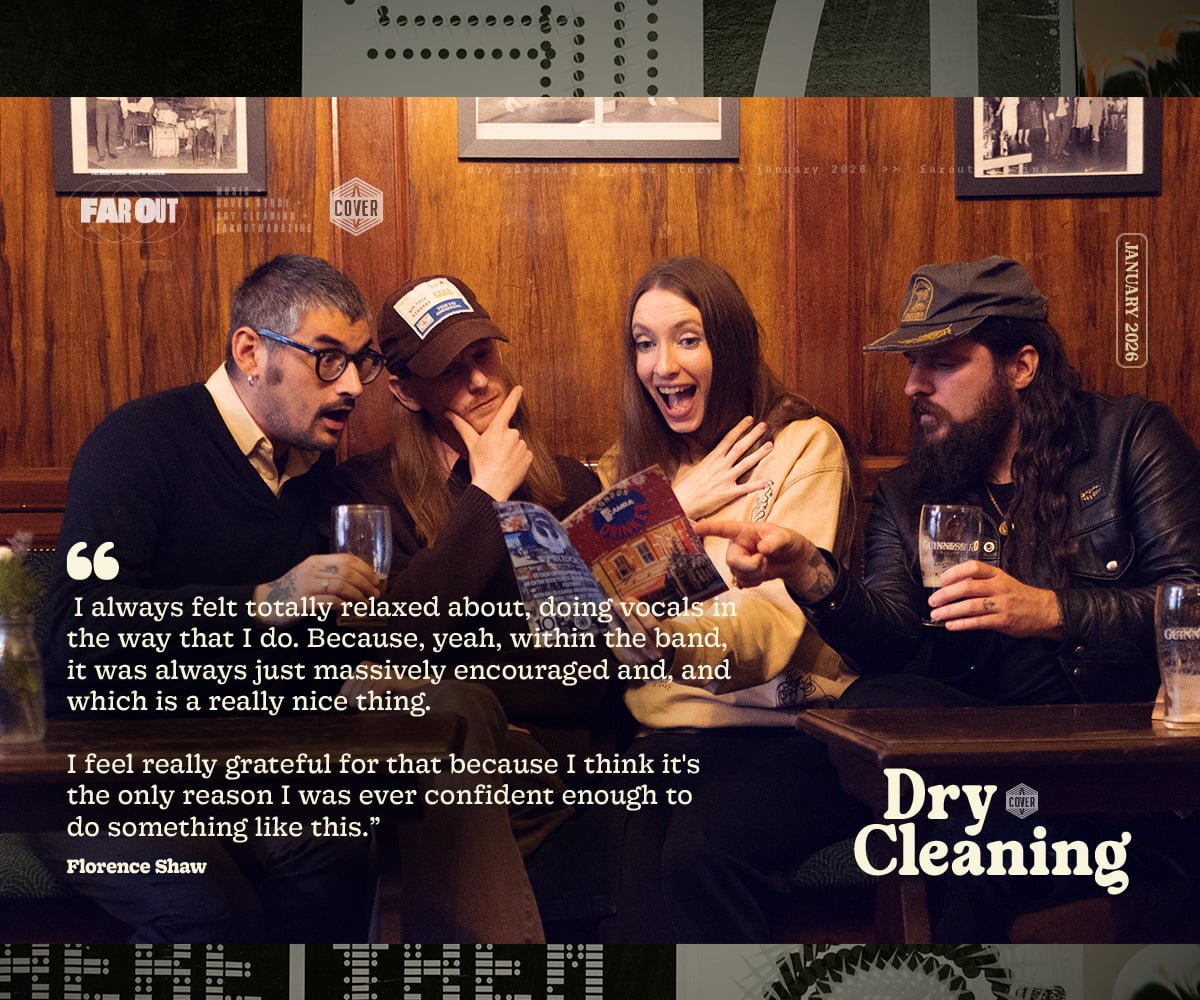
“I always felt totally relaxed about doing vocals in the way that I do,” she explains. “Because, yeah, within the band, it was always just massively encouraged… which is a really nice thing. I feel really grateful for that because I think it’s the only reason I was ever confident enough to do something like this.”
Adding, “And even if it is kind of this weird kind of at times, like not really functional in a way, like some rooms, it’s really hard to get vocals up, you know, that’s just the nature of acoustics or whatever, you know… we all kind of just believe in it.”
That’s the prevailing sense I get from Dry Cleaning, as I sit with them on the eve of their third album. Maybe it’s the heady enthusiasm of being sat in their local pub, The Ivy House in Peckham, sharing a pint and taking turns to dote over drummer Nick Buxton’s dog. Or maybe it’s the resolute assurance of a band basking in the knowledge that in the writing of their music, they’re doing something that is becoming increasingly difficult in the modern world: being truthful.
Secret Love represents that wholly. At its best, it sounds like the conversation you crave in the nooks and crannies of a pub like The Ivy House. Shaw’s lyrics switch between welcoming in-jokes and third-person observations that make you feel like a part of a group operating on their own steam. Not drunk on the validation of those around them but sober in the careful crafted assurance of themselves. To get to that point, they had to do what societal noise seems hellbent on preventing: accepting their own quirks.
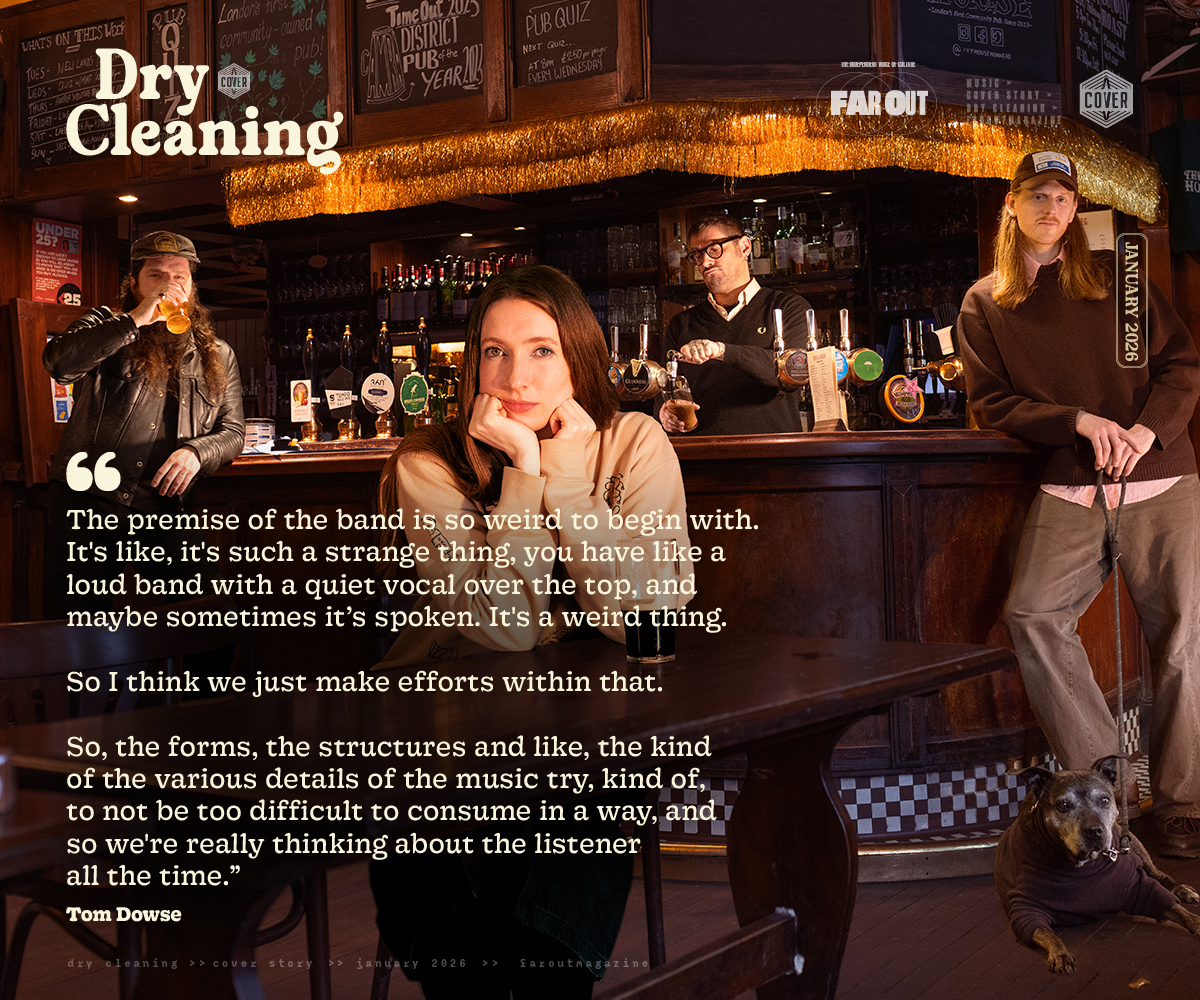
“The premise of the band is so weird to begin with,” Dowse explained. “It’s such a strange thing, you have a loud band with a quiet vocal over the top, and maybe sometimes it’s spoken. It’s a weird thing. So I think we just make efforts within that. So, the forms, the structures and the kind of various details of the music try, kind of, not to be too difficult to consume in a way, and so we’re really thinking about the listener all the time.”
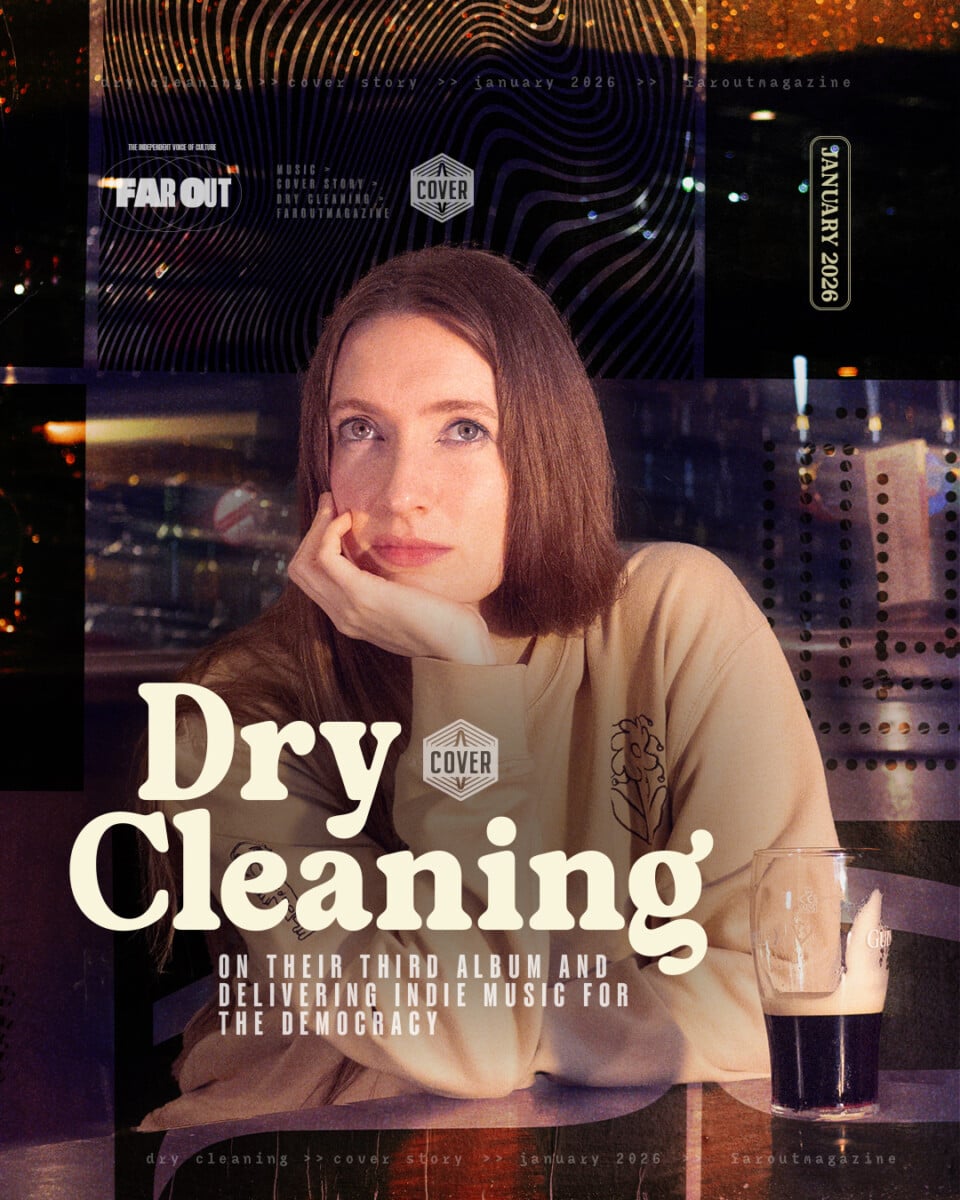
Democracy prevails yet again in the world of Dry Cleaning. A band as conscious of others as they are of themselves, and so prove to be the musical mirror we all need in 2026.
“Everyone who hears the record will have their own interpretation of what it is, and you know what it does for them,” Buxton calmly explains. The lack of pretence in the room is astonishing for a band who have crafted a record as considered as Secret Love, but I quickly realise, if it wasn’t followed up with this sense of receptiveness, then this wouldn’t be the real Dry Cleaning I’m speaking to.
He continued, “I think we are all extremely proud of it. And it doesn’t seem like such an obvious thing to say, but I really am proud of us, you know? I’m so proud of us for, you know, it’s just that weird thing where you’re making something out of nothing that never really ceases to amaze me. You know, a year ago, we didn’t have an album. We had nothing, really. And then you always have to suspend your disbelief that it’s actually going to happen and that it’s actually going to be good.”
Whether Buxton yet realises it is a mystery, but I can confirm this record is in fact great, and I would be less surprised than him when the next one drops and is even better. But that’s a long way in the distance, especially for a band as present-minded as Dry Cleaning. And Secret Love is as good a record as any to soundtrack the present: part antagonistic and partly escapist, it covers all bases of this ever-changing society.
Let’s just hope amidst it all, Dry Cleaning doesn’t change with it.
