


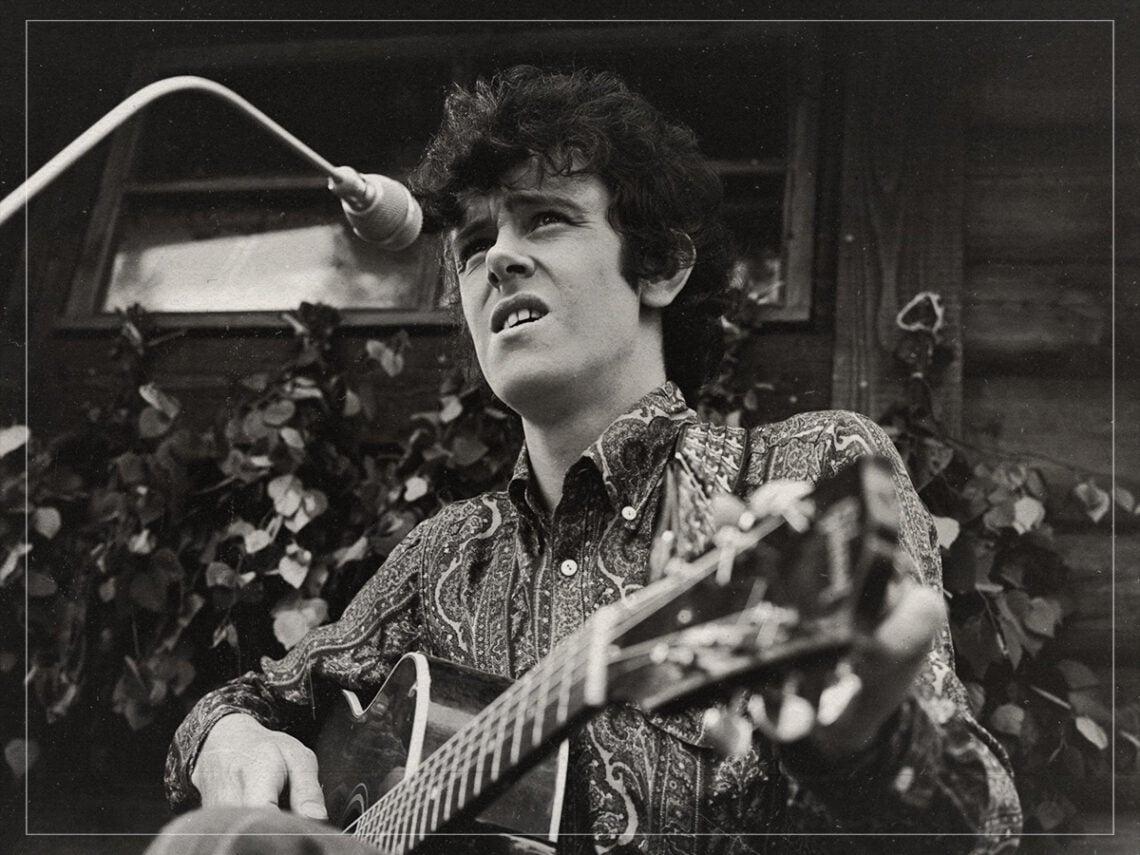
Donovan: the biggest bullshitter of the 1960s or the decade’s true architect?

The only songs from the 1960s that Donovan didn’t either write, directly inspire, or get ripped off for are the ones he hasn’t heard of yet.
Over the years, he has laid claim to a catalogue of catalytic moments in the history of music to the point where, without him, culture would surely be different by dramatic degrees. He taught Bob Dylan everything he knows, got John Lennon onto finger-picking, and he even says he’s responsible for David Gilmour’s property portfolio.
By his account, he dramatically changed the direction of The Beatles. “In India, I introduced John Lennon to a finger-picking style that I had learned with great difficulty,” he once recalled. “I learned it from this one guy one day, and I taught it to John, and he taught it to George.”
Thereafter, he saw shades of his lessons in a whole host of what followed from the Fab Four. “When John learned a new guitar style, he usually wrote a new song. With this style, he wrote ‘Julia’ and ‘Dear Prudence’. That finger style that John plays on The White Album is the one that I taught him,” he said. As it happens, ‘Dear Prudence’ is also his favourite Beatles song.
“Just as I learned many things from the Beatles about song formation, George definitely picked up the style that I taught to John and a finger style that they had not known before lead to some new songs,” he told Meet The Beatles for Real. Harrison apparently even made the connection clearer, as Donovan recalled, “He also said that I was, and am, fully a part of their music.”
Alas, he is perhaps even more a part of Pink Floyd’s music. David Gilmour made this perfectly clear when they met. “He said, ‘You know I bought your cottage?’” Donovan recalled. “I said, ‘Yeah? Why’d you buy my cottage?’ He said, ‘You wrote all those bloody songs there’.”

Referring to himself in the third person, he even told Record Collector that the White Album came about after the Fab Four were “exposed to weeks of Donovan”.
According to Donovan, he had changed Gilmour’s life as the 1960s rose to a head. “One song on Sunshine Superman [Donovan’s 1966 album] was called ‘Three King Fishers’, and he said, ‘When I heard that song, my future with the band I was with – which I suppose was Floyd – I knew my direction.’ That’s the effect of a catalyst: He bought my cottage. He said, ‘Maybe all that happened there would rub off on me.’”
A different permutation of a similar story makes itself known when it comes to Robert Plant purchasing Donovan’s old Aston Martin. When they first met, Plant had claimed he purchased the car because it was a unique custom. But Donovan thought there might have been more to it. “I said, ‘But what was the real reason?’ He said, ‘Maybe you wrote a couple of songs in that car.’”
His impact on Bob Dylan, however, was rather more direct. “Folk met rock when Dylan, Joan Baez and myself were together that May in 1965,” he recalled. He later elucidated that affinity in a more general sense, telling the BBC, “I am the counterpart to what Bob represents in the USA – I am the European singer-songwriter who is the most successful at appealing to the mass yet keeping the integrity of the subjects of which I write.”
His own memoir adds further vainglorious glitter to this sentiment. “I was making the music and writing the songs which reflected the emerging consciousness of my generation,” he wrote. “I was here to… present the bohemian manifesto to the world.” While he remains outside of the top 600 best-selling artists of all time, spiritually, his impact caught hold.
“Is it possible that this anticipated heavy metal?“
Donovan humbly musing on ‘Hurdy Gurdy Man’
He reflected on his ability to harness inspiration from others in a recent interview with The New Cue. “It should be what I’ve achieved,” he said of his finest triumph, “but I realised that, as a catalyst, what I suggested with what to do with blending and fusing styles of music…” he said.
Continuing, “I didn’t know what to call that achievement, but I worked it out when George Harrison said, ‘Donovan is a catalyst’. A catalyst can put two things together and create something completely different.”
He profoundly added, “To be a conscious catalyst is a huge achievement. Being a catalyst, I’ve helped multiple possible changes for various important artists in the world, but it’s best to go, ‘Ssh, I didn’t do it, you guys did it.’” If that’s his outlook, then you can only wonder what majestic second-hand triumphs his has kept secret over the years.

At the core of that exuberant influence is surely ‘Hurdy Gurdy Man’, the anthem that rocketed to a whopping fifth in the US charts. The act of putting the track together, Donovan posits, may well have invented heavy metal.
“John Paul Jones and Jimmy Page were very strong session guys for me,” he told The Telegraph. “At that period when ‘Hurdy Gurdy Man’ was released, that’s when those two guys put the band together.”
While he was too modest to say that he “created Led Zeppelin,” he did add with a wink, “Let’s say John Paul Jones saw the possibilities” following that fateful session, and so after, Led Zep were coincidentally created.
With its sitar and electric interplay, coupled with its dark mysticism, the song certainly was groundbreaking. As Donovan mused, “Is it possible that this anticipated heavy metal? After that came Black Sabbath, and after that came Deep Purple.”
While his supposed contributions to the likes of ‘Eleanor Rigby’ might not be reflected with writing credits, that doesn’t seem to bother Donovan much. As he told Shaun Ryder when a strange encounter with the Happy Mondays prompted the frontman to declare that he had stolen one of Donovan’s famed choruses, “‘That’s OK, you can take my melody, it’s terribly OK, it’s OK you took the song because I am a catalyst but you just nicked it, why did you do that?’”
Well, not to put words in Ryder’s mouth, but given the untold riches of Donovan’s back catalogue, why wouldn’t you? After all, everyone else in the history of music is clearly at it.

Never Miss A Beat
The Far Out Beatles Newsletter
All the latest stories about The Beatles from the independent voice of culture.
Straight to your inbox.