


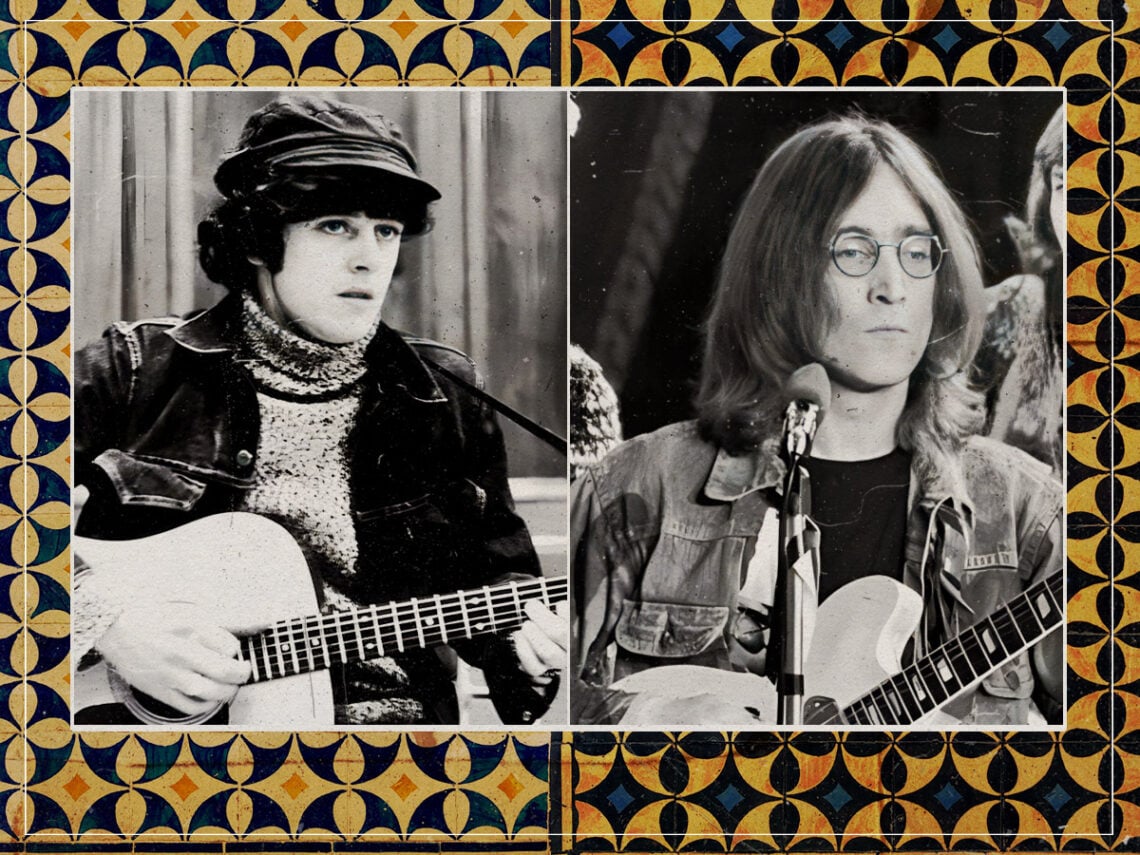
Donovan picks his favourite song by John Lennon: “It was very touching”

When Donovan broke out as Britain’s answer to Bob Dylan with his debut release, ‘Catch the Wind’, he was only 18 years old. Following up swiftly and stylishly with ‘Colours’ and ‘Universal Soldier’, he gained overseas attention and stirred the first rumours of rivalry between himself and his US counterpart. Even though Dylan acquainted Donovan on his 1965 tour of the UK, the press had its fill of feud fabrication.
During this period, several publications accused Donovan of copying Dylan’s style, but such comparisons were rooted in the fact that Dylan introduced many people to acoustic folk for the first time. If you have only heard one folk-pop artist, upon hearing the next, you will pick up on the comparisons.
“We were not captured by his influence,” Donovan said, reacting to claims that he had copied Dylan during a 2001 interview with the BBC. “We were encouraged to mimic him, and remember every British band from the Stones to the Beatles were copying note for note, lick for lick, all the American pop and blues artists – this is the way young artists learn.” Indeed, The Beatles, too, were accused of copying Dylan, even by the man himself.
Continuing in his defence, Donovan explained that consciousness of the musical vanguard is a vital part of musical evolution. “There’s no shame in mimicking a hero or two – it flexes the creative muscles and tones the quality of our composition and technique,” he said. “It was not only Dylan who influenced us – for me, he was a spearhead into protest, and we all had a go at his style. I sounded like him for five minutes – others made a career of his sound. Like troubadours, Bob and I can write about any facet of the human condition. To be compared was natural, but I am not a copyist.”
As the 1960s progressed, Donovan expanded his musical horizons, becoming particularly enamoured with the psychedelic movement. The October 1968 album The Hurdy Gurdy Man was among Donovan’s most famous psychedelic era releases, driven by droning instrumentals inspired by the Eastern meditation rituals and their associative musical accompaniment.
The Eastern influence on Western music during the ‘60s is usually accredited to the Beatles’ embrace of Indian spirituality and their famous visit in 1968. When the Fab Four visited Rishikesh, India, to study Transcendental Meditation under Maharishi Mahesh Yogi, they were accompanied by Donovan, The Beach Boys’ Mike Love and sisters Mia and Prudence Farrow, the latter of whom inspired The Beatles’ classic White Album song ‘Dear Prudence’.
Speaking to Uncut in 2014, Donovan discussed the John Lennon composition as a personal favourite from The Beatles’ vast catalogue. “It has a particular connection to me because John wrote it while we were in India – the four Beatles, Mike Love, Paul Horn, the jazz flautist and friends. We went in February 1968 to study Transcendental Meditation with Maharishi Mahesh Yogi, which was a life change for us all.”
Donovan, an accomplished fingerstyle guitarist by this point, helped Lennon compose an early draft for ‘Dear Prudence’. “As I was acoustic all my life, I was playing guitar constantly, and John looked at me and said, ‘How do you do that guitar pickin’?’ So I taught John,” he remembered. “It’s called the clawhammer. It was invented by Ma Carter in the Carter Family in the 1920s. She adapted a banjo style to guitar, and it changed folk music forever.”
As for the lyrics, Lennon noticed that Prudence Farrow had been absent for a long time. “She had come to the ashram, as we all had, with various problems, and Maharishi kept her locked away in meditation for days on end,” Donovan recalled. Meanwhile, Lennon thought, “Where is Prudence?” which led to the idea of lyrics centred on the literal meaning of “prudence”.
“With the guitar style and John’s caring attitude to Prudence, it was very touching,” Donovan reflected.
Listen to The Beatles’ ‘Dear Prudence’ below.
