


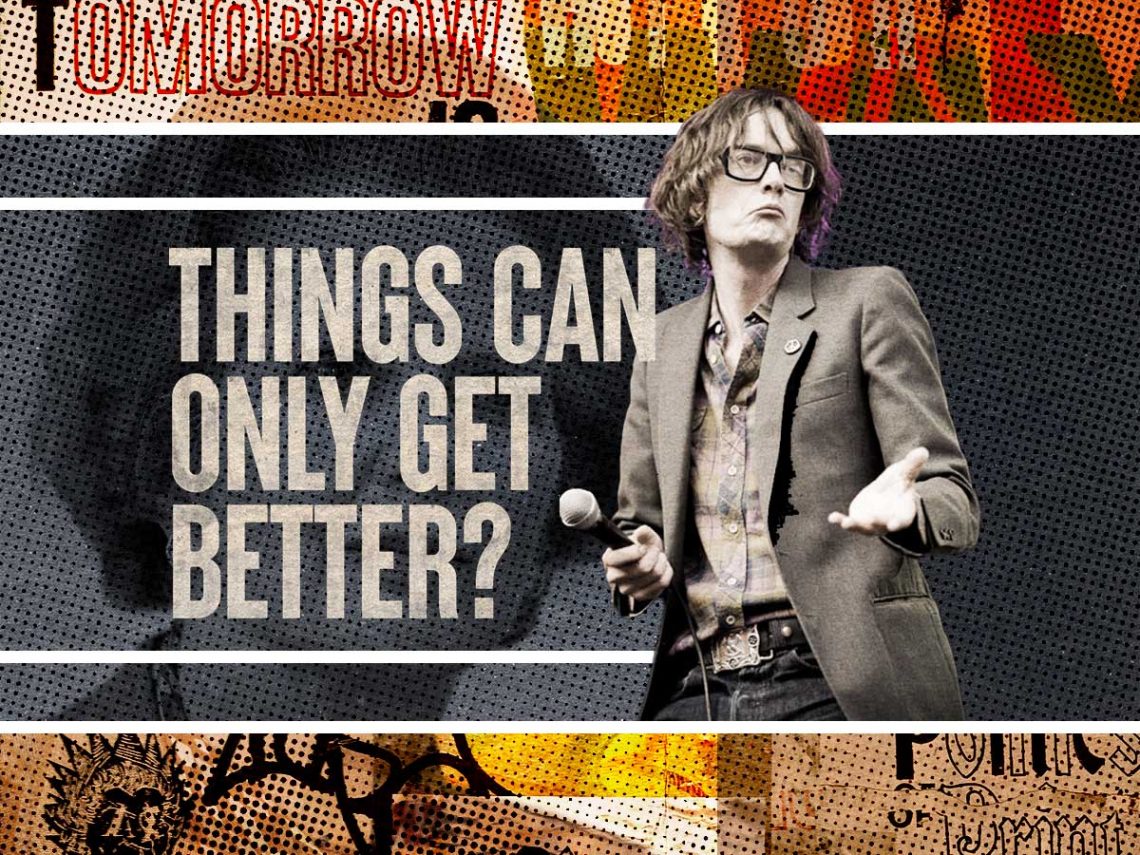
Things can only get better: Does optimism breed the best music?

We live in an age where hope and optimism are hard to come by. We’ve been here before, of course. Though the 1980s has benefitted from a rebrand in the last few years, mass unemployment and a generalised sense of cultural decline made it a pretty grim time to be young. The music was distinctly bleak, too, even if it tried to convince you otherwise. Pantera, Status Quo, White Snake, Bananarama. Honestly, it’s enough to make you wonder if hard times and crap music have always walked hand in hand.
Consider, by way of contrast, the 1960s. Though the decade was undoubtedly tumultuous, there was a sense that young people were participating in a moment of becoming. After two world wars and a decade of post-war austerity, things could only get better. Love was the only way to achieve a new world. It’s worth bearing in mind, however, that alongside songs like ‘All You Need Is Love’, ‘You Really Got Me’ and ‘Good Vibrations’, the 1960s provided us with the melancholy tones of Leonard Cohen and The Kinks’ ‘Dead End Street,’ in which Ray Davies captures the hopelessness of the British working classes with the refrain: “People are dying on dead end street/ Gonna die on dead end street.”
The mood of the 1970s stood in stark contrast to that of the jubilant ’60s. The decade is generally remembered as the UK’s gloomiest period, a little dark age nestled between the swinging ’60s and Thatcher’s divisive 1980s. Recession, political extremism and class conflict made many feel that the UK was going through a period of vulnerability akin to that of the Second World War. To top it all off, youth culture was pretty much non-existent. The artists who had once claimed to stand in opposition to everything the suits held dear were now an essential part of the establishment.
Vitality had given way to sludgy self-indulgence, revolutionary zeal to contentedness. Punk was a reaction to this inertia. The innovators of the genre found a way of transforming the disillusionment coursing through the country into something regenerative and celebratory. The Sex Pistols found little cause for optimism, and yet when Johnny Rotten sang the words “no future” during ‘God Save The Queen’, he did so with one eye on tomorrow. For Lydon, anger was an energy, and it was far more constructive than hope.
Perhaps, then, it is not optimism that breeds great music but defiance. In the 1980s, the whole anarchy in the UK thing became much harder to pull off. The political battles that had dominated the previous decade had been fought and won. Thatcher’s project of deregulation and privatisation instilled a new kind of consumer capitalism, and people suddenly had a bit of money to spare. Strangely, rather than instilling a hopeful vitality, this new wealth helped forge a truly dismal pop culture, where the biggest stars splashed shed-loads of cash on studio time and fancy music videos, and those on the lower rungs grew increasingly embittered.
During an interview with Select in 1993, Pulp frontman Jarvis Cocker declared that he “resented the 1980s”. The soon-to-be Britpopper talked of feeling “cheated” by the decade, as though it had somehow stolen his youth. Cocker could remember watching TV in the late ’60s and seeing the stars of the day truly enjoying themselves. He must have felt that his objective in the 1990s was to bring that joy back to UK music.
Many of his contemporaries shared this sentiment, with the likes of Suede, Blur and Oasis doing away with the maudlin aesthetics of grunge and celebrating what Cocker dubbed the “romantic in the every day”. The 1990s is, of course, remembered as a period of enormous optimism, and it certainly produced brilliant music. But let’s not forget that that same optimism generated a huge amount of crap. As in the ’80s, there was a sense that the battles had been fought and won. Things, as Blair so famously put it, could only get better.

Never Miss A Beat
The Far Out Beatles Newsletter
All the latest stories about The Beatles from the independent voice of culture.
Straight to your inbox.