


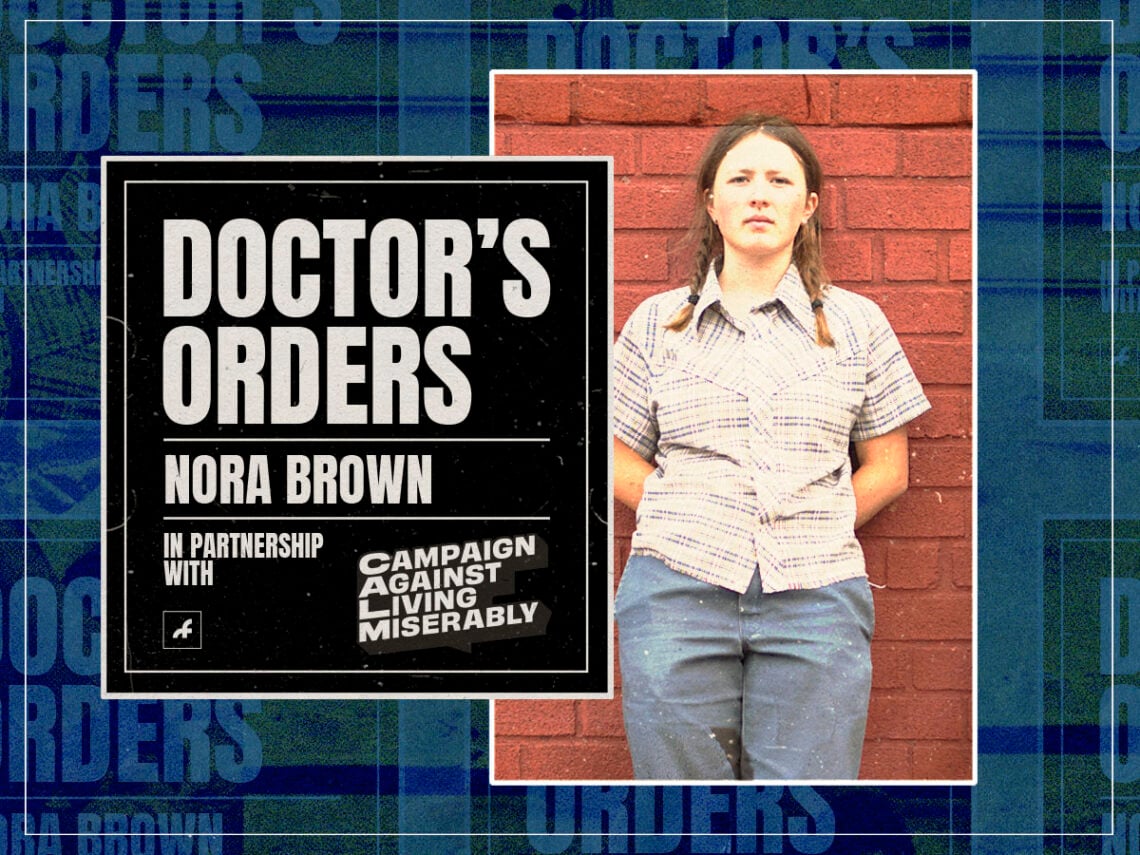
Doctor’s Orders: Folk prodigy Nora Brown prescribes her nine favourite albums

The term “prodigy” seems to have found its purest epitome in Nora Brown. A perfect storm of predisposition and chance encounter set this virtuosic multi-instrumentalist on the path to success from a tender age. With a family history steeped in folk music, Brown’s parents nurtured an early passion for music by introducing her to the legendary folk musician Shlomo Pestcoe.
At the age of six, Brown began visiting Pestcoe in his small apartment in Brooklyn, initially for ukulele lessons. Despite a vast age gap, Pestcoe treated Brown like any other mentee, instilling the maturity and wisdom that walk hand in hand with the folk tradition. Brown excelled during these early lessons, soon honing talent far beyond her years.
Brown describes Pestcoe as more of a musicologist than a musician. “He was a historian of old-time and traditional music, maybe more than he actually played it … he was pretty invested in history,” Brown told me during our recent conversation. Pestcoe’s holistic approach to education engendered unwavering respect for traditional American folk music, a crucial platform from which to build a dignified career.
Surrounded by all manner of instruments at Pestcoe’s emporium, Brown’s eyes landed most favourably upon the banjo; within months, she could imitate some of her mentor’s old-time records. In due course, the familial folk community genially welcomed the young prodigy, with legendary musicians like John Cohen, Alice Gerrard, George Gibson, Lee Sexton, and Art Rosenbaum devoting their time to shape her burgeoning talent in private jams.
Brown has only recently celebrated her 18th birthday, but her solo catalogue already boasts three studio albums, released on Brooklyn’s own Jalopy Records label. Having caused a stir in the Billboard Bluegrass Charts with each of these releases, Brown enjoys a career rich in collaboration, including that with acclaimed fiddler Stephanie Coleman.
Despite their 20-year age gap, Brown and Coleman bear unmatched chemistry as budding folk fanatics, encouraging one other to broaden stylistic approaches and record collections alike. They first met in 2017, when Brown was just 11, and released The Lady of the Lake, their debut EP as a duo, in the summer of 2023.
As this remarkable double-act prepares to cross the Atlantic to tour the UK and Europe this spring, we catch up with Nora Brown to discuss nine of her all-time favourite records.
Nora Brown prescribes her nine favourite albums:
Andy Irvine and Paul Brady – Andy Irvine/Paul Brady (1976)
“I love this record,” Brown said, selecting this Irish folk classic. Following the initial disbandment of Planxty in 1975, Andy Irvine and Paul Brady formed a duo. For their inaugural record, the pair teamed up with Dónal Lunny and Kevin Burke for a session at Wales’ Rockfield Studios, during which Lunny took on production duties.
“I found out about [Andy Irvine/Paul Brady] through my friend and bandmate Stephanie Coleman,” Brown noted. The album is considered a classic feat of folk ingenuity, flowing seamlessly through a broad convergence of instruments, including the hurdy-gurdy, bouzouki, mandolin, mandola, tin whistle, cittern and harmonium. Burke’s fiddle can also be heard in five of the songs, supposedly the principal lure for Coleman.
Foghorn Stringband – Devil in the Seat (2015)
This selection pays homage to one of the finest old-time string bands on America’s West Coast. Like Brown, the band adheres fastidiously to carefully nurtured tradition. In its distinctive approach to the old-time style, Portland’s Foghorn Stringband brings a jagged, often danceable energy to the fore, evoking cordial Irish taverns.
“I met these guys at this festival called Old Town that’s just upstate New York,” Brown revealed. “They’re from the West Coast mostly, but a really great string band and I made good friends with all the people in the band, especially the fiddle player, Sammy Lind.”
Gillian Welch – Time (The Revelator) (2001)
“This one was always playing in my household growing up, but I got really into it at one point and started learning lots of songs from that record,” Brown remembered. Gillian Welch brings our list into the 21st century with this 2001 album, often regarded as the Nashville singer-songwriter’s finest album to date.
Welch performs predominantly with an acoustic guitar and, like Brown, upholds Appalachian traditions while venturing into bluegrass and country realms. Coinciding with Brown’s mid-teens digression to learn the six-string guitar, Time (The Revelator) marks another important educational milestone.
Lankum – False Lankum (2023)
Hailing from Dublin, Lankum champions a niche in the contemporary folk scene. Faithful to tradition, the band enriches its sound with uilleann pipes, concertinas, tin whistles, fiddles, violas, banjos and organs but remains refreshingly present with characterising drone effects and punk infusion. The band’s fourth studio album, False Lankum, was a breakout of sorts, introducing Lankum to a wider audience and earning a Mercury Prize nomination.
“I’m really inspired by how they approach traditional stuff and how they interpret tunes with the drone work they do,” Brown said, identifying the band’s nuances. “It’s so, so amazing how they build songs. It’s really cool arrangement-wise, but I also really like how they let everything ring. I think there’s probably some electronic stuff in there, too, and really great singing!”
Matt Molloy – Matt Molloy (1976)
Returning to the realm of traditional Irish music, Brown picked out the eponymous debut album of the celebrated flautist Matt Molloy. Throughout the 1970s, Molloy gained attention beyond the County Roscommon limits as a member of The Bothy Band. He later joined the reformed Planxty in 1978 alongside Dónal Lunny, Andy Irvine, Liam O’Flynn and Christy Moore.
“I got really into Irish Trad music after being introduced through Steph, but also, there’s this great place called the Irish Art Centre in New York City,” she told me. At the centre, Brown rubbed shoulders with the Limerick-born musician Mick Moloney, who introduced her to fellow Irish artists like Molloy. “Last year, Mick actually passed suddenly, and we had a memorial celebration for him at the centre. There was a week of preparation, and there were all these musicians from all over the world,” Brown mused, warmly remembering the community spirit so commonly associated with the folk genre.
Roscoe Holcomb – The High Lonesome Sound (1998)
“One that meant a lot to me when I was starting out making music was The High Lonesome Sound by Roscoe Holcomb,” Brown said, selecting her sixth record. Although the compilation arrived in 1998, the legendary Holcomb had passed away some 17 years prior. This collection of highlights sought to immortalise Holcomb’s legacy, and had it only reached Brown, it would have accomplished handsomely.
Brown inherited her vinyl copy from Shlomo Pestcoe, the famous Brooklyn banjoist she was lucky enough to understudy from the age of six until his death in 2015. “I inherited a lot of Shlomo’s records after he passed,” she recalled. “It was a massive collection with lots of old banjo music. I started listening to those, and that was kind of the first time I had some more agency over what I wanted to learn. I was really inspired by that record, especially the songs’ Trouble in Mind’ and ‘Little Birdie’.”
Ry Cooder – Into the Purple Valley (1972)
Perhaps the most widely known of Brown’s selections, Into the Purple Valley is the second solo record of Ry Cooder’s solo oeuvre. Throughout the 1970s, Cooder brought his passion for traditional country and folk music to the masses with an eye for sultry slide guitar riffs and choppy rock ‘n’ roll licks.
While Cooder welcomed more refined, pop-orientated tones in the late 1970s and ’80s, Into the Purple Valley was a highlight from his earlier, more traditional chapter. The album holds a special place in Brown’s growing vinyl collection, and is certainly no stranger to the stylus. “I listen to it a lot, and it always makes me feel good,” Brown smiled.
Various Artists – High Atmosphere: Ballads and Banjo Tunes from Virginia and North Carolina (1975)
“This is another banjo record, a compilation of a bunch of different artists put together by the great John Cohen,” Brown said of her penultimate record. High Atmosphere, released in 1975, is a consummate celebration of Appalachian folk music. Collated by musician and musicologist John Cohen in 1965, it features contributions from Lloyd Chandler, George Landers, Wade Ward, Fred Cockerham and more.
Brown became acquainted with Cohen several years before his death in 2019. “I started hanging out with him when I was like 12 or 13, and even though he was in his late ’80s, he was very fascinated by the things he had collected in the past.” As the pair listened to old records like High Atmosphere, they would try to emulate the recordings by ear, a skill crucial to Brown’s ongoing development.
Virgil Anderson – On The Tennessee Line (1980)
“Virgil quickly became my favourite banjo player ever,” Brown asserted, making her final selection. Anderson is another legend of traditional American folk music. Born in Kentucky in 1902, he lived through a transformative period for Western music but stayed true to his roots, inspiring banjo artists for generations to come. “I obsessively listen to that record, and it’s still one of my favourites,” she added.
On The Tennessee Line is predominantly a banjo album, but also hears Anderson playing his acoustic guitar in places. “He plays in a crazy fingerstyle picking technique,” Brown said of Anderson’s nuanced approach. “It’s interwoven sort of up-picking with two fingers, but not like bluegrass rolls. He was heavily influenced by a lot of blues musicians in his community when he was growing up. So he saw the way you play chords in blues guitar playing, and he kind of applied that same structure to the banjo.”
