


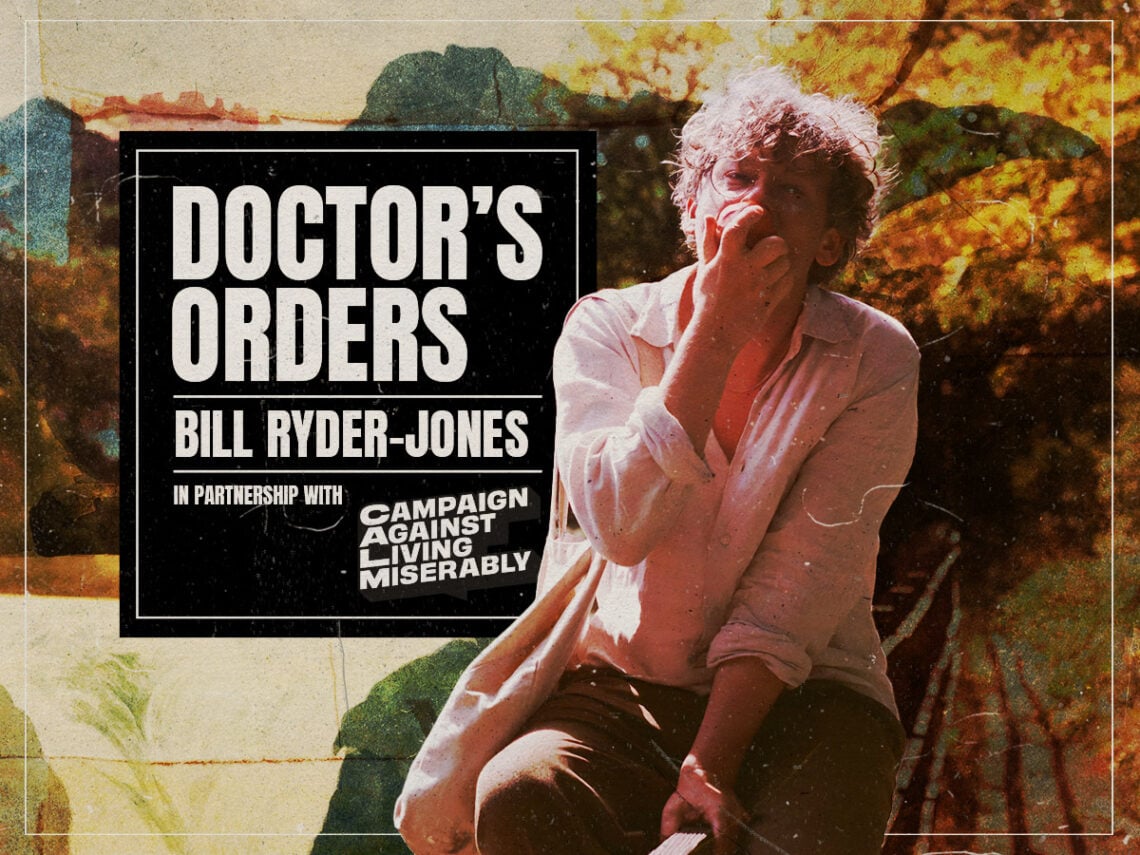
Doctor’s Orders: Bill Ryder-Jones prescribes his nine favourite albums

The healing power of music can never be understated. Of course, it’s not quite as actualised in this capacity as antibiotics, but like the perfect cuppa, the crispest pint, or Gone Fishing with Whitehouse and Mortimer, it can alleviate woes and elevate the status of the soul with only a few swift gilded notes. When I spoke to Bill Ryder-Jones recently, he needed the affirmation of music more than most—his beloved Everton had just been docked an unprecedented ten points moments before our Zoom commenced.
But he was upbeat, in part because he felt assured that Sean Dyche’s disk-bearded guidance would see his team safe, but also surely because he was buoyed by bagging perhaps the finest work of his career to date with the new album, lechyd Da. Fittingly, it is a record that speaks to the virtue of music’s ability to improve things. Ryder-Jones is confident in capturing this; nobody hires a choir of school children without being so. As a result, he’s crafted something that soars with all the glory of parting the curtains on a sober Saturday morning to a salvo of bright sun.
Thankfully, having recently produced the likes of Saint Saviour and Michael Head, he’s constantly reminded of the beauty of great music in motion. In this regard, upholding the creative spark of others has made lighter work of keeping his own aflame, as he jokes regarding his producer duties at his own Yawn studios in West Kirby: “It’s a ready supply of ideas, isn’t it? I mean, that someone brings them to you and pays you as well. It’s kind of a dream.”
However, quick quips aside, the album actually feels like the work most true to himself—it’s the culmination of all his output to date. The earnest songwriting is galvanised by the grand majesty of orchestration from If… “I think it was the scope of If… really that I was thinking about—the ambition. I wanted the songs to be largely just me doing what I do. But I didn’t want it to sound safe. In my opinion, Yawn is quite a safe record. And I think West Kirby can be quite a safe record.”
And on a more practical note, he adds: “It’s also the last record on my deal with Domino. So, you know, you never know if you’re gonna get offered a new one. And I don’t know if I’ll do another one for a while. So, I consciously wanted to pick the best parts of myself and somehow try and squeeze them together. And I think I’ve gotten away with it.”

Those best parts tesselate with a stirring beauty to create a work that bears the weight of experiential truth like a tonne of feathers. Because the album isn’t just the culmination of his solo work, it seems to touch upon the grief of losing his brother at the tender age of nine, his battles with agoraphobia, pleasant summers of the past in Cambridge gardens and a reconciliation of what the future holds, with Wales serving as a spiritual touchstone throughout.
He mused over all of this “over the last four years”, beginning his writing in lockdown before waiting for another “little shit sandwich and then digest that shit that out and then all of a sudden, you’ve got a few more ideas and that happened three or four times?” Throughout that pitted journey, the music of others remained a constant companion, which is why we asked him about the music that has healed him over the years.
So, in our ‘Doctor’s Orders’ feature in partnership with the mental health charity CALM, we take a trip back through the records that satiate Bill’s soul and inspired him over the years. From Nick Drake to Super Furry Animals, these are the nine albums that Bill Ryder-Jones loves more than most.
If you’re able, and if you can afford to, please consider a small donation to help the CALM cause. £8 can answer one potentially life-saving call.
Bill Ryder-Jones’ nine favourite albums:
Out Spaced (1998) – Super Furry Animals
“I guess the first one that springs to mind would be Out Spaced, Super Furry Animals. It’s B-sides and rarities, sort of a compilation. And it was one of the first records that I really, really loved. All my mates were into Super Furries, and everyone knew that record, but no one really loved it. It felt like it was mine,” Bill begins. It’s a personal corroboration we can all appreciate. Sometimes, there are records you don’t even want to recommend to others because they just seem so personal, and for Ryder-Jones, that endeared him even further to this ‘90s oddity.
“For some reason, made absolute sense to me in a period when all I was listening to was sort of DMX and Lee Perry,” he continues. “Somehow, that slotted in.” Now, it takes him back to that period in an instant. He says he moved out of his parents’ house quite young, but Spaced Out zaps him back to his “little bedroom. Sitting in, smoking. Waiting until my parents went to bed and having a spliff out the window at five past 12. I always knew it was five past 12 because The Phil Silvers Show was on at five past 12 every weekday night. I used to have a joint, watch that, and listen to the record, and Out Spaced was a big one.”
Speaking about how it shaped him, he adds: “That band in them in themselves were like an identity band. I think with us being from the Wirral, we were playing in Liverpool a lot, and you’re not quite a Scouser, so we were a bit uncool. Then to look over that way and see the Super Furries are there, and Gorky’s are there, it’s like, ‘Oh no, maybe we’re just a bit mad, maybe we’re just a bit like them’.”
Concluding: “But it’s hard to pin down why it meant so much to me. Musically, massively. I think they are particularly important for The Coral as well. They didn’t seem to have any rules whatsoever. So, with this record being B-sides and oddities, they’re typically your most out-there sort of ideas. So, I mean, it’s quite out there, but beautiful, beautiful songs.”
Dark Side of the Moon (1973) – Pink Floyd
Some records wax and wane perennially, somehow woven into the fabric of your life like a trinket you can’t seem to get rid of. For Bill, this classic is a rather massive trinket. “I don’t want to be boring, but I’ve got to tell the truth,” he qualifies before selecting the Pink Floyd classic. It has stayed with him “for a couple of reasons at different times in life,” he said, adding: “It’s one of them records that has sort of enveloped me in different times. Like my dad, when we used to go on holiday to Scotland, he’d put his music on his music, which was very much Floyd and a lot of prog. So, I’ve got very, very lovely young memories of driving around with this”.
He continues: “We used to go to the Isle of Mull, which is quite a journey in an old Volvo. But I remember driving through that scenery listening to ‘Us and Them’, and it was really powerful stuff. Then, when I got ill and moved down to Cambridge, I was living with my then-girlfriend’s parents, and my dad came down to visit for a week. He drove down, and one of the things that we bonded over was listening to that a lot in his car. So, there’s quite a nice little full-circle thing going on there”.
More generally, like the mighty Aphrodite’s Child single ‘The Four Horsemen’ before it, Ryder-Jones reckons this is a record simply made for car stereos. “There’s some records that are just really good in cars, aren’t there? You can kind of be ‘in’ the record in a car, and I like that. It’s one of the only fucking things I do like about cars.”
Barafundle (1997) – Gorky’s Zygotic Mynci
“It probably had the most effect on me that any record ever has… ever,” Ryder-Jones begins in bold fashion about another Welsh band. “It was everything I wanted from a record. I’ve never heard anything like it. But it was so familiar. It all makes so much sense. The musical choices, not just in the songwriting but the instrumentation, little extra things, the fun things that you do in the studio. It’s just a joyous, joyous record.”
Recalling how it came into his life, Ryder-Jones figures one of his former Coral bandmates handed him the CD when he was 16 and fatefully uttered, ‘Here, you’ll like this Bill’. Since then, he’s listened to it for “many, many hours”.
He adds: “I used to cycle down the beach at West Kirby; there was a little cove where I’d go and smoke me weed with a little portable CD player. With my little speakers, there was a little bush, and you’d climb underneath this bush, and you’d be in this little secluded bit where nobody could see you and that record was an absolute must. I had it in my bag constantly for about three years just in case I needed to listen to it.”
Super Ape (1976) – The Upsetters
“Again, in my mid-teens, my obsession with pot and all things pot-related, of course, led me to The Upsetters. And that record is a masterpiece of sonically. How did he do it with the equipment they have? It’s just fascinating. You know, it’s like real marvel how they could produce that music, and it sounds so good: it breathes, it swirls.” And once again, he had a friend in The Coral, Nick Power, for lending him the vinyl.
It had a big influence on the band, too. “It was huge. We listened to that a load when we were making the first Coral record,” he adds, admitting that they might have lifted a motif for the middle eight of ‘Calendars and Clocks’. “Big record. I love the artwork. It looks like the album sounds and I just always found it quite funny. It’s just like, ‘What are we calling it? Super Ape. It’s just a big fucking massive ape.”
And he continues to marvel at the work of Lee Perry to this day. In fact, he may even have inspired him to venture down the production route. “I certainly got my first four-track cassette recorder solely with the intention of sort of making dub music at home. I had loads of fun. It was great trying to work out how all those things were done, cutting them in and out and doing the filters. It was great fun.”
Magical Mystery Tour (1967) – The Beatles
After explaining that Pet Sounds has been scrubbed from his selection because its joy goes without saying, Ryder-Jones segues onto The Beatles. “Magical Mystery Tour is a good album forgotten about because of the awful film,” he says, quickly clarifying, “And I’m including ‘Strawberry Fields’ and ‘Penny Lane’ on that as well because I think when I first got it they were sort of tacked on at the end.”
He adds: “I don’t feel like enough gets said about how full of information those Beatles songs are. There’s so much going on. And it isn’t like, ‘let’s just lash a load of shit on it’. You can tell it’s done with taste. And it’s a very hard thing to do. You can hear the difference between them and the Stones when the Stones tried to go psychedelic, and it’s like, ‘Fucking shut up, you are useless’. You know what I mean? It’s like, give up on that you’re crap. But with the Beatles, it wasn’t just, ‘OK we’re doing psychedelia now’.”
Concluding: “I mean, some of this is really quite mad, but the record has also got some absolutely beautiful songs on it. And I think productions are so, so weird, in a great way. Greatest band of all time. Amazing drummer. Certainly, my favourite drummer. It’s just such a shame that it’s called Magical Mystery Tour. Someone should have said, ‘Don’t try to be cool, Paul, that’s not your bag’.”
The W (2000) – Wu-Tang Clan
Bill begins: “Even though this is nowhere near as good as 36 Chambers, it was just the one for me. I was obsessed with ‘I Can’t Go To Sleep’ and ‘Hallow Bones’, so for a long time, I didn’t listen to 36 Chambers because of it, which was, admittedly, a mistake. But at the time, hip-hop was everywhere, and I’d kind of gotten bored of the whole whores and bitches and guns and rims thing—it had gotten to a point that wasn’t of any interest. Then The W came along, and it was a real eye-opener again.”
“The songs are about inequality and the death of a lot black civil rights activists, and it’s the first time you hear these lads – these rough lads from Staten Island – crying on the record,” he continues. “That’s incredibly powerful. And it hit me around the same time as a lot of these others. In fact, a lot of these records came to me around the same time. They live in my head together. I could easily see myself at 16/17 putting on Out Spaced, Super Ape, The Beatles, then Wu-Tang Clan. They all feel like my bedroom. But I guess that’s where my identity was born.”
Before concluding: “And these are still really my favourite records, too.”
Five Leaves Left (1969) – Nick Drake
“When I left [The Coral] the first time, I moved to Cambridge. I just didn’t want to be in West Kirby, I didn’t want to be near my parents, and I didn’t want to be in music. So, I ended up sort of semi-adopted by my then-fiancés family. They were just such a lovely, lovely family who had this nice house, and – no offence to my family – they didn’t eat their dinner in front of the tele. They read books and played board games,” Ryder-Jones fondly recalls.
Continuing: “It was a very different world, and I loved it. I absolutely loved it. And that record, obviously because I was in Cambridge, became the soundtrack. I remember learning to play those songs in their garden in the summer, with butterflies and mum’s lemonade, and I’m sat there thinking, ‘What is this?! What is this life?!’”
It then returned for a second chapter. “Then, when I moved to Italy, and I was writing If… the string arrangements in particular stay with me, and it always reminds me of things long forgotten. It’s just a phenomenal, phenomenal record. The musicality of it, and his writing is just… because his guitar playing is so impressive and his voice is so lovely, it distracts from how strange his writing is. When you sit down and try to work out the chords and shifts that he’s doing, it’s not normal stuff; it’s incredible. He’s a real genius,” he explains.
Concluding his eulogy of the Earl Grey Jeff Buckley, he states: “I also think with Nick Drake that unlike John Lennon, where you get the impression that had he lived he would’ve made some absolute stinkers in the ‘80s, I don’t think Drake would’ve. But who knows? Even David Bowie went to jungle, I mean bloody hell, nobody is safe.”
Up The Bracket (2002) – The Libertines
“It was very rare for me to like a record at the moment it came out. In fact, we actively avoided that in The Coral. We actively tried to dislike The Strokes for a while. But with The Libertines, we were on a flight to Japan, and James said, ‘Oh, I’ve got that Libertines record; you’ll like it,’ and he passed it to me, so I listened to it on our first trip to Japan,” Ryder-Jones continues.
“The reason he had it was because they were over there at the same time, and someone had said that they were fans and they’d like to meet us. Instantly, egos are massaged, and they’re no longer scruffy cockney gimps, you know, ‘actually these are alright’. And then I remember just being like, this is pretty strong stuff,” he says.
Concluding: “And what was weird is that all my mates back home would go to those Meet Me in the Bathroom club night, with all those New York bands coming over to England and playing gigs. But I was away touring, and I remember being quite jealous. I loved the Yeah Yeah Yeahs and these lads were always off seeing them. So, I was gutted because I was actually touring. But after one listen, it became that had I not been in a band, Up The Bracket would have been something I would’ve adored.”
And yet he also states: “I’m still not a fan of aggressive guitar music or anything too fast, but it was the songwriting that really moved me.”
Two Sunsets (2009) – Pastels / Tenniscoats
“I love the idea that two groups can come together and make a record,” Ryder-Jones explains. “I love that there’s a song called ‘Tokyo Glasgow’, I love that the whole thing is such a bold concept. Sonically, it is really pretty and warm. It is just a proper lullaby of a record. And unlike the other albums, I’m not really sure how it came to me. I just know that this is one of my ex-partner’s favourites, so I would hear it quite a lot, and it reminds me of her in a really sweet way.”
Perked up by that notion, Ryder-Jones then mused that he may well listen to the record later that night. “You don’t think about these moments of your life before someone asks you,” he reflects. “I’ll be honest, beforehand, I was complaining about the concept of this interview, saying, ‘Fucking hell, they used to just ask you questions, now you’ve got to do homework’, but I’m glad really because it’s rare to actually relive these things, and they are warming.”
“Anyway, I’m gonna have a bath,” he concludes, having seemingly snubbed the dinner with his label that was once in the offing before the promise of Pastels and Radox offered something more appealing.
