


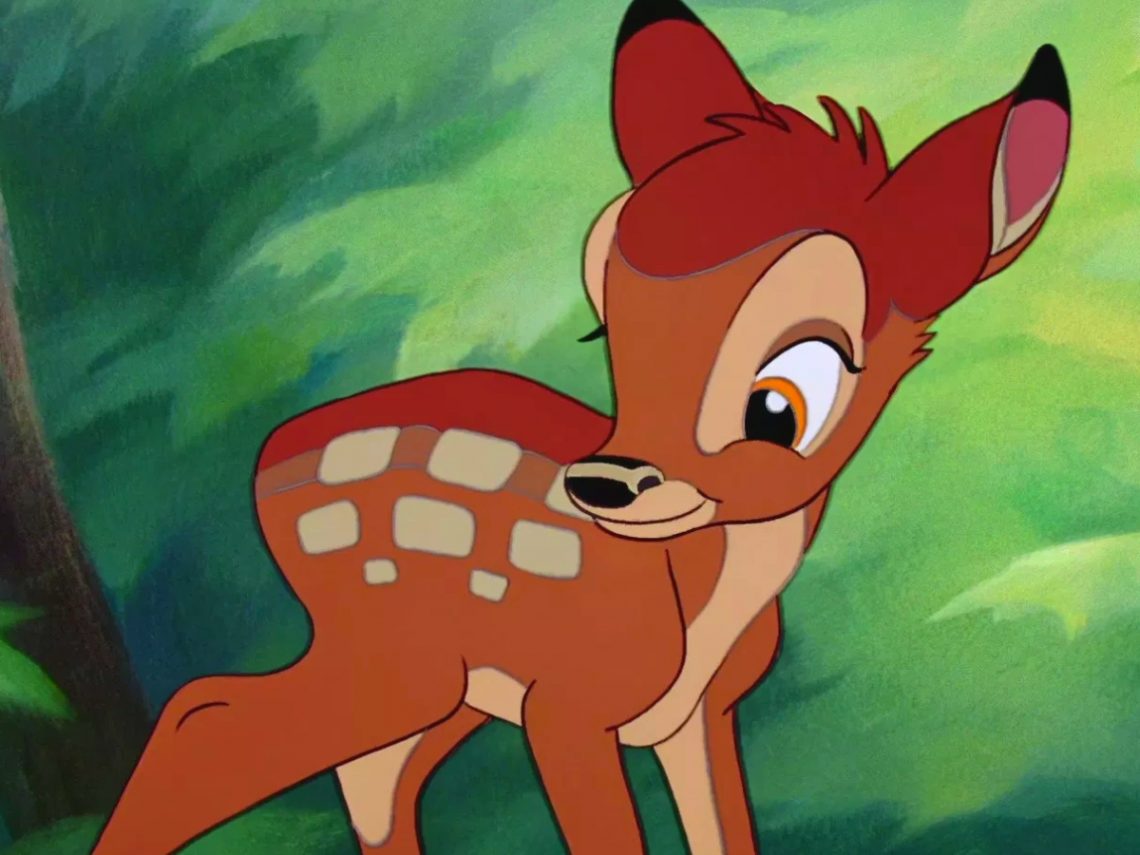
How did the Disney movie ‘Bambi’ change the world?

One of the greatest animated films of all time, Disney‘s Bambi, is so good that the AFI named it the third best-animated film in history (Snow White got the top spot). The film tells the story of a young fawn raised by his mother deer in the wilderness before tragedy strikes. It is a simple, beautiful and tear-inducing tale.
The reason for those tears is primarily owed to one of the film’s most harrowing scenes. One of the most iconic moments in Disney’s history comes when an unnamed hunter tracks, shoots and kill’s Bambi’s mother. It’s a genuinely tragic scene that often serves as the earliest confrontation with mortality for many children.
However, a profound social impact also remains within the fact that the scene is sad beyond measure. Bambi is often referred to when examining the change in views concerning hunting altogether. When the film came out in 1942, deer hunters experienced a far greater outcry against their practice over the proceeding years than they had hitherto.
Cambridge University’s David Whitley once explained that Disney’s films have the power to incite social change, given their broad appeal. He wrote, “Disney films have often been criticised as inauthentic and pandering to popular taste rather than developing the animation medium in a more thought-provoking way.”
“[But] in fact, these films have taught us variously about having a fundamental respect for nature,” he added. “Some of them, such as Bambi, inspired conservation awareness and laid the emotional groundwork for environmental activism. For decades Disney films have been providing children with potent fantasies, enabling them to explore how they relate to the natural world.”
Bambi played a significant role in changing the views of hunting that had been established for millions of years. That deep-seated need to hunt, though, had, of course, changed by the time the 20th Century rolled around. The Disney film helped to reinforce the fact that hunting is cruel and utterly unnecessary, which was, of course, much to the chagrin of its proponents.
“If you can accept their sentimentality,” Whitley added, “it becomes possible to see that these films are giving young audiences a cultural arena within which serious environmental issues can be rehearsed and explored. Popular art often does more than we think to shape our feelings and our ideas about certain themes. Disney may well be telling us more about the environment and the way we relate to it than we tend to accept.”
However, Bambi also helped to bring about the notion of ‘the Bambi effect’, which posits the incongruence between the objection of killing a “cute adorable” animal such as a deer or fawn and the lack of care about the mass slaughter of “less desirable” animals like pigs or cows.
Regardless of the consequences, through Bambi, Disney managed to rouse the public’s attention into questioning the broader practices of society. In many ways, Bambi would then inform future animations that toyed with the protection of the natural world, particularly Studio Ghibli films like Princess Mononoke. It remains a classic work of animation, and for a good reason.
