


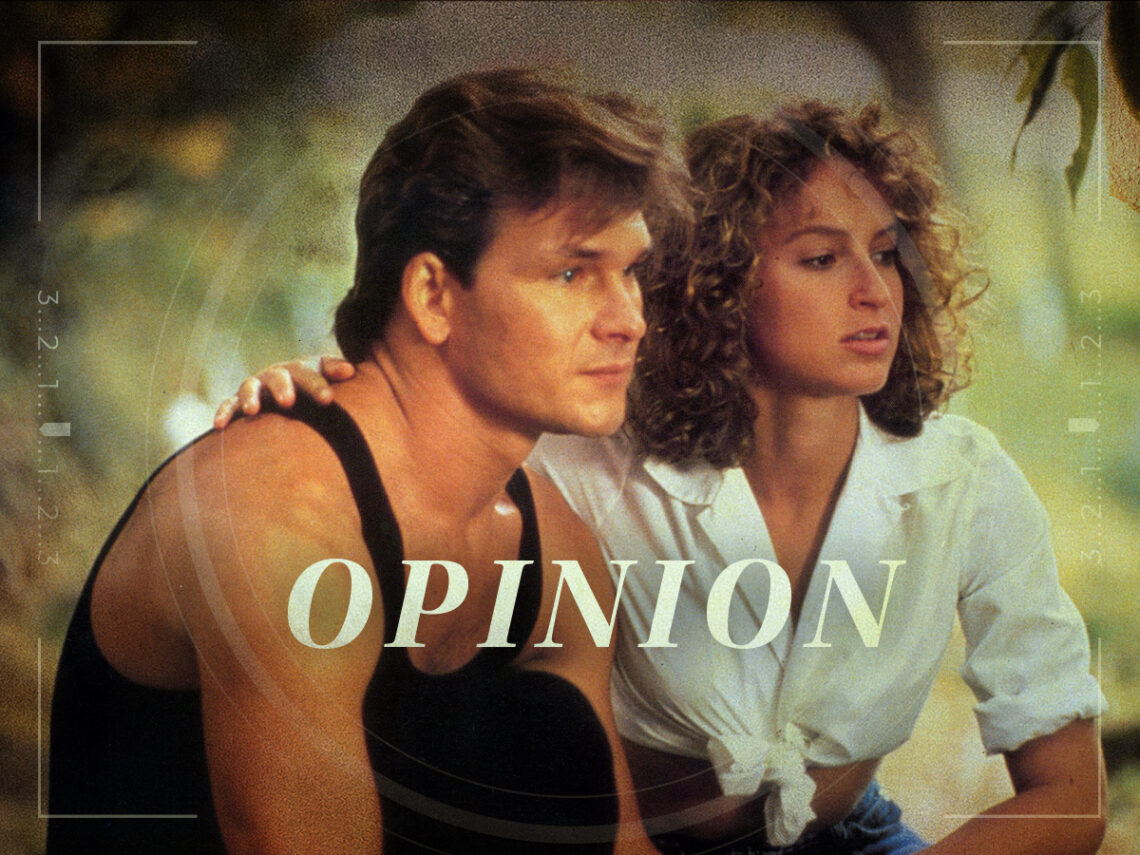
Hear Me Out: ‘Dirty Dancing’ is still the most radical rom-com

There is perhaps no genre more sorely overlooked than the ‘chick-flick’, a title given to any film revolving around women to dismiss its meaning, implying our experiences to be vapid and lacking in substance. It’s an age-old stereotype that has taken many years for Hollywood to catch up to, with the industry only recently attempting to level the playing field and give women a chance to exist outside of these reductive labels and be taken seriously as an audience.
From the groundbreaking impact of Bridesmaids in 2011, which challenged the stereotype that women can’t be funny or the cultural phenomenon induced by Rosamund’s Pike “cool girl” monologue in Gone Girl, waking up mass audiences to a new trend of fucked up female characters, there have been many films recently that have aimed to reverse the damage caused by years of belittling comments. However, while the industry has worked to mend the gender gap on screen, there was one movie that managed to do this before anyone else, despite its dismissive label of ‘chick flick’.
After years of watching people fall in love on the silver screen, we’ve come to expect a few story tropes from the rom-com genre, from kisses in the rain, a titular airport scene, a penultimate screaming match and conversation montage as the writer implies the strength of their bond while masterfully avoiding writing any dialogue. But despite being hailed as one of the definitive films of the genre, Dirty Dancing manages to avoid all of these cliches, forging an entirely new path and creating an impressively progressive story about class, privilege and gender identity.
Set during the summer of 1967, Dirty Dancing follows a young woman called Frances (‘Baby’) who visits the Catskills with her family, expecting the usual tedium that goes with a holiday in the middle of nowhere. However, after a professional dancer called Johnny catches her eye, Baby finds herself stepping into the shoes of his dance partner and unexpectedly falling in love.
In the beginning, Baby is painted as a naive rich kid who is out of touch with the real world, priding herself on her political awareness despite living in a privileged bubble that has sheltered her from the world’s harsh realities. Her parents proudly proclaim that she will save the world, while her sister Lisa, will ‘decorate’ it. However, over the course of summer, Baby is made aware of her own privilege and the injustices of the world that can’t simply be waved away, experiencing a harsh wake-up call to the pains around her that no amount of volunteering ever could.

The writer of the film, Eleanor Bergstein, cleverly uses the class divide between the guests and workers at the resort to highlight Baby’s journey of enlightenment, highlighting the disparity between her naively optimistic quest to change the world and the workers who are bitter and resentful about their exploitation and poor working conditions.
However, the class divide is particularly explored through Baby’s relationship with Johnny, a working-class dancer who initially resents Baby for her narrow worldview, dismissing her as girlish and immature. But within the rom-com genre, the haters-to-lovers arc is a tale as old as time. Baby and Johnny are soon thrown together after his dance partner Penny finds herself unexpectedly pregnant and unable to dance following a botched illegal abortion, begging Baby to take her place in an upcoming performance.
Given the time of its release, the incorporation of an abortion storyline was extremely radical—with the procedure still being illegal in much of the United States—and so was the progressive portrayal of Penny’s experiences rarely seen on screen. Penny’s decision to have an abortion is entirely her own, and after the complicated procedure, she remains happy in her decision to do so, exercising complete agency over her body and her right to choose (despite America’s resistance to the concept).
The entire plot of Dirty Dancing hinges around Penny’s abortion, with Baby and Johnny only being thrown together as a result of this. At the time, the producers were encouraged to cut this storyline from the film for fear of dividing audiences, with some of the financiers threatening to pull their funding to avoid being associated with the controversial subject matter. However, as a movie written and directed by women, they remained adamant in their decision to include the storyline, even though this meant losing one of their biggest sponsors.
After Baby and Johnny are paired together, the couple clash over Baby’s relentless optimism and Johnny’s jaded cynicism, snapping at each other as the former tries to learn Penny’s routine in time for the big performance. However, chemistry begins to blossom between them, with Baby’s growing confidence as she dances with Johnny and learns how to embrace her sexual identity—something she had previously ignored because of her blinkered commitment to her education.
During one truly gorgeous scene, Baby visits Johnny’s cabin and expresses her feelings towards him, finding a newfound sexual agency and confidence as she invites him to dance with her. It’s a beautifully soft and intimate scene, with Cry to Me by Solomon Burke playing as they embrace in a dimly lit room, with the camera remaining close and slowly panning up and down as their bodies begin to intertwine, eventually giving into each other.
There are many films that paint sex as being a life-destroying and ruining experience for women, particularly for young women who have sex for the first time. But in Dirty Dancing, sex enriches Baby’s life and allows her to discover a new aspect of her identity, becoming empowered through her newfound agency and expanding her perception of the world through her relationship.
After spending the night together, Baby and Johnny begin a secret relationship at the resort, something that remains hidden due to Johnny’s insecurities over not coming from money, knowing that Baby’s family won’t accept him and judge him for his working-class background. Baby initially believes the best in everyone and thinks that her father will be different, but she is woken up to the prejudice of her parents after they wrongly judge Johnny and believe him to be a criminal. Baby’s entire worldview comes crumbling down, waking up to the imperfections of her beloved father, realising him to be just as bigoted as all the other wealthy guests.
Baby is also made aware of the limiting gender roles that prevent Johnny from openly expressing himself, with the character only being vulnerable around Baby and maintaining a facade of unfeeling masculinity around everyone else. His character becomes an early reflection of ‘soft masculinity’, with Johnny opening up through this relationship and allowing himself to feel, crying to Baby and sharing his struggles of feeling used by the wealthy guests at the resort.
Dirty Dancing is criminally overlooked and dismissed as nothing more than a fluff piece despite the fact that the film grapples with weighty themes that add layers of nuance to an otherwise light-hearted genre. Over the course of one summer, Baby goes from being a girl to a woman, letting go of her naive worldview and confronting her own privilege. She flourishes through the transformative power of love and grows into the person she was always meant to be.
