


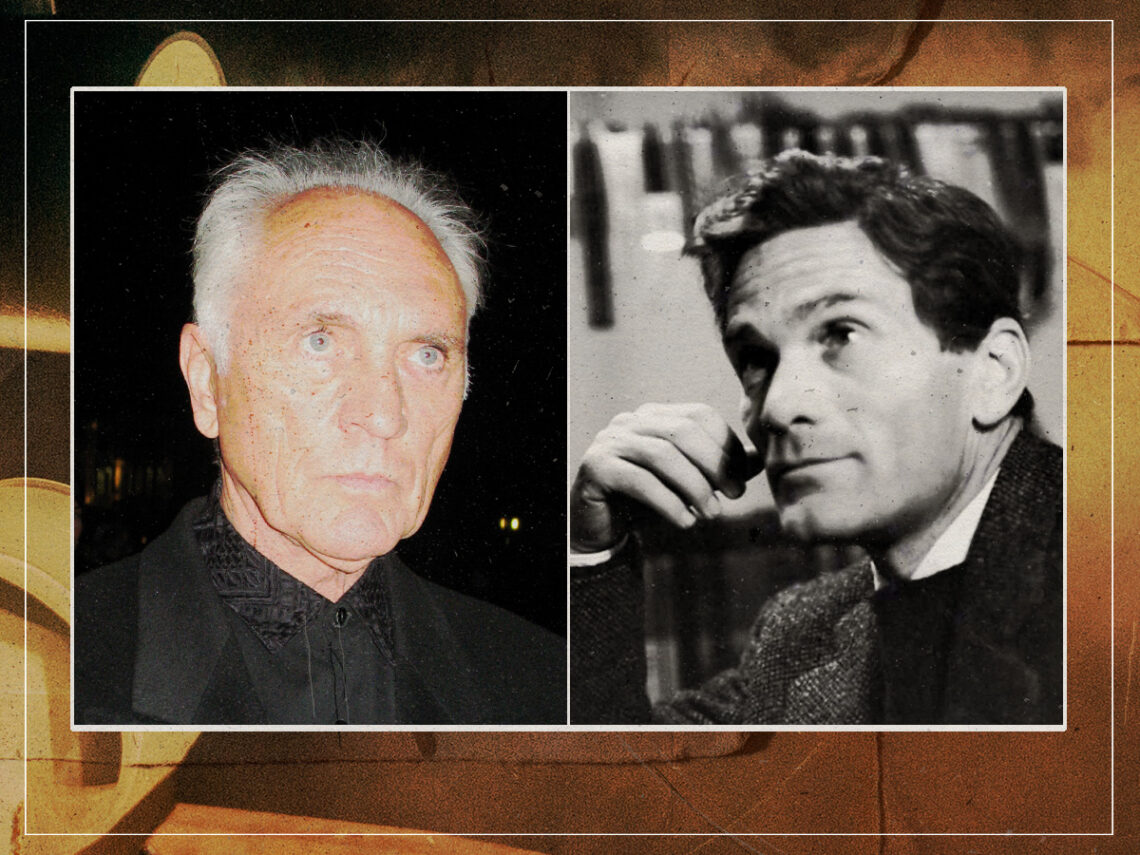
The unusual direction Terence Stamp received from Pier Paolo Pasolini

Terence Stamp has worked with some of the most influential global directors of all time, from Federico Fellini and Roberto Rossellini to George Lucas and William Wyler. Heralded as the ‘Master of Brooding Silence’, Stamp has a commanding and unnerving screen presence that demands every ounce of your attention. It comes as no surprise that these performances are a cumulative result of the many interesting directions that Stamp has received over the years, particularly from Pier Paolo Pasolini, with which it’s safe to say he had an unconventional working relationship.
Pasolini has an extremely controversial body of work, spanning from Salò, or the 120 Days of Sodom, which was famously banned in many countries for its explicit use of violence, to Accattone and Theorem. The nature in which he uses violence in his work is still discussed and debated today, which was exacerbated after his brutal murder in 1975, a case that is still unsolved and remains a mystery.
But for someone who was so confrontational with his visual storytelling, he appeared to be almost shy and reluctant to interact with his actors, which Stamp later discussed when reflecting upon their work together.
Stamp met Pasolini in an unusual way after Silvana Mangano recommended that they work together. Soon after, the director flew to London with Rossellini, where they all met for lunch at Claridge’s. Neither of the directors could speak English, and there was a translator present to help them communicate, but Stamp was loosely told about the plot of Theorem and agreed to play the leading role of The Visitor.
According to Stamp, this interaction at Claridge’s was the only interaction he ever had with the director, later saying, “If he [Pasolini] needed to direct me, he would tell Laura Antonelli; and Laura Antonelli would come up to me just before a take and say, ‘Pier Paolo wants you to get an erection for this scene!’ So that was the only kind of direction I got from him”.
Adding: “But what was unusual was that it took me a few days to work out that he was actually filming me when I wasn’t performing. It took me a while to realise that he had a little camera. He held a camera of his own, and he was just shooting me, sort of sitting around the set and stuff.”
For an artist so direct in what they were saying on-screen, it’s fascinating that he chose to communicate discreetly and carefully with people in real life, a style that couldn’t be more opposite to his adverse and somewhat aggressive storytelling approach and the political messaging that was so blatant within his work, which some say is the reason why he was killed.
It is understandable why Stamp was so disoriented by the interactions that he had with Pasolini; to work with somebody who demands so much of your screen presence but who shares so little of himself within the creative process is a strange and unique collaborative experience, to say the least. Nonetheless, the two merged together to create a long-lasting legacy and a film that still resonates with modern audiences, and perhaps the little communication shared between them is what led to such a puzzling and enigmatic piece of work that people are, funnily enough, still talking about to this day.
