


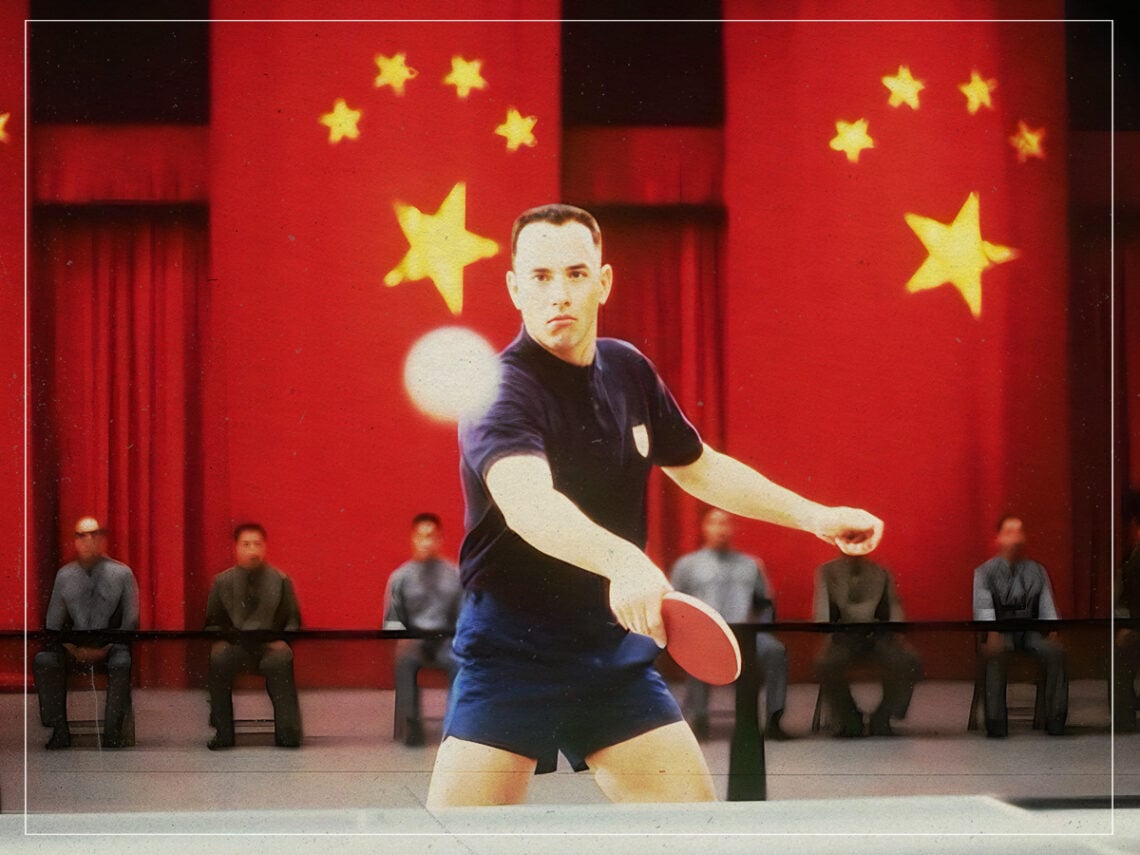
Perfect ping-pong: did Tom Hanks really master table tennis in ‘Forrest Gump’?

Most movies that incorporate cutting-edge visual effects tend to be sprawling blockbusters that use the latest technology to present audiences with something they’ve never seen before. Forrest Gump did that and then some, but it was more subtle than showstopping.
To underline that point, three of the four movies to win the Academy Award for ‘Best Visual Effects’ prior to Robert Zemeckis’ cultural phenomenon were Paul Verhoeven’s Total Recall, James Cameron’s Terminator 2: Judgment Day, and Steven Spielberg’s Jurassic Park, all of three of which were spectacle-driven crowd-pleasers.
The fourth was Zemeckis’ own Death Becomes Her, which may have been an outlier of sorts as a darkly comedic fantasy, but it still made history as the first film to digitally create the texture of human skin. Forrest Gump deserved its Oscar, but the advancements it made weren’t quite as pronounced.
It was still a trailblazer, though, with the ‘Best Picture’ winner the first major motion picture to digitally manipulate historical and stock footage to place fictional characters into the context of events that had actually transpired, not to mention the removal of Gary Sinise’s legs as Lieutenant Dan, the creation of a massive crowd at the Lincoln Memorial, or Forrest and Bubba Gump escaping a napalm attack in Vietnam.
During the title character’s military service, he becomes an unlikely celebrity in the sports world after developing a taste for table tennis. Competing against the best players in the world, Forrest makes such an impact that he ends up on The Dick Cavett Show alongside John Lennon, serving as the inspiration behind ‘Imagine’.
Hanks certainly looks convincing trading paddles with his skilled opponent, but did he really master the art of ping-pong in order to do so? Technically, no, but kind of. The actor expertly mimicked the actions required to give off the impression that he was engaging in a tense game of table tennis, but during shooting, the ball wasn’t even there.
Instead, Hanks and his opposite number struggled for different reasons. For the trained thespian, he had to perform as though he was an elite-level player to a convincing degree without having a ball to work with, while his opponent – who was genuinely an elite-level player – had to do something they were very good at without the thing that made them very good at it.
When the scene was being shot, Hanks and his opponent rehearsed their movements and knew when to swing their paddles to timed clicks that were played on set, with the ball added in post-production. The sequence was also filmed on a sparsely-populated soundstage, with the sellout crowd another CGI enhancement made after the end of principal photography.
Hanks may not have become a table tennis expert in the strictest sense, but it can’t be denied that he knew how to behave like one, even though at no point did his paddle ever connect with a ball.
