


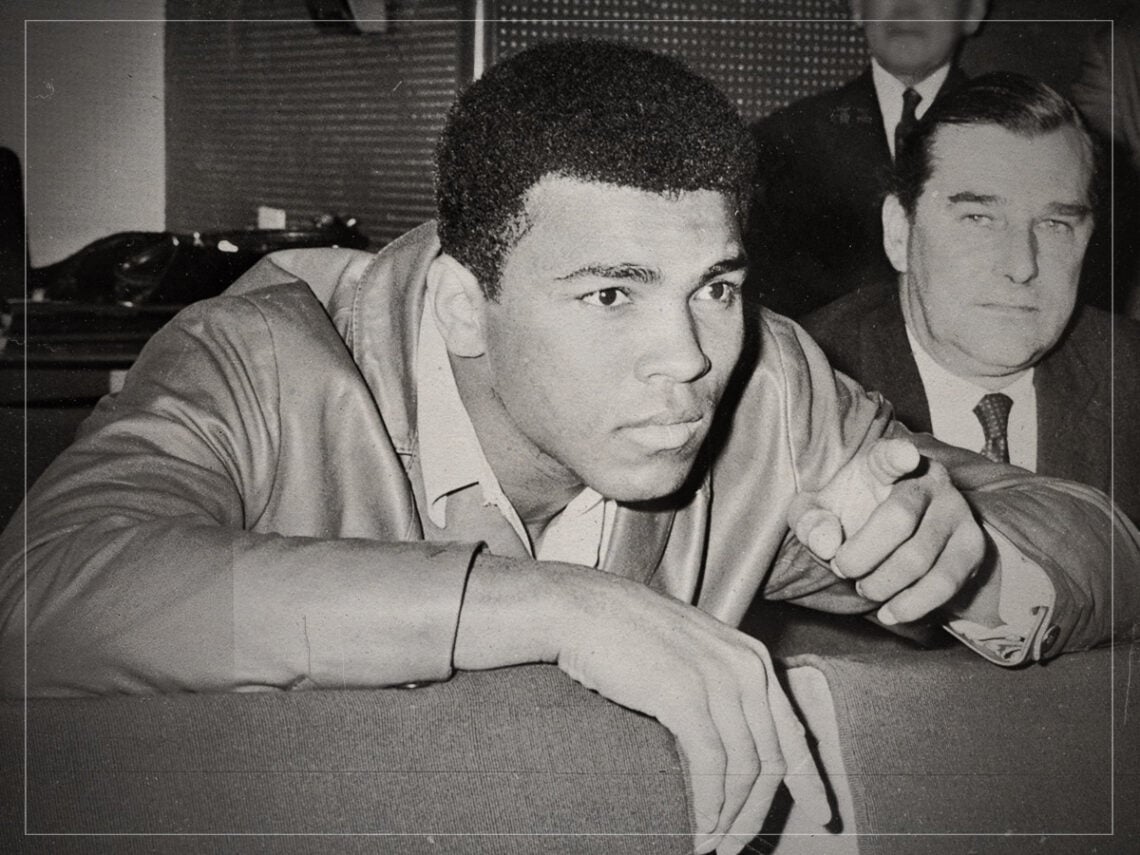
Did the heavyweight champion of the world help invent rap?

It’s now over 50 years ago that Kool Herc’s idiosyncratic DJ style birthed hip-hop. Raiding funk, soul and R&B’s rich litany of records and hit singles, his characterful technique of extending a tune’s instrumental “breakbeat” soon spread across the block parties in South Bronx and eventually a ubiquitous soundtrack among Black, Latin American, and Caribbean working-class neighbourhoods in New York City.
Alongside the emerging graffiti art and break-dancing that formed hip-hop’s essential identity, the practice of MCing became its most immediate feature. Originally fulfilling the role of ‘Master of Ceremonies’, MCing began as the art of introducing DJs and maintaining the room’s party revelry—chiefly via rhythmic wordplay, clever rhymes and lively tales of braggadocio and satirical barbs of the urban Black experience.
What became known as rapping would find life in the concurrent disco scene, entering the charts on arguably hip hop’s first single with The Sugarhill Gang’s ‘Rapper’s Delight’ and Kurtis Blow‘s ‘The Breaks’ the following year.
From Grandmaster Flash and the Furious Five’s social reportage through Zulu Nation’s electro-rap and the new school’s rise alongside the evolving innovations in sampling technology, hip-hop would dominate popular music with permanence as seismic as rock and roll had been 20 years before. Yet rap has deeper roots in Black culture long before Kool Herc’s novel DJ practice, forming just one part of the musical tradition passed down among Black communities alongside the blues, gospel, and jazz.
Before Gil Scott-Heron’s politically charged spoken-word poetry in ‘The Revolution Will Not Be Televised’ and ‘Whitey on the Moon’ plus Black nationalist collective The Last Poets’ debut album, Colombia Records had issued a comedy album from one of the world’s most famous boxers. It has loomed large in hip-hop’s legacy and is often credited as instrumental in the development of rap.
So, did the heavyweight champion of the world help invent rap?
By 1963, Muhammad Ali had already honed the fine art of trash-talking. In the run-up to his World Heavyweight Championship fight with the incumbent title holder Sonny Liston, Ali dropped the I Am the Greatest LP while still named Cassius Clay, full of withering takedowns, generous expressions of self-worth and various skits surrounding his large personality. Much of rap’s flow and defiant lyrical punch can be witnessed all over his humorous monologues—a gift that he’d only get sharper with later for The Rumble in the Jungle’s taunting of George Foreman.
While his comic charms play it relatively safe for the white audience—the political radicalism that followed his joining the Nation of Islam six months later—I Am the Greatest‘s monologue pugilism and tongue-in-cheek arrogance would shape many future rap stars before hip-hop had even been a twinkle in South Bronx’s eye. Selling 500,000 copies and nominated for 1964’s Grammy Award for ‘Best Comedy Album’ at the 6th Annual Grammy Awards, I Am the Greatest helped set rap’s template without even realising it.
“Without Muhammad Ali, there would be no ‘Mama Said Knock You Out’, and the term GOAT would have never been coined,” LL Cool J conclusively declared in 2016.
