


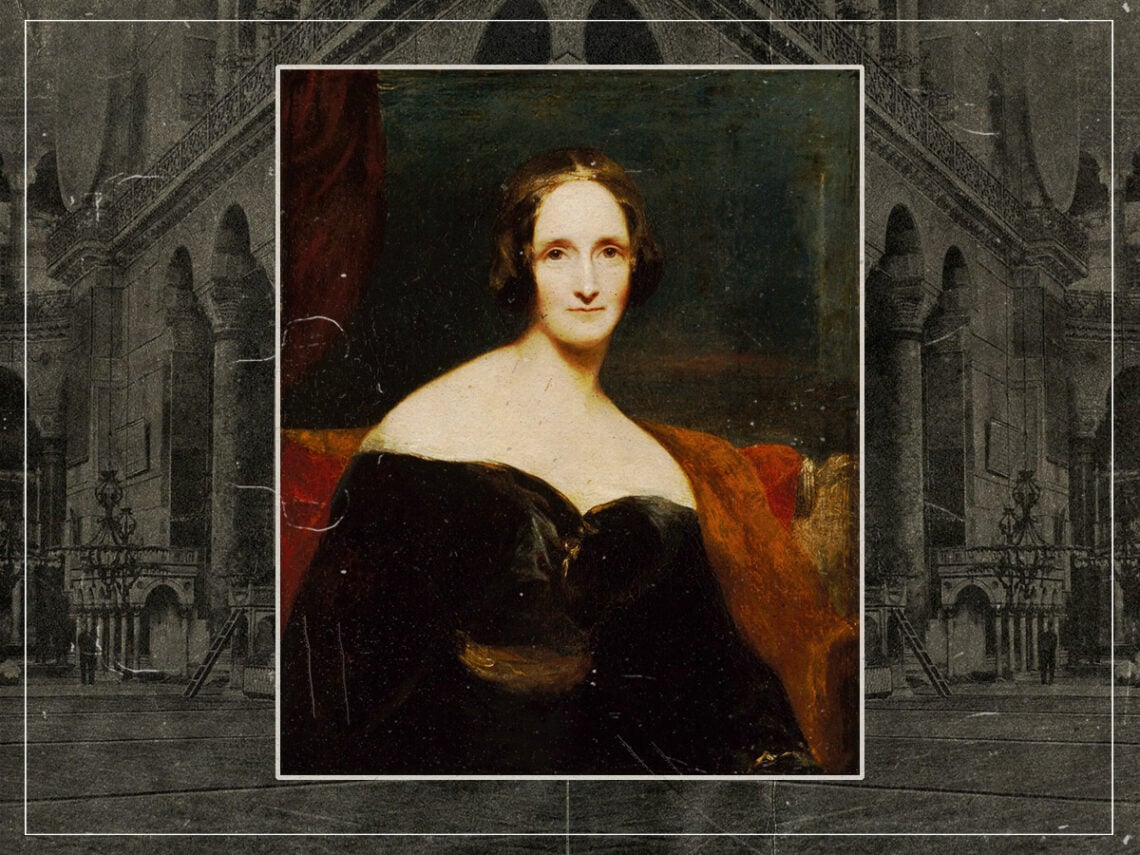
Did Mary Shelley really lose her virginity on top of her mother’s grave?

It’s one of the most famous literary bursts of inspiration in history. On a rainy night in 1816, during one of the coldest summers on record, romantic poet Lord Byron hosted a shindig of like-minded writers and dramatists at his Swiss Villa Diodati mansion in Geneva and entertaining themselves that evening, reading aloud various German ghost stories collated in the Fantasmagoriana French translation.
Struck with the capital idea of writing their own horror tales, Byron proposed each of his guests conceive of a spooky yarn over the following days. Initially bereft of ideas, an evening’s discussion on the nature of life sowed the seed in the 18-year-old Mary Shelley née Godwin of the gothic novel that birthed modern science fiction and forever defined her.
“I saw the pale student of unhallowed arts kneeling beside the thing he had put together. I saw the hideous phantasm of a man stretched out, and then, on the working of some powerful engine, show signs of life, and stir with an uneasy, half-vital motion,” Shelley wrote in the forward to the 1831 edition of Frankenstein, or, The Modern Prometheus, describing the dream which further inspired her Galvanist nightmare. “Frightful must it be; for supremely frightful would be the effect of any human endeavour to mock the stupendous mechanism of the Creator of the world.”
Initially released anonymously in 1818 and assumed to be the work of her husband, the radical poet Percy Bysshe Shelley, Frankenstein‘s cautionary tale of nature tampering and the irresponsible unleashing of the dead body composite creature in a world he never made has proved an enduring story of morbid pathos, further immortalised as one of the 20th Century’s most famous pop-cultural icons with Universal Pictures’ 1931 adaptation, albeit with its numerous creative departures from the source material.
Born in 1797 to anarchist political philosopher William Godwin and proto-feminist writer Mary Wollstonecraft, who died 11 days after giving birth due to septicemia complications, Shelly grew up in an intellectually nurturing environment of private tutors and keenly encouraged unorthodoxy to the patriarchial mores of the era. A progressive challenge to the early 19th Century’s rigid social codes was a rebellious streak Shelley absorbed from her late mother, having read repeatedly 1792’s A Vindication of the Rights of Woman essay advocating reform of female education and the right for women to earn a living.
As a young child, Shelley was frequently taken to her mother’s grave in London’s St Pancras Old Church, later moved to the family grave plot in Bournemouth’s St Peter’s Church. A site of private, meditative sanctuary, Shelley would visit the maternal graveside throughout her life, learning to spell their shared name by tracing the headstone’s engravings, bringing her many books for quiet reading time, or merely to escape her father’s new wife Mary Jane Clairmont whom she had a troubled relationship with. It was also here that the young Shelley shared numerous romantic liaisons with her lover and groom-to-be, Percy Shelley, founding the enduring and salacious legend of the first consummation of their relationship.
So, did Mary Shelly lose her virginity on her mother’s grave?
Naturally, it’s a piece of apocryphal lore we’ll never know for certain, but there’s credible historical consensus that they may well have had sex for the first time by Wollstonecraft’s grave, on top or otherwise.
While meeting briefly when the up-and-coming literary wildcard Percy had joined the Godwin’s for dinner, it was two years later, when he was 21 and she 16, that courtship first sparked. Nevermind, he was already married and father to a child, and according to Shelley’s stepmother, had behaved flirtatiously with both Shelley, her half-sister Fanny, and their stepsister Claire ‘Jane’ Clairmont.
It was the young Shelley who ultimately won his heart. Often making their excuses to take clandestine walks through the St Pancras churchyard, one secret stroll on June 26th, 1814, resulted in both their declaration of love for each other and Percy announcing he could no longer hide his “ardent passion” and triggering a “sublime and rapturous moment”, as detailed in a letter to friend and barrister Thomas Jefferson Hogg. So pleased with himself, he described the seductive moment as his “new birthday” in his own journals.
After eloping shortly after and following the devastating disintegration of her relationship with her father a result, Shelley and Percy fled the stigma of their illegitimate coupling and travelled around Europe, but by 1822, Shelley had tragically lost three children and suffered a miscarriage, and Percy had drowned in the Don Juan sailing disaster. Haunted by the loss of her mother and stung by her father’s rejecting cold shoulder, the weary traversal across Europe as nomadic outcasts no doubt inspired Frankenstein‘s isolated creature and its poignant light.
Now covered in moss and its etchings barely legible, Wollstonecraft’s weathered headstone is a popular tourist spot for fans of Frankenstein and admirers of Shelley’s turbulent and free-spirited life, drawn to the churchyard locale where grief, passion, and adventure all clashed together at once.
