


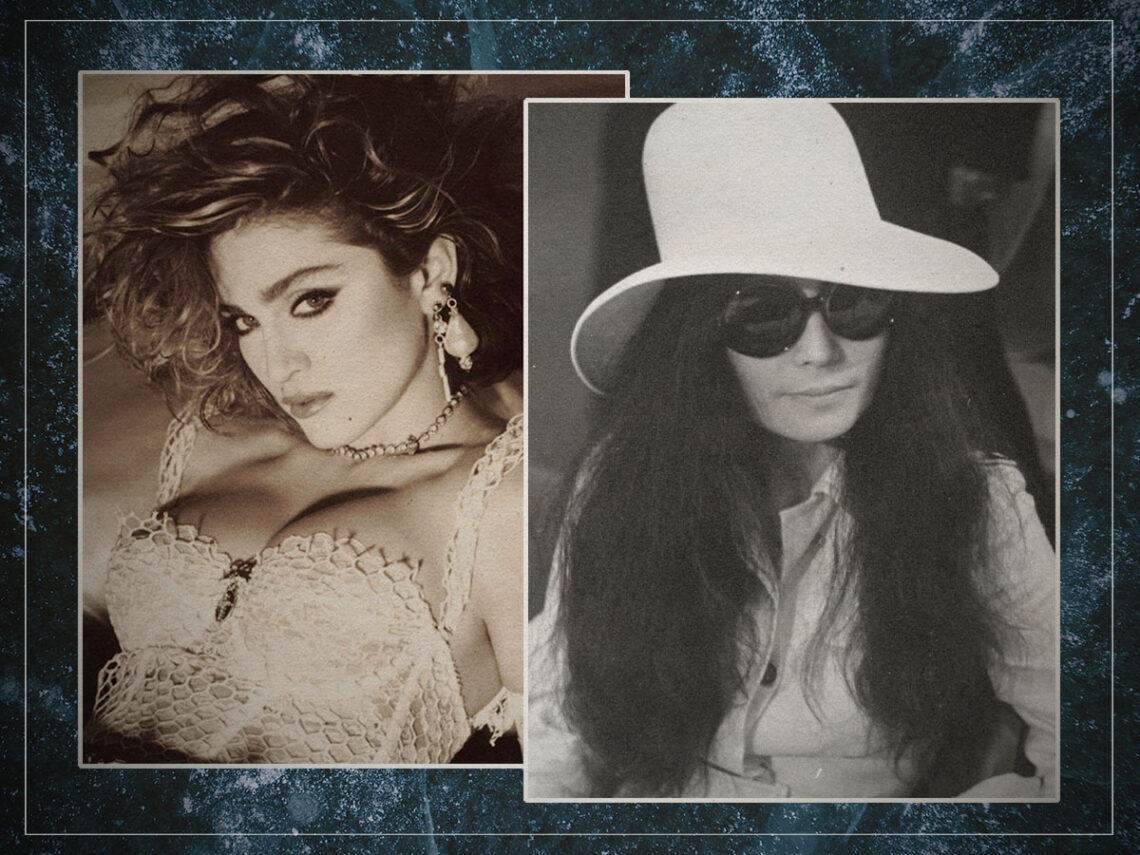
Did Madonna rip off Yoko Ono for ‘Papa Don’t Preach’?

Generally speaking, Yoko Ono gets a tough rap in the canon of cultural history. Her harshest critics are quick to label her the original WAG (wives and girlfriends) and lay most, if not all, of the blame for The Beatles’ break-up in her lap. They’re less inclined to grant her the appropriate credit she deserves as an artist in her own right.
Ono’s artistic endeavours began long before her collaborations with John Lennon and continue to extend into the ripples of modern-day culture. Be it conceptual pieces, performance art, or experimental music, she is a fearless artist who, by nature of her artistic bravery, was perennially at the heart of originality whenever creating.
In the 1970s, Ono’s primary source of creative expression was music, and by the end of the decade, she was a truly established artist in the field. In 1981, she released the track ‘Walking on Thin Ice’ to a rather tepid reception, yet it sparked a flame of influence that would go on to change music culture. But, in keeping with the continued oversight and mistreatment of her influence, it wouldn’t be to Ono’s credit.
Many have highlighted Madonna’s ‘Papa Don’t Preach’ to be a sort of rip-off of Ono’s 1981 hit. Referencing the disco-come-new-wave rhythm sections burgeoning in Ono’s home, New York, her song hung upon biting rhythm sections that would anchor the oncoming revolution of electronic music that Madonna would occupy so well.
The latter’s iconic track would come five years later and celebrate what many critics label a strikingly similar rhythm section to Ono’s track. Additionally, there are thematic parallels to be drawn from the lyrical narratives in both songs. While Madonna introduces listeners to a pregnant young woman, she ultimately tells the tale of the strength in her ability to exercise free will against societal expectations and the subsequent power of choice. While the narrative details in Ono’s tracks differ slightly, their underlying sentiment remains the same in what can generally be perceived as a feminist anthem.
As both artists sing with emotionally strained euphoric vocals, they both showcase how subtle humanitarism and existentialism can be filtered into dance-floor filler pop tracks. But for what feels like the first time in her career, many critics are keen to attribute Ono full credit for both songs, labelling Madonna’s as a mere rip-off.
While music is a widely subjective medium and has the capacity to defy artistic conventions, the reality is that it exists within theoretical boundaries, and there will forever be crossovers. As Nick Cave said, “The great beauty of contemporary music, and what gives it its edge and vitality, is its devil-may-care attitude toward appropriation—everybody is grabbing stuff from everybody else, all the time. It’s a feeding frenzy of borrowed ideas that goes toward the advancement of rock music—the great artistic experiment of our era.”
Both Yoko Ono and Madonna are innovative artists in their own right and would shudder at the idea of critics trying to bestow either of them with the sole right of penning electronic, feminist pop anthems. They would rather savour the opportunity to bask in the glory of passing the baton of innovation and celebrating music’s ability to expand similar ideas.
