


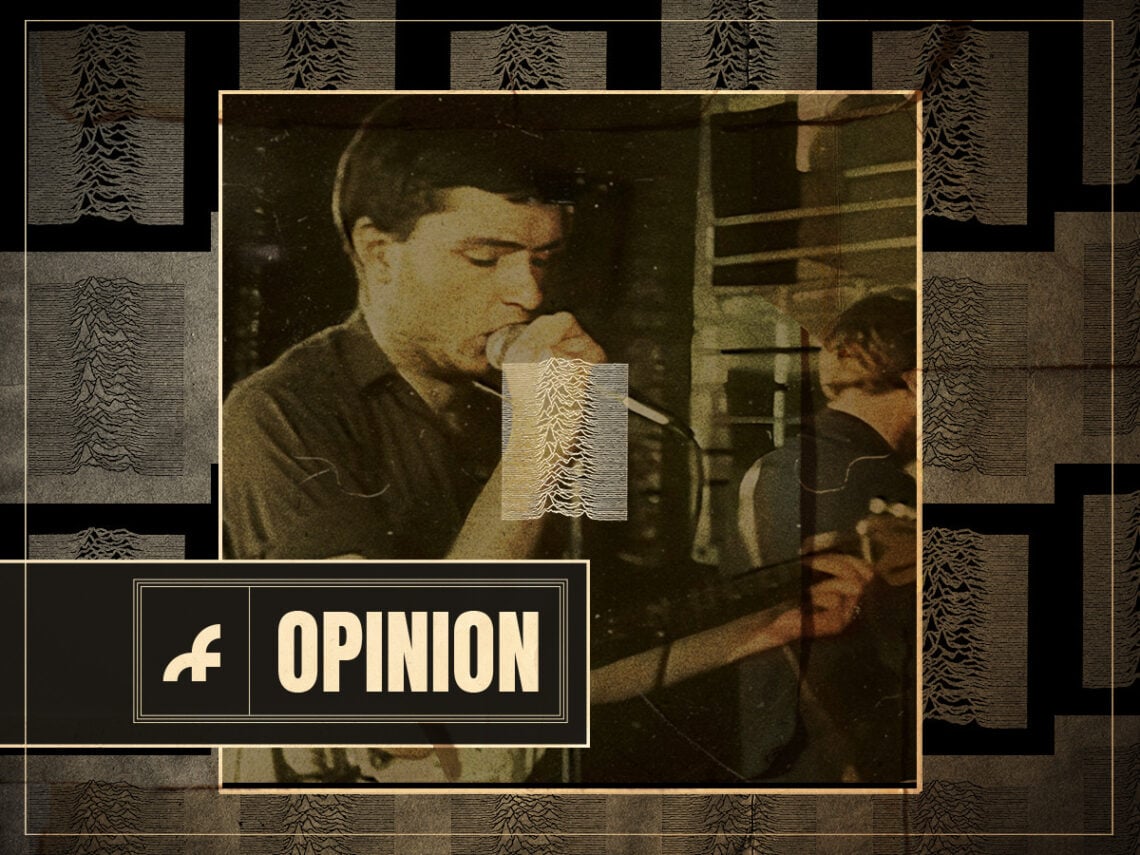
‘Unknown Pleasures’: did Joy Division capture the sound of today in 1979?

Power cuts, rubbish piling up on the street, and infrastructure ground to a halt by striking, underpaid workers. 1970s Britain was a grim place to be, with the memory of the war still very much alive in the minds of those who fought it, embodied by the physical totems of the destruction it wrought still clinging on in the crippled bombed-out buildings of our cities. The country was stuck in a bleak limbo between its past – with the glory of empire withering – and its future, as its standing in the global order changed. It wasn’t just its place in the world that was evolving, either, but the very fabric of life itself was transforming. This is something Joy Division packaged astutely into their 1979 debut, Unknown Pleasures.
In the late 1970s, the end was nigh for Britain’s traditional industries, such as metalwork and coal — industries which had powered the Empire’s expansion and the technical developments of the Industrial Revolution. While they would cling on for years after, a new global hierarchy was forming: that of neoliberal economic thought, and with the rise of Margaret Thatcher as Prime Minister in 1979 and her more brazen American counterpart Ronald Reagan the following year, the former transatlantic enemies would lead the charge into the future. Now, business was to be left unrestrained thanks to the demise of the so-called nanny state of the post-war consensus. The rich man’s world was on its way.
While producing several incredibly destructive effects, including avarice and apathy among working folk, coinciding with the emergence of unrestrained neoliberal economics was the dawn of the technological age. Technological advancements such as computers and electronic instruments were fast becoming all the rage, and by the end of the next decade, they would have impressed themselves on life even further, contorting it. The ubiquity of technology and economics today would still be years off, but developments moved at a rapid rate, just like the new commodities that were being constructed faster than ever on the conveyor belt.
The most sagacious of the era’s musicians could see that life was moving on from the smoggy industrial era deep into the belly of quinary stupor, where man would eventually end up chained by his own constructions, physical innovations and the economic world order—two realities that have sadly come to pass.
Industrial Records, the label of Throbbing Gristle, the band who led the transgressive and era-signalling industrial sound, explained that their new genre, industrial, was intended to mirror the essence of this new age. Their sound, which fused traditional rock instrumentation like the guitar with the latest electronic developments, underpinned the industrial movement, with them choosing the word “industrial” to clearly represent the mass-production of commodities, from music itself to mobile phones, that was on the way, as they believed earlier sonic forms had been “agricultural” apropos to the economic environment of the past. In short, this was the sound of the future. Industrial music embodied the mechanised landscape.
Joy Division followed suit, crafting a glacial, almost inhuman post-punk sound that evoked the harrowing beauty of the wind-swept moors surrounding their Manchester base and, more importantly, the cold, mechanical stupor of the technological age. While Unknown Pleasures is undoubtedly one of the most robust and vital debut albums of all time, it often gets forgotten just how perceptive of a record it is in that the sound of today, in all its TikTok, Instagram and streaming-obsessed torpor, was signalled. They knew, just like T.S. Eliiot before them, that we were becoming the ghastly ‘Hollow Men’.
“She expressed herself in many different ways until she lost control again,” a classic Ian Curtis line from ‘She’s Lost Control’. It might well point to the way people of today pour every ounce of their being onto social media, an unmistakenly hollow platform, to make themselves feel better in the short term while also feeling pressured to by seeing what other people post, exacerbating this feeling of emotional emptiness. In reality none of it matters or has a bearing on their being. It’s all superficial, and this is why it is so maddening, aggravating the mental health crisis.

Elsewhere, when Curis sings “Me, seeing me this time, hoping for something else”, during the climax of ‘New Dawn Fades’, might well be the late frontman accepting that times were changing, at first expressing positivity that they’re leaving the grim post-war era behind. However, the dream of the new and fulfilling dawn quickly faded into this technological and neoliberal nightmare, where society was losing any humanity it had.
Despite it being hellish and freezing, at least people of their era knew how to speak to each other. Instead of walking into a public place and not interacting with the environment, they opted, quite cowardly, to be consumed by their phone screens. Many people might have struggled on welfare payments back then, but they were immersed in the natural, not in the ether and the coming metaverse, where we’re trading humanity for electronic avatars, representations of our supposed best selves.
Lyrically, ‘Wilderness’ seems to point quite clearly to the spirit of the technological, post-modern era. You could argue that the title evokes the spiritual and personal inertia of today, with lyrics such as “I saw the saints with their toys” perhaps suggesting the sanctimonious nature of many, particularly on the internet, regardless of political persuasion, with the “toys” representing gadgets like phones and laptops. Interestingly, the line “I saw all knowledge destroyed” could be seen as Curtis wisely noting that people were starting to shed their individuality and genuine care for history, the arts and literature for aesthetics, appearances, and money.
Look at today’s “influencers” and how droves strive so hard to be considered one, and for what? What does it actually mean? They influence people to look and operate the same as them? It doesn’t take a lot to express that outside of Mac cosmetics and the new fast fashion brand, the majority of this set would have nothing to say on anything of real substance.
It’s not just Ian Curtis’ informed, intersectional words that qualify Unknown Pleasures as astutely capturing the essence of today. Like Throbbing Gristle before them, Joy Division pushed rock forward by instituting their own industrial sound. By fusing traditional rock instrumentation with gothic characters, electronic instruments and a minimalistic stance, their atmospheric but commanding nature was far before its time.
The sound of today, an eclectic postmodern blend of traditional forms and newfangled electronic ones, can trace much of its spiritual foundations back to Unknown Pleasures, as it challenged social mores. Unlike Throbbing Gristle’s work, it had much greater appeal due to the masterful fusion of hooks and dissonance. Jarring but all-encompassing is precisely the sound of today, whether it is Charli XCX, Radiohead, Gilla Band, or Nine Inch Nails.
