


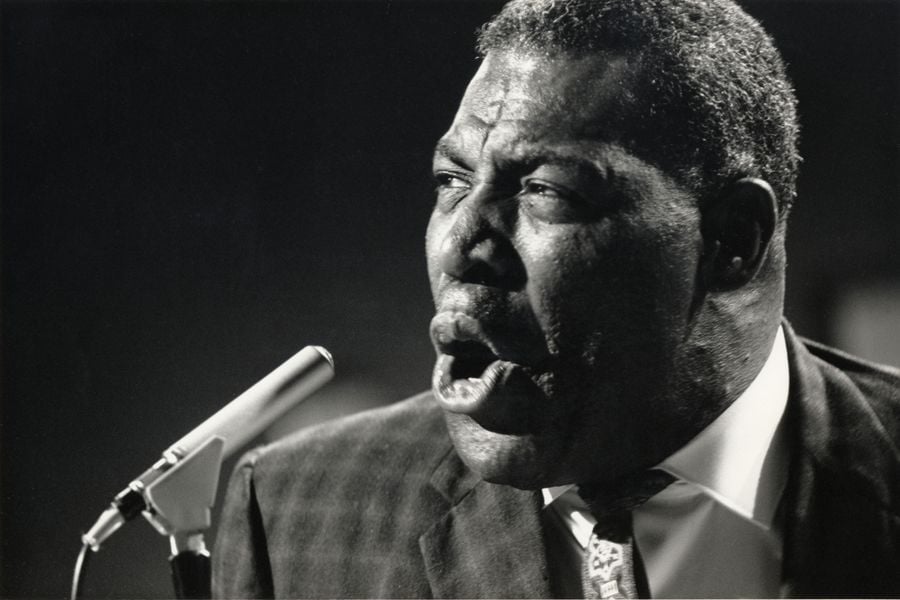
“The central guitar lick”: Did Howlin’ Wolf write the first rock ‘n’ roll song?

The question of rock ‘n’ roll‘s roots is popular music’s biggest can of worms. Defined by Elvis Presley in America’s 20th-century landscape, ‘The King’s deified domination of the 1950s’ explosive art form is a narrative that’s less robust in pop lore in the contemporary scrutiny of music’s Black pioneers who enjoy less credit than the white imitators packaged to make the subversive, racially charged rock ‘n’ roll palatable to middle-America.
Years before DJ Alan Freed had popularised the rock ‘n’ roll tag, popular music’s rebellious birth was in gestation amid the blues, country and R&B, slowly forming music’s DNA from the poverty-stricken Black townships of the Southern states. One such maverick was Mississippi’s Chester Burnett, better known as Howlin’ Wolf. Cobbling the money together for his first guitar in 1928 and learning under the tutelage of Delta legend Charley Patton, he spent the 1930s playing solo sets as well as playing with the likes of Robert Johnson and Willie Brown, as well as honing his distinctive howling vocal style.
Following a traumatic spell in the US Army—routinely beaten and berated by drill instructors due to his functioning illiteracy—an honourable discharge and a few years working his family’s newly-moved Arkansas farm led to Wolf corraling a new band for his working-class blues act. Recruiting guitarists Willie Johnson and Matt Murphy, Junior Parker on harmonica, drummer Willie Steele, and a pianist known as ‘Destruction’, Wolf began broadcasting live performances via West Memphis’ KWEM radio station.
Catching the attention of 19-year-old Ike Turner while working as a talent scout, Wolf was invited to Memphis Recording Service—later to be the prestigious Sun Studio—and cut his first single for Chess Records, the 1951 double A-side ‘Moanin’ at Midnight’ / ‘How Many More Years’.
The record would be instrumental in Wolf’s trajectory, the raucous studio capture paving the way for the rock ‘n’ roll revolution that awaited. Moving to Chicago and pioneering the city’s electric blues, Wolf would endure as one of the genre’s towering figures.
“That’s when he started bringing the bass and drums up loud,” 1970s Bob Dylan guitarist T-Bone Burnett told Alternatives to Valium in 2012. “Back in those days, the bass and drums were background instruments; it was all about the horns and the piano, the melody instruments, and Sam (Phillips, the producer) brought the rhythm section right up front, and that became rock ‘n’ roll. That was a big shift…”
He added: “In some ways ‘How Many More Years’ by Wolf would be the first rock ’n’ roll song because that has the guitar lick that became the central guitar lick in rock ‘n’ roll, and that’s the first time we heard that played on a distorted guitar. It was an old big band lick, turned into something completely fresh”.
His influence would stretch beyond rock ‘n’ roll. Devouring Wolf’s records as youths, The Rolling Stones‘ cover of ‘Little Red Rooster’ would reach number one in the UK and introduce the old Delta blues maestro to a new audience when invited to play alongside the Stones for their appearance on ABC-TV’s Shindig! music show.
