


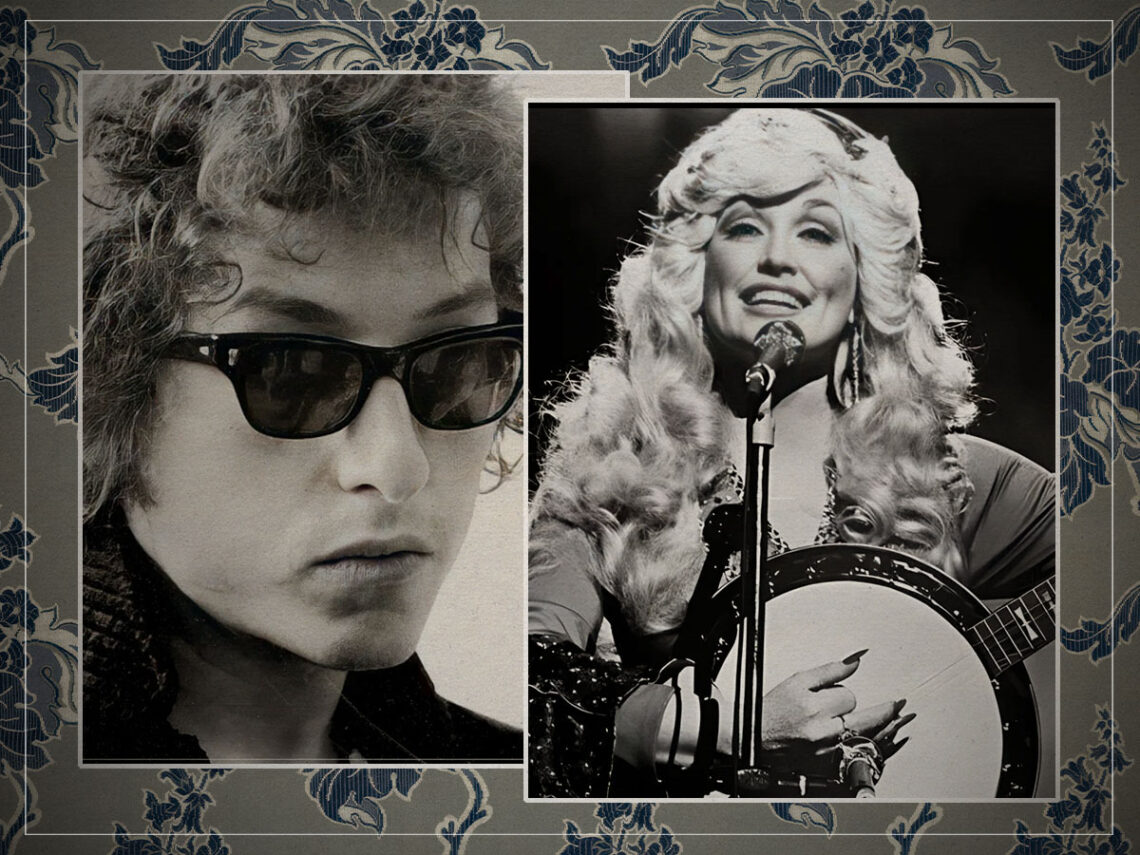
Did Bob Dylan deprive us of the greatest Dolly Parton album?

You could probably write a thesis on the butterfly effect of Bob Dylan. But, really, that’s only because he’s the only one who presented the world exactly as it was in a way that beckoned endless decoding.
As Bruce Springsteen once said, “He initially provided me with a picture of a country that I recognised. One that feels real, feels like the truth.”
But Dylan’s verbosity and poetic lyricism weren’t the only things that sparked an eternal revolution rooted in the flames of ambiguous artistic intent; it was also the satirical self-awareness that foreshadowed such a cultural upheaval, like he always knew what he was doing, always knew his words cracked the world wide open, merely a seed for directionless unraveling. As he once put it, “How does it feel, how does it feel? To be on your own, with no direction home, a complete unknown…”
Unfortunately, or fortunately, depending on how you look at it, this also preceded a reputation based on self-assurance, or some might say arrogance, or a kind of mystique that could only be decoded as egotism, emerging from an awareness of the impact he’s had on the creative industries and the gratification of knowing that everybody wants a piece of it, especially because he knows they never will.
Take A Complete Unknown – Timothée Chalamet might look the part, and the historical recollections might be based on a heady dose of internal intel and reputable documentation, but how much is to be taken at face value, when so many nuances have been picked out? What about his darker moments, the hard evidence of his wrongdoings, beyond the mere movie-esque implication of his egotistical character, diluted for a modern audience?

But all of that gets into another debate entirely, distracting from the fact that, on music alone, Dylan is nothing short of a legend. Everybody knows it, too, including the personality antithesis of his entire being, Dolly Parton. Parton also wanted a taste of the elusive troubadour while working on Those Were The Days, a record that included a cover of one of his biggest tunes, ‘Blowin’ In The Wind’. However, after reaching out to request his inclusion, Dylan declined.
“To be fair, I didn’t actually speak to him personally,” Parton clarified to the Irish Times in 2005. “I’d sent a message to him because I wanted him to say at least one line on ‘Blowin’ In The Wind’,” she continued. “I got the message back that he didn’t want to do it, so I got Nickel Creek to sing on it, so, in a way, it worked out better.”
The next thing she said probably opened up a world of speculation she hadn’t intended with such an off-hand comment: “I was going to do a whole album of his [songs], and I was going to call it Dolly Does Dylan. Now I’m having second thoughts.”
This isn’t the first time Parton has teased the idea, once revealing even a veteran as seasoned as she never managed to get a read on him. In her mind, though, it seemed like he took issue with her appearance, dismissing her presence because he just didn’t see eye-to-eye. “I don’t feel like we ever connected,” she once said, before praising his music and stating again why Dolly Does Dylan will probably never see the light of day.
“I always loved his music,” she said. “His mind is so deep, but his melodies are so good. They lend themselves so well to harmonies. I’ve even thought about making an album called Dolly Does Dylan, but I think that sounds too close to Debbie Does Dallas!”
Perhaps then it wasn’t Dylan’s dismissal that pushed Dolly Does Dylan into the ground, but it certainly seemed like the nail in the coffin.

Never Miss A Tale
The Far Out Bob Dylan Newsletter
All the latest stories about Bob Dylan from the independent voice of culture.
Straight to your inbox.