


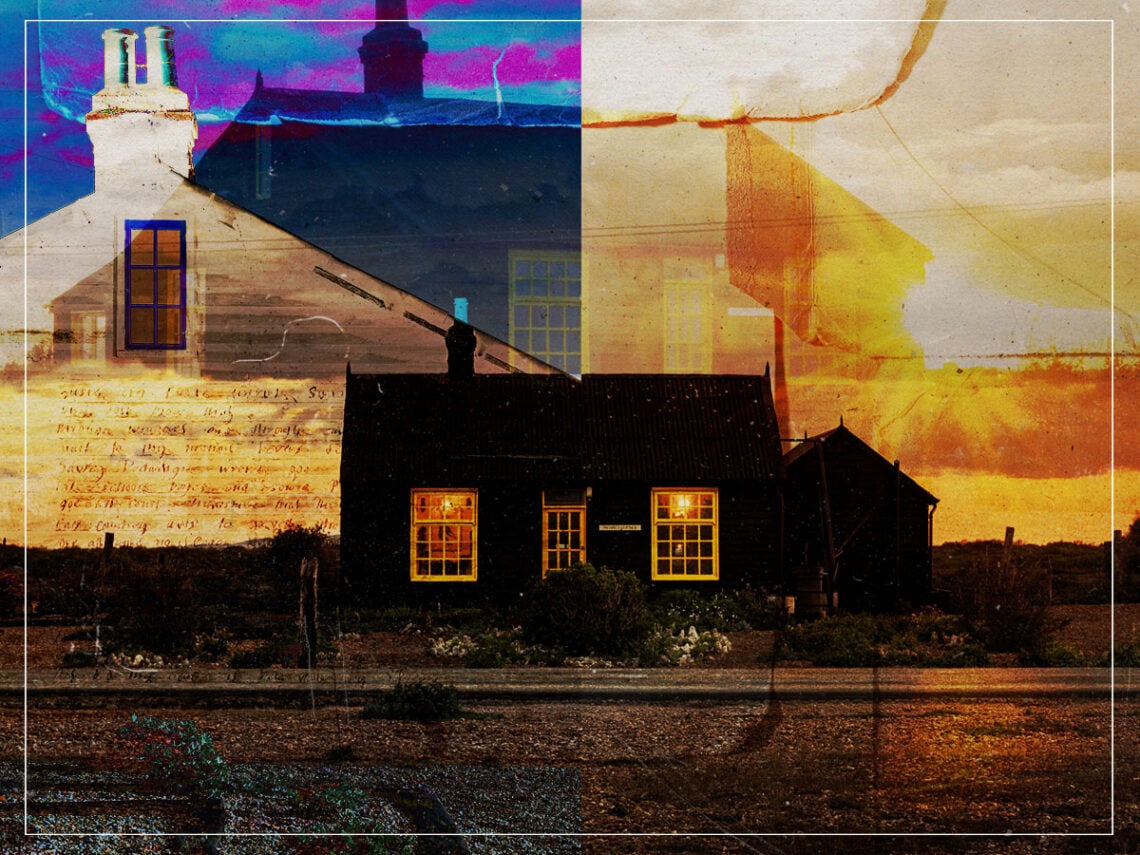
Derek Jarman: Prospect Cottage through the lens of Gilbert McCarragher

Although he has now been dead for over three decades, Derek Jarman lives on through a powerfully consistent directorial portfolio, not to mention his legacy as a queer icon and gay rights activist. Born in Middlesex, England, in 1942, Jarman began his career as a painter and set designer before transitioning to filmmaking in the early 1970s. Over the course of his career, he honed a diverse body of work that defied categorisation and challenged societal preconceptions.
Known for his short, experimental movies shot using a Super 8 camera, Jarman prided himself on developing oblique and affecting plots. Among his acclaimed contributions to cinema was a series of uncompromising exhibitions of queer identity and sexuality. His early movies, such as 1976’s Latin language movie Sebastiane and 1978’s Jubilee, helped to topple boundaries, offering a candid portrayal of homoeroticism.
Such artistic expression is commonplace today, but in the 1970s, this was brave, pioneering material. Alongside his progressive filmography, Jarman was also a prolific painter and maintained a prominent position as a gay rights activist. Whether through artistic expression or public discourse, he held political persuasion paramount, leading the charge with a solid example for marginalised peoples to follow.
Tragically, this creatively verbose beacon of hope flickered to darkness in 1994. Jarman was diagnosed as HIV-positive in 1986 amid the decade’s rife AIDS epidemic. Like Freddie Mercury, the Queen frontman and fellow queer icon, Jarman battled with the debilitating disease for several years.
“I thought, ‘This is not true.’ Then I realised the enormity. I had been pushed into yet another corner, this time for keeps,” Jarman reflected in 1989. He finally succumbed to the illness on February 19th, 1994, nearly three years after Mercury met the same fate.
In 1986, at around the time of his diagnosis, Jarman moved to Dungeness, Kent, where he lived in a quaint building known as Prospect Cottage. The cute fisherman’s cottage served as a creative haven and cathartic sanctuary during the final years of Jarman’s life. Located in a vast, rugged landscape far from neighbouring civilisation, Jarman made his home an artwork in its own right.
Although the cottage was little more than a timber shed when Jarman moved in, he gradually transformed the place through his love for gardening and interior design. The garden, known as the ‘Derek Jarman Garden’, was a stark reflection of Jarman himself: bold, colourful and tasteful, it stood distinct from the comparatively dull and lifeless surrounding landscape.
While suffering from AIDS in the late 1980s and early ’90s, Jarman logged his experiences in his pensive and detailed personal diaries, many of which were written at Prospect Cottage. Some of these poignant accounts were published in the popular book Modern Nature: Journals, 1989 – 1990, which features a painting of the now-iconic garden on the cover.
After Jarman’s death, the cottage was preserved by his partner, Keith Collins, until his passing in 2018. In 2020, Prospect Cottage was saved from private sale through a crowdfunding campaign led by Art Fund, ensuring Jarman’s flame continues to burn for many years to come.
On April 4th, the esteemed photographer Gilbert McCarragher is scheduled to publish his new book, Prospect Cottage: Derek Jarman’s House. With over 100 unseen photographs taken at the cottage, the book invites readers to acquaint themselves with Jarman’s final and most personal artwork. Prospect Cottage remains untouched as one of the most vivid self-portraits of all.
McCarragher has kindly shared a sneak preview of some of the book’s contents. See a selection of intimate photographs from Prospect Cottage below.


