


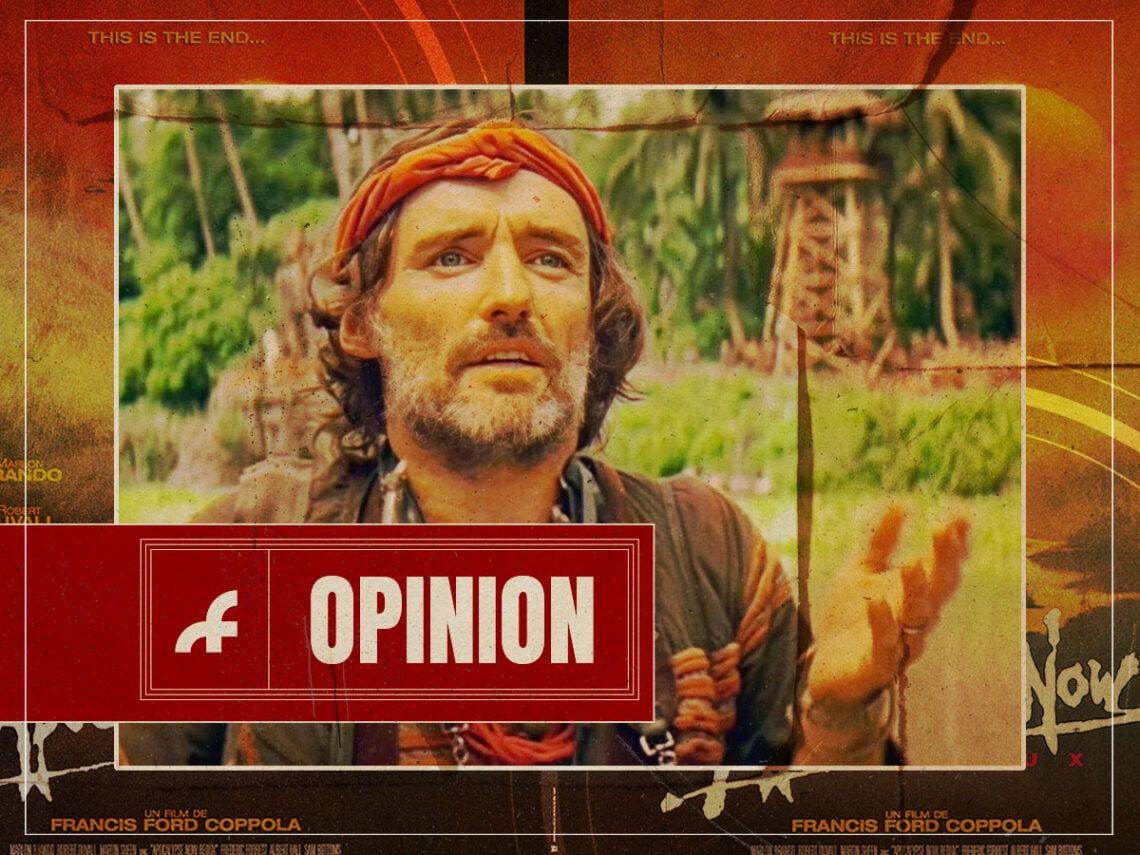
Hear Me Out: Dennis Hopper is the real star of ‘Apocalypse Now’

In 1979, Francis Ford Coppola released one of the most significant war movies of all time: Apocalypse Now. Loosely based on Joseph Conrad’s 1899 novella Heart of Darkness, Coppola’s film transports the action of the text to the conflict of the Vietnam War and details the shocking depravity of the historical event.
Martin Sheen plays Captain Willard, an experienced Vietnam soldier who is given a secret mission to assassinate Marlon Brando’s renegade Colonel, who is believed to have gone insane and is committing serial murder without the approval of the US Army.
Both Sheen and Brando gave magnetic performances, and the film, in general, is doused in quality of the highest order despite its notorious production difficulties. However, Apocalypse Now is an instance in which the supporting cast seemed to steal the show from even the excellent Sheen and Brando, with Robert Duvall winning the Academy Award for ‘Best Supporting Actor’.
Interestingly, though, Duvall wasn’t even the best actor in the legendary war film because that honour ought to have gone to Dennis Hopper, who plays an American photojournalist and disciple of Kurtz, who equally seems to have gone insane with the fervour and crazed nature of the Vietnam conflict and all its atrocities.
Even with a relatively short screen time, Hopper undoubtedly stole the show, and his depiction of a mad hippie journalist living amongst the followers of Kurtz brought the film to new artistic and performative heights. Hopper’s character is the man who meets Willard and the few men who survive the journey down the river at Kurtz’s camp. At the moment of his first arrival on screen, Hopper injects striking energy into the narrative with his maniacal form of address and crazed behaviour. There’s a hallucinatory feel to the final act of Apocalypse Now, and Hopper’s character shows the kind of god-like reverie that Kurtz commands from his followers and the sheer power he possesses.
Coppola wanted to detail the madness of the Vietnam War, and Hopper provided the perfect outlet for the narrative and thematic facet, eclipsing even Marlon Brando’s iconic turn as Kurtz. Hopper himself had been well wrapped up in the counterculture movement of the 1960s and tapped into his own experience to lend his manic photojournalist character an air of believability and authenticity. In addition, his introduction to Willard allows for yet another sense of unpredictability upon his arrival at Kurtz’s stronghold. The stoned dialogue, reminiscent of the best moments of Easy Rider, adds to the sheer chaos of Coppola’s movie, and when he tries to explain the philosophy of Kurtz and inevitably fails, he consequently details his cultish devotion.
This also allows Kurtz’s eventual arrival on screen to be one of control, juxtaposed with the frantic quality of his photojournalist follower. If it weren’t for the high energy and almost fear-inducing qualities of Hopper’s character, then Brando’s ascetic and monk-like performance might not have possessed the striking quality it eventually had.
With such a strong cast, it might have been easy for Hopper to fade into the background of Apocalypse Now, but even with such limited screen time, he served as an essential part of its overall brilliance. A truly unstable performance, Dennis Hopper’s turn as Coppola’s photojournalist ought to be praised as one of the best pieces of the masterpiece war film.
