


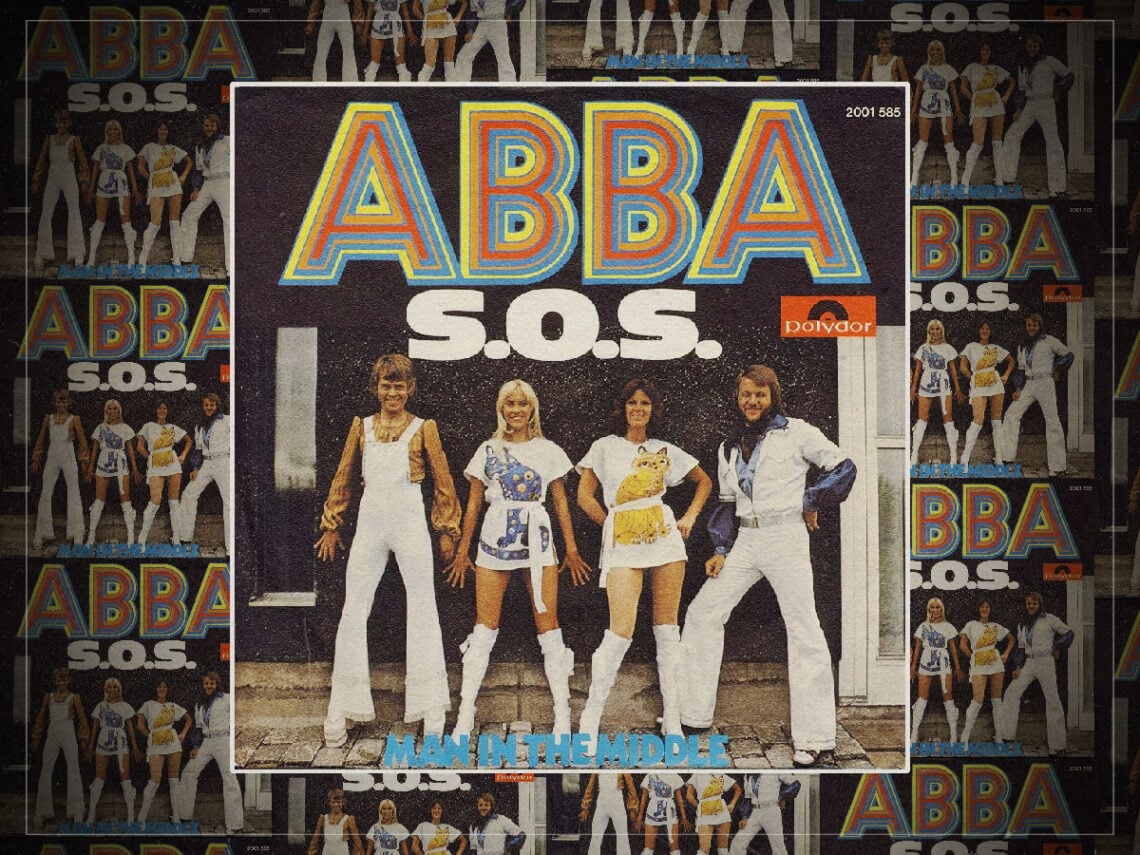
‘SOS’: Deconstructing ABBA and the greatest pop chorus of the 1970s

The rise of ABBA is usually remembered as a hop, skip, and a jump from formation to Eurovision to worldwide superstardom. In reality, though, the melody machinists from Sweden nearly fumbled away their momentum after the contest-winning ‘Waterloo’.
The group’s next four singles across 1974 into 1975 each failed to climb the charts in the UK or the US, and the prospect of one-hit-wonder status briefly loomed. The real problem was down to which songs they were choosing to release as singles, however, not ABBA’s ability to churn out more bangers. By the summer of ‘75, ‘SOS’ was finally put out as the fifth single off the group’s self-titled album, and it quickly righted the ship, sending Agnetha, Bjorn, Benny, and Anni-Frid on their path to creepy holographic immortality.
There are certainly more grand, impressive, and emotionally impactful pop/rock choruses from the 1970s – David Bowie’s ‘Life on Mars’; Elton John’s ‘Goodbye Yellow Brick Road’ or ‘Tiny Dancer’; Bruce Springsteen’s ‘Born to Run’; even Boston’s ‘More Than a Feeling’. But there was something about the almost ludicrously catchy and flawless ‘SOS’ that seemed to reveal something deeper about pop music as an architectural concept, almost as if the Swedes had somehow figured out the DNA of a guaranteed earworm; the double helix of a harmonic hook.
It wasn’t just the Eurovision kids who were slapped in the face by it, either. The rockers and the serious artists, the ones who were supposed to be rolling their eyes at ABBA, were equally mesmerised. Pete Townshend would admit years later that ‘SOS’ was one of the greatest pop songs ever written, and back in 1976, the Sex Pistols – supposed antithesis of ABBA in all ways – lifted part of the song’s melody for their own single ‘Pretty Vacant’. Sid Vicious’s personal fandom was further confirmed when he supposedly pursued Agnetha and Anni-Frid around the Stockholm Airport as they nervously tried to give him the slip.
‘SOS’ landed smack dab in the centre of the ‘70s, hinting at the dominant rise of disco while also calling back to the purist perfectionism of Brian Wilson’s best Beach Boys records. “As long as we feel happy with a song, we don’t care if it has a Spanish feel or a rock n’ roll feel or whatever,” Benny Andersson said in 1979. “All music is a big melting pot.”

Reaching the point of being “happy” with a song didn’t come without some sacrifice, of course, especially for a band far more accustomed to the studio than the stage. “When we recorded ‘SOS’, Frida and I were very tired of the choruses,” Agnetha Fältskog told The Sun in 2013. “I don’t know how many times we had to sing them to make them big, but we’d had enough of that song that day.”
For critics who might have called it soulless Euro-pop with goofy synthesisers, Agnetha’s lead vocal was the counter-argument. Rather than going through the motions and reading her lines to get to the big fireworks of the chorus, she communicates a very real-sounding sense of confusion and loss over why her relationship has gone tits-up. When she sings, “It used to be so nice, it used to be so good,” it hits a bit like Nico singing “I’ll be your mirror” – it’s a little icy, a bit off-centre in the accent, but it hits the feels nonetheless.
What makes the chorus of ‘SOS’ so irresistibly pleasing, even on the hundredth listen, is how it resolves all that emotional tension built up in the verses. The song begins in a minor key – moody, plaintive, almost claustrophobic – with Agnetha’s voice sitting in a tight melodic range. Then, like a trapdoor opening beneath your feet, the chorus modulates upward and outward. The chords bloom into a bright major progression just as the melody takes a confident leap, giving listeners that fizzy, dopamine-surging sensation of release.
Frida’s harmony doesn’t just support Agnetha; it lifts her, creating a united front of pleading voices that sound both triumphant and desperately vulnerable. The rhythmic propulsion helps too. The piano stabs and Benny’s arpeggiated synth line give the chorus a forward thrust that practically forces the hook deeper into your brain with machine-like precision.
Some 20 years later, when pop music had truly become a machine-based industry, Brian Higgins of the UK hitmaking team Xenomania (Sugababes, Girls Aloud, Kylie Minogue) told the Evening Herald that ‘SOS’ was “the benchmark song I chose to indicate the direction I wanted us to aim for. That was the standard we aspired to reach melodically.”
So I guess this song has a lot to answer for in the modern pop landscape, as well.
