


Decay, 9/11, and shortwave radio: How William Basinski created the most moving ambient album

Ambient music has a long and impressive history, although it wasn’t officially recognised as a genre until the 1970s. From Erik Satie to Laurie Spiegel and Aphex Twin, ambient music is often rooted in avant-garde practices, prioritising minimalism and found sounds.
The genre became more significant after Brian Eno began making ambient albums such as Ambient 1: Music For Airports. Predominantly using synthesisers, ambient music can often be soothing but also melancholic, producing a sense of profoundness from its slow and repetitive sounds.
William Basinski, born in 1958, found Eno’s work incredibly inspiring and moving, subsequently creating his own minimalistic ambient pieces, beginning in the 1980s. However, his most notable work is The Disintegration Loops, which has been lauded as one of the greatest ambient recordings of all time.
Basinski began working on the album in 2001, using old tape loop recordings he had made in the ‘80s. The sounds on the tapes were taken from shortwave radio and various other sources, which he formed into a minimalist piece. Around 20 years later, Basinski decided to digitise the unreleased recordings, soon noticing that as the tapes played, they began to deteriorate.
Instead of disregarding them, Basinski used his findings to his advantage and kept allowing the tapes to disintegrate, turning them into what is known as the aptly titled The Disintegration Loops. The musician was finishing up his project on the morning of September 11th, 2001, when he witnessed the 9/11 attacks from his apartment. He went and sat on his roof to watch the terror unfold, deeply moved by what he was witnessing. He found a link between his reflective tape loops, decaying with every play, and the terrorist attack occurring in front of his eyes – the deadliest in US history.
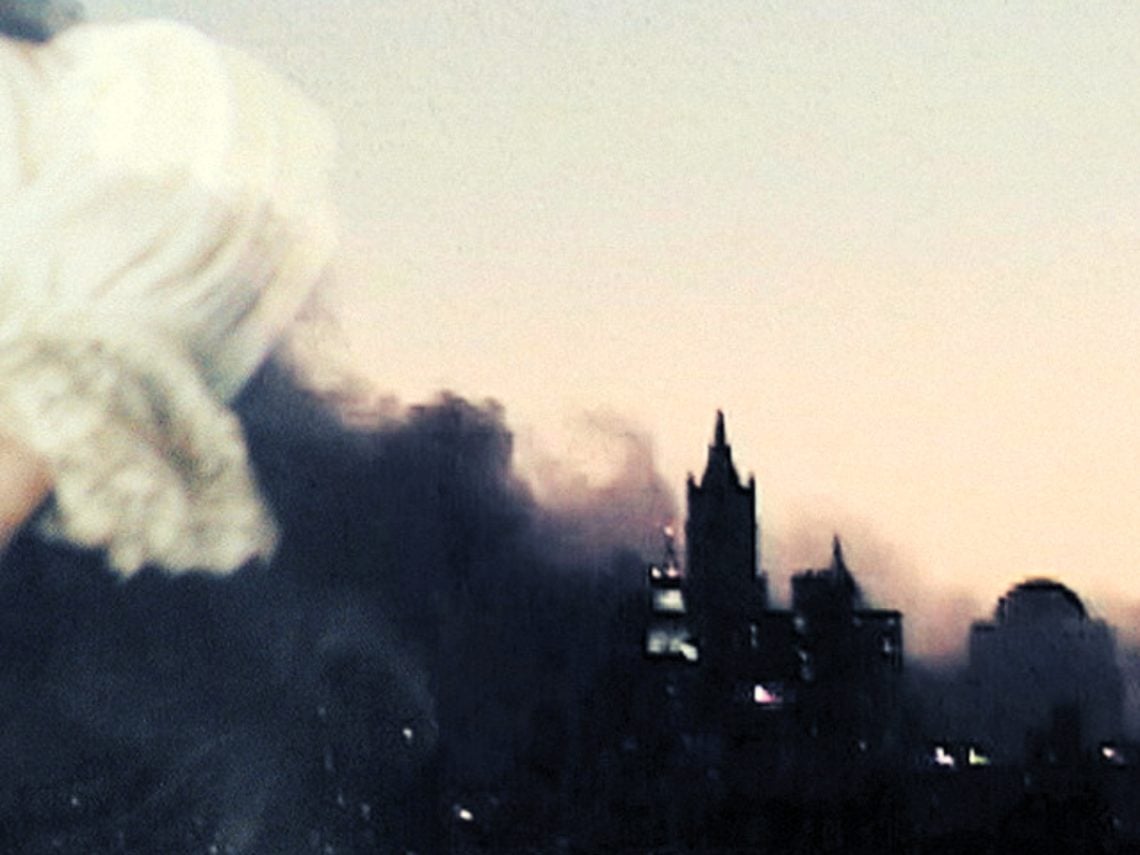
For many people that day, the 9/11 attacks felt like the beginning of the end – the disintegration of a once-prosperous America. Thus, Basinski brought a video camera onto the roof of his building in Brooklyn and recorded the last hour of sunlight in the city, with clouds of smoke spreading across the sky.
Talking to the Guardian, Basinski revealed that he had a “job interview at the World Trade Center that day, for an arts organisation who had offices on the higher floors. Administrative assistant. Luckily for those kinds of jobs, the interview isn’t at 8 o’clock in the morning, it’s at 11, and by then the buildings were gone.”
He added, “No one on TV knew what the fuck was going on. The radio too, so we turned it all off, turned the music on and just sat up there and looked at that smoke, in shock.”
The next day, Basinski used his music to soundtrack the footage he had recorded, which was made available as a DVD. The Disintegration Loops remains a vital document of a catastrophic moment in American history, with Basinski’s music perfectly capturing the tragedy that occurred that day through its contemplative, lamenting atmosphere.
However, Basinski believes that the album speaks for more than just that one event – after all, he recorded it before 9/11 even took place. “We’re still going through The Disintegration Loops. The whole world is falling apart. I can’t fight all this crazy-ass shit that’s going on in the world by marching in the streets. But I can create a different resonant frequency, taking people out of time for a minute.”
Listen below.
