


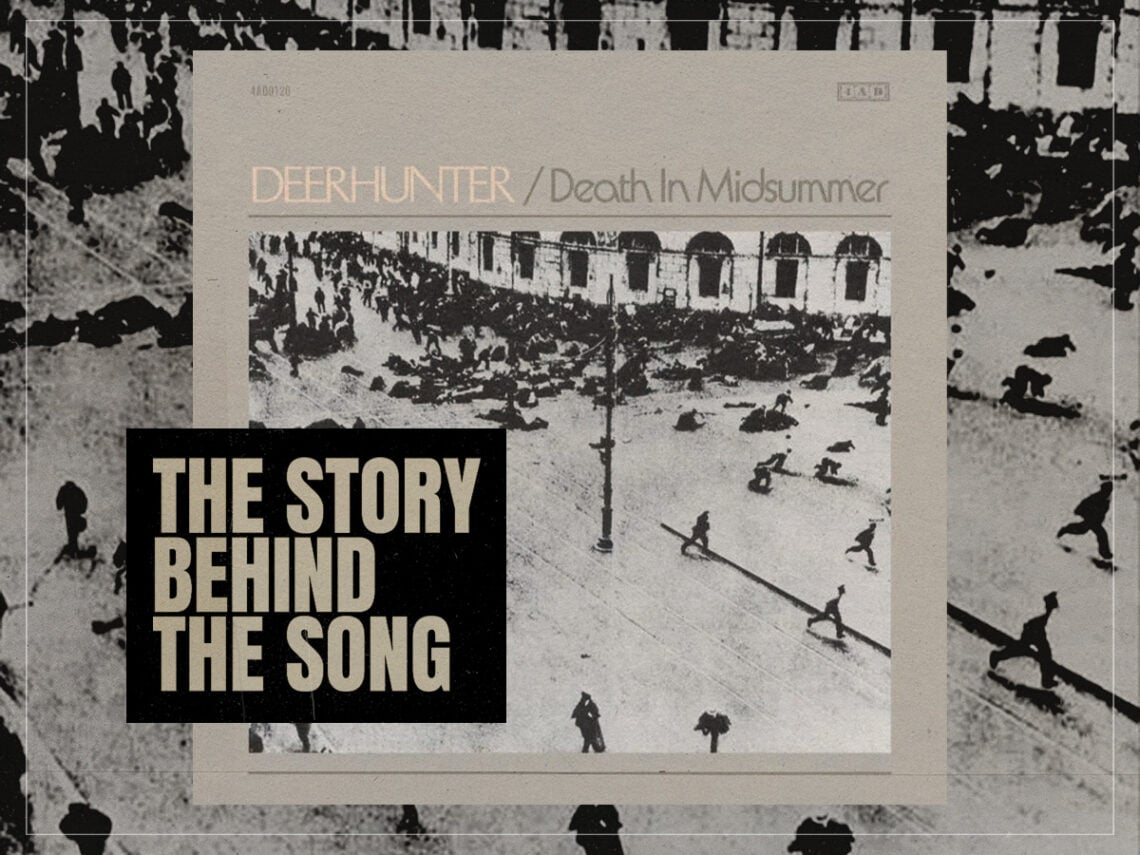
The Story Behind The Song: Understanding ‘Death in Midsummer’ by Deerhunter

For a musical instrument almost exclusively deployed to project a rarified air of foppish privilege, the harpsichord has a pretty storied history in the world of rock ‘n’ roll. The plucked proto-piano is featured on The Beatles’ ‘Fixing a Hole’, Bat For Lashes’ ‘Horse and I’, Richard Harris’ ‘MacArthur Park’, among many others. That’s even before you get to the defining moment of its history in rock music with The Stranglers’ ‘Golden Brown’. However, most would think twice before suggesting it is a part of a song by Deerhunter.
At least to their fans from the beginning. The Atlanta art-rock mainstays began life as a thunderous garage rock band, more likely to be found on bills with Lightning Bolt and Black Lips than anything more palatable. Their shows often descended into feedback-soaked guitar wig-outs bordering on noise and drone music over anything that shared a lineage with The Sonics. Yet as time went on, and singer Bradford Cox began to direct the sound of the band more directly, something changed.
Deerhunter started to focus their sound. Retaining that garage rock groove and adding elements from psychedelia, indie rock and shoegaze to restructure their sonics and create one of the most interesting and lovable cult bands around. Perhaps the ultimate form of this comes in the intro to the first single to the band’s eighth album, Why Hasn’t Everything Already Disappeared, when the first notes heard in the song are played on, you guessed it, a harpsichord.
The simple hook, played by Welsh singer-songwriter and the record’s co-producer Cate Le Bon, opens up a song that sounds like a completely different band from the one that gave their debut record the disgusting title, Turn It Up F*ggot. For one thing, Cox is singing the songs these days, his plaintive croon drifting over an incoming piano part to hide just how dark the lyrics of the song get.
What makes this Deerhunter song so dark?
While most bands with a psychedelic bent to them use that as an excuse to write songs about not very much at all, there’s a pointed socio-political commentary in ‘Death in Midsummer’. As the song opens up, Cox sings lyrics like “Some worked the hills / Some worked in factories / Worked their lives away / And in time, you will see your own life fade away”.
Like a hipster Ray Davies, Cox has written his own take on ‘Dead End Street‘ by The Kinks, a study of working-class lives trapped in a cycle of labour and debt until their time on this earth is complete. Joining their comrades in the one place that a boss, hopefully, will never bother them: the grave. However, where Davies viewed that cycle with a macabre acceptance, Deerhunter let their anger at the injustice of it all build into a stinging, fuzzy guitar wigout, the kind the band used to make their name with.
Interestingly, Cox talked about the song in an interview with NPR and noted that the politics is more personal than it may seem. In the interview, he said, “This song, really, to me, is not a political song as much as it might seem. It’s more of a song about the people who are caught, the people that suffer the consequences of these political push-and-shoves, which is, I guess, is particularly poignant at this moment, where the government’s shutdown, and a lot of people are kind of caught in the crossfire.”
For all his talk that it’s not as political as it might appear, though, there was still a very good reason why Cox gave the single such a striking cover. A black and white photo of St Petersburg’s Nevsky Prospect during the July Days massacre of 1917, when rioters had machine gun fire turned on them by the Russian Provisional Government. A chilling reminder that whether it’s through work or through warfare, the labour force of a nation is often viewed as fodder for its government.
Those radical thoughts are all over Why Hasn’t Everything Already Disappeared, making ‘Death in Midsummer’ a perfect primer for such an album.
