


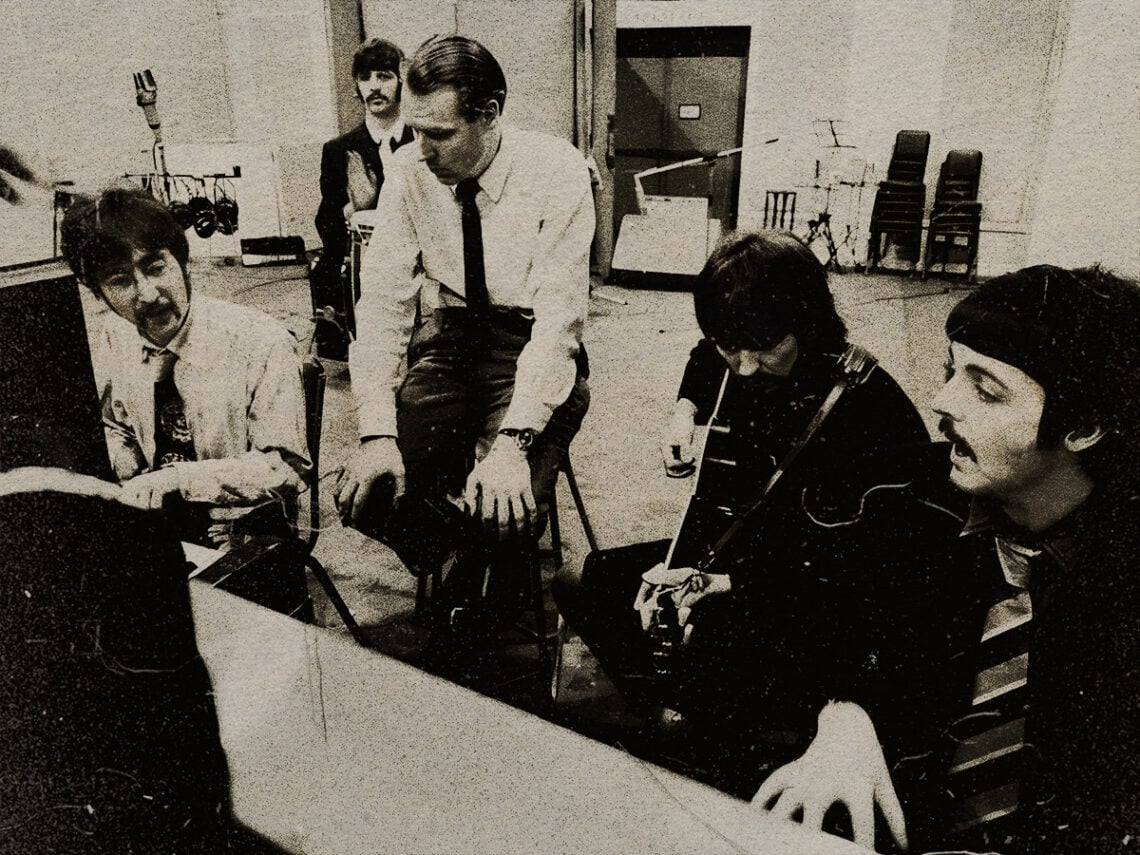
The day The Beatles broke George Martin’s trust: “You are bastards, aren’t you?”

The rise of The Beatles certainly wasn’t entirely due to the talent of John Lennon, Paul McCartney, George Harrison, and Ringo Starr alone. The group relied on several familiar faces who would not only provide the launchpad and help fuel their preposterously fast launch into the outreaches of the previously expected atmosphere of pop music but would also be the daring adventurers pushing them to break on through it.
Brian Epstein, the band’s manager until his untimely death in 1967, can regularly be thought of as the brains behind the group. It was his decision to pitch the four members as the different personality types, i.e. Harrison as the ‘Quiet Beatle’, so the quartet could appeal to a wider section of the market. But the truth is, there is only one man without whom The Beatles would have simply fallen by the wayside: George Martin.
Martin wasn’t just an expert producer with a keen ear for fidelity and a penchant for orchestral pop; he acted as a creative ballast to a group that quickly became a band who were given no limits. With a guiding hand, Martin would operate as a stern headmaster at times and a comforting embrace at others. While he was always disappointed when the group would allow their experimentation to get ahead of making a good pop song, Martin was rarely upset with the members of the band, instead, largely understanding the perils that four young men with the world at their feet may face.
Of course, it wasn’t all plain sailing. There were many songs Martin didn’t like and some that he downright hated. Even the group’s first session, when they tried to lay down ‘Love Me Do’ in 1962, displeased Martin as he questioned the songwriting potential of the Lennon-McCartney partnership and cast aspersion on then-drummer Pete Best. Of course, he was correct about the latter. “They were still fairly irreverent even in those days which I loved, I like a little bit of rebel in people,” Martin shared on 1995’s Anthology series when remembering how Harrison had quipped back at him following Martin’s displeasure at the group’s rough-around-edges sound.
However, one of the few times The Beatles truly let their mentor down came in the face of a German-language recording that could have been make-or-break. The band were at a show in Paris when given the opportunity to record their two hits, ‘She Loves You’ and ‘I Want To Hold Your Hand’ in German in an attempt to try and sell more singles in the country.
It was a record executive who encouraged the band to pursue this, believing that without the songs in their native tongue, the German market would decline the chance to buy into The Beatles. “I was disinclined to believe this, but that’s what he said, and I told The Beatles,” Martin said in Anthology. “They laughed: ‘That’s absolute rubbish.’” However, Martin, operating as the conduit between band and label, knew he had to deliver the right response: “So I said, ‘Well, if we want to sell records in Germany, that’s what we’ve got to do.’ So they agreed to record in German. I mean, really it was rubbish, but the company sent over one Otto Demmlar to help coach them in German.”
Sadly, with Martin and Demmlar sitting in the studio waiting for the soon-to-be Fab Four, the group simply didn’t turn up. “It was the first time in my experience with them that they had let me down, so I rang the George V Hotel where they were staying, and Neil Aspinall answered,” Martin said. “He said, ‘I’m sorry, they’re not coming, they asked me to tell you.’ I said, ‘You mean to tell me they’re telling you to tell me? They’re not telling me themselves?’ — ‘That’s right.’ — ‘I’m coming right over,’ I said.”
“So I went to see them and I had Otto with me,” Martin continued. Rather than find a trashed hotel room and debauchery pouring out of every pore, what Martin saw was rather quaint. “I was really angry and stormed in to find they were all having tea in the centre of the room. (They were, after all, very charming people.) It was rather like the Mad Hatters Tea Party with Alice in Wonderland in the form of Jane Asher, with long hair, in the middle pouring tea.”
Perhaps fearing the scolding which was undoubtedly heading their way, the band jokingly hid from the cane-wielding headmaster: “As soon as I entered, they exploded in all directions; they ran behind couches and chairs, and one put a lampshade over his head,” Martin said. “Then from behind the sofa and chairs came a chorus of: ‘Sorry George, sorry George, sorry George…’ I had to laugh. I said, ‘You are bastards, aren’t you? Are you going to apologise to Otto?’ And they said, ‘Sorry Otto; sorry Otto.’”
The group eventually got wrangled into the studio to record a German version of each of the tracks, marking themselves out as the only two singles they ever released in a foreign language. But the band and Martin were right. The English singles sold particularly well in Germany, and the band never returned to such a marketing ploy.

Never Miss A Beat
The Far Out Beatles Newsletter
All the latest stories about The Beatles from the independent voice of culture.
Straight to your inbox.