


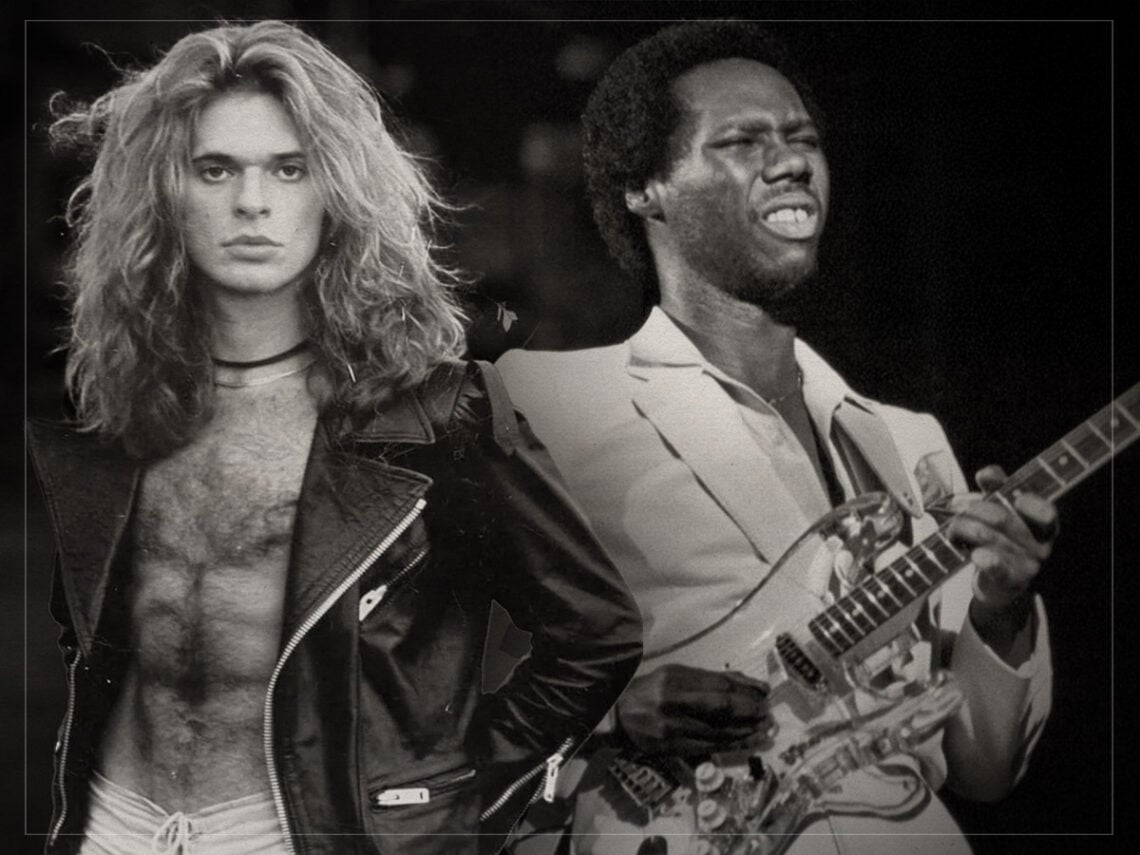
David Lee Roth’s career destroying collaboration with Nile Rodgers

While many people would have questioned David Lee Roth’s decision to leave Van Halen when they were arguably at their creative and commercial peak in the mid-1980s, the vocalist would ultimately have believed at the time that it was the right choice for him at that moment in time.
With the group moving in a different creative direction to what he believed they ought to be doing, as well as a growing concern coming from his perspective about Eddie Van Halen pursuing more extra-curricular work rather than prioritising the band, Roth knew that after the 1984 world tour, he needed to start fresh and chase a solo career of his own where he would have complete artistic freedom.
His early work without the rest of Van Halen was a commercial success, and was aided by the fact that he had assembled a group that contained an equally virtuosic guitarist in Steve Vai to fill the shoes of the guitarist he had just parted company with. Eat ‘Em and Smile, his debut record, was highly acclaimed and proved that Roth didn’t need to be flanked by the members with whom he’d previously risen to the top.
However, his subsequent two releases, while still successful, showed that Roth wasn’t exactly interested in maintaining a sense of consistency, with Skyscraper being considerably more experimental in nature, and A Little Ain’t Enough seemingly marking a return to the hard rock style that had characterised his earlier ventures.
Knowing where Roth would go next was anyone’s guess, and unfortunately for him, his fans, and everyone involved in the process of making his fourth album, Your Filthy Little Mouth, he ended up making one of the most catastrophic sharp turns towards eclecticism and musical disjointedness that would all but destroy his credibility for a period.
Choosing to recruit funk impresario and Chic spearhead Nile Rodgers as producer for the album certainly raised a few eyebrows before the album had even been released, but when the record presented itself as an auditory identity crisis, fans and critics were left aghast at how rapidly he had managed to tank his career in the name of branching out.
In the interest of giving credit where due, Roth was simply trying to have fun, evidenced by the fact that he began dabbling with everything from his usual hard rock fare to country, and from doo-wop to reggae. Choosing to combine his regular style with perhaps one slight diversion from the norm may have paid off for him, but to take such a scattergun approach to genre experimentation without having previously tested the waters proved to be a cataclysmic error.
After getting involved in a minor drug bust in 1993, Roth chose to clean up his act and abstain from substances, and yet the clarity of mind was not enough to save him from this disastrous decision. The other issue that ruined the album’s chances of connecting with his audience from the outset was the fact that he played the entire process of his creative diversion completely straight-faced, and given how his tongue-in-cheek humour had always played such a big part in his personality, to hear him segue into R&B without so much as a smirk felt incredibly uncharacteristic.
While Roth’s career didn’t completely derail as a result of his collaboration with Rodgers, who could reasonably have stepped in to tell him when enough was enough, he chose to return to his roots once more in 1998 for the hard rock DLR Band album. Selling only 8,000 copies in its first week, it’s safe to say that the public needed a little more time to forgive him for Your Filthy Little Mouth.
