


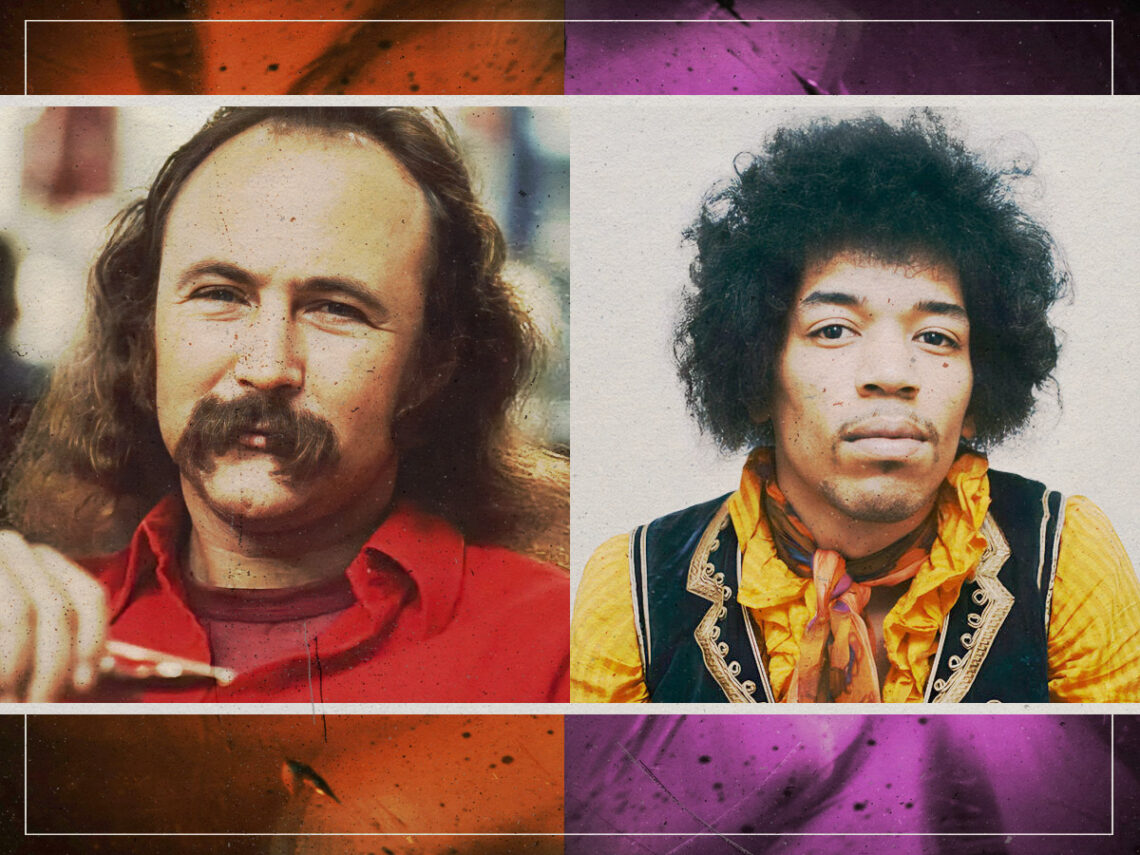
“He was the guy”: David Crosby’s first encounter with Jimi Hendrix

David Crosby sure had some wild tales to tell. A counterculture stalwart right until the very end and one of his era’s most notorious hedonists, Crosby lived a life on the edge, producing other narratives outside of him and helping to construct some of the most influential records of that period.
Despite coming from a well-to-do family with origins in the highest strata of East Coast society going back hundreds of years, it became clear early on that Crosby was not to take the traditional route. His father was an Oscar-winning cinematographer in Hollywood, and this example of creating successful art for a living made a great impression on the young artist. He later found solace in musical expression after being shown jazz by his older brother. This led to him picking up a guitar.
As a naturally enquiring spirit with a real taste for adventure, Crosby made his own luck regardless of his father’s connections and would try his hand at various musical outlets before his journey saw him converge with future Byrds members Roger McGuinn and Gene Clark. This included playing with Les Baxter’s Balladeers and Terry Callier.
Callier introduced Crosby to McGuinn and Gene Clark, who were performing in the Jet Set. Artistically, they hit it off and formed a trio, and were later joined by drummer Michael Clarke and bassist Chris Hillman. They became The Byrds in 1964, and together, they pioneered folk rock and later psychedelia, weaponising McGuinn’s jangling Rickenbacker and the group’s potent vocal harmonies, of which Crosby was the driving force.
An utterly innovative band, The Byrds’ story is a fascinating one, filled with artistic disputes, hedonism and a cluster of significant members. For Crosby, though, his time in the group would be up in 1967, after his relentless partying, often challenging demeanour, and artistic demands became too much for his bandmates. He simply had to go. Luckily for him, though, he would form the supergroup CSN with Stephen Stills and Graham Nash, another era-defining act. Their 1970 record with Neil Young, Déjà Vu, remains the ultimate goodbye to the outgoing hippie era.

Being in both bands, Crosby experienced much of the era’s most storied moments from the inside. Because of this, he accrued a long list of legendary friends, including pioneering guitarist Jimi Hendrix. Tragically, the Seattle native lost his life aged 27 in 1970, but due to his force as a musician, he remains one of the greatest of all time. His old friend Crosby was in no doubt about this either, and once remembered his first encounter with the ‘Purple Haze’ star fondly.
Crosby revealed to Rock Cellar in 2017 that he first saw Hendrix perform and met him at the Monterey International Pop Festival in June 1967. It was the celebration of the counterculture at its peak, which featured the first major American appearance from The Jimi Hendrix Experience and a host of other stars, including The Byrds.
Hendrix’s band had released their debut and psychedelic masterpiece, Are You Experienced, the previous month, and Crosby was already a big fan. He brought it back to the States from England after touring there with The Byrds. People just couldn’t believe its sound, he recalled.
He said: “But the first time we saw him, he was so flamboyant, he was so outrageous, and he was on two tabs of acid [laughs]. How do I know that? ‘Cause I saw him take them.”
Crosby – who was known for making bold and sometimes tenuous claims – asserted that he saw the revered Grateful Dead sound engineer and LSD mass manufacturer Owsley Stanley take a couple of Blue Cheer tabs out of his pocket. The nonchalant Hendrix dropped them instantly, went on stage, and delivered one of the most iconic performances ever. He said: “It didn’t slow him up one inch [laughs]. And we were … stunned. We didn’t know how you did that. It was amazing.”
To Crosby, Hendrix was the greatest and always would be. He could do things that no one else could, and nothing would tarnish his memory. “He was the guy,” he concluded. “He’s still … the guy”.
