


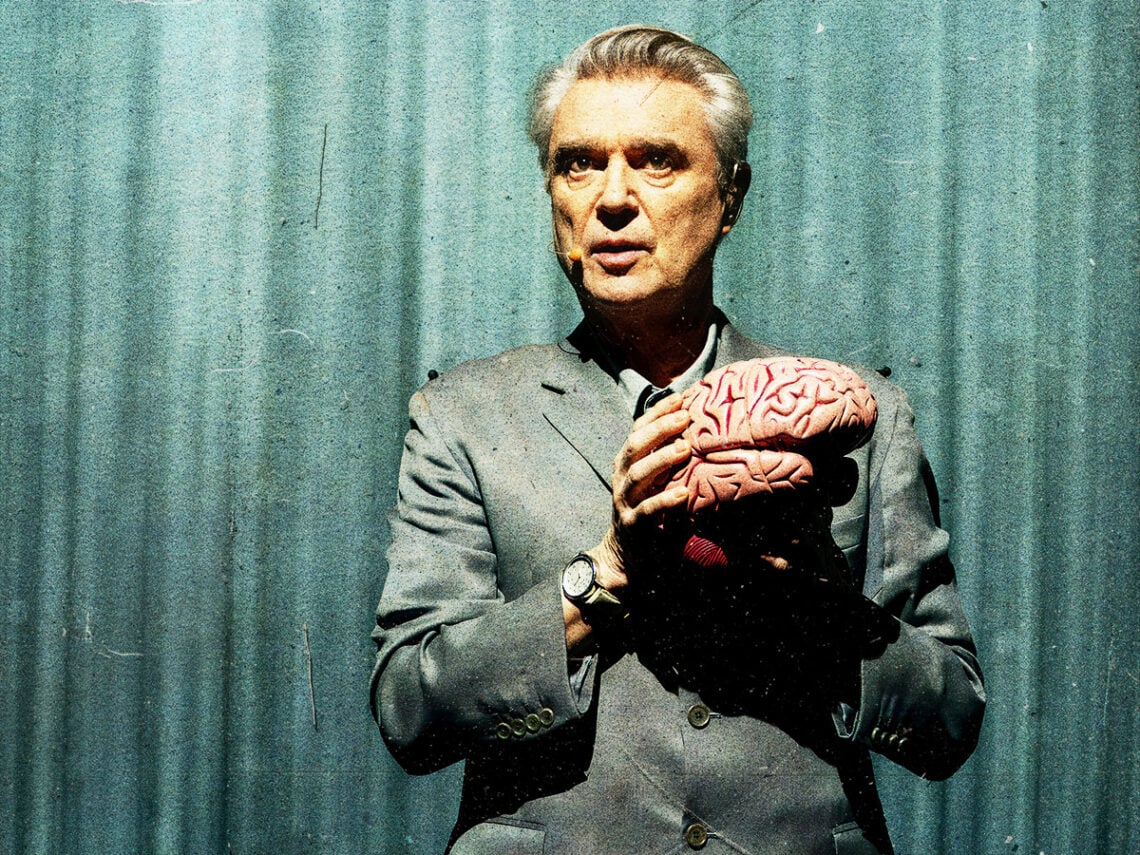
David Byrne on “the best soundtracks of all time”

In 1986, David Byrne directed the comedy True Stories. Among many other things, the surrealist assortment of vignettes is perhaps the most accurate depiction of living with autism in cinema history. This premise is further bolstered by the music that he provided for the picture with his band, Talking Heads. The soundtrack faithfully captures the whimsy of what unspools on screen without pandering.
Clearly, among Byrne’s many talents, understanding the marriage of music and movies is one of them. However, in his view, there is one maestro who stands out from the rest: the late, great Ennio Morricone. When discussing the brilliant work of the Italian composer on his radio show, Byrne mused: “Morricone wrote at least 400 film soundtracks and 100 pieces of classical music. Mind-boggling.” In truth, he was so prolific that nobody can say for certain how many film scores he actually wrote, with the figure landing somewhere between 450 and 500.
Byrne continues: “He started off as an experimental composer but was adaptable and realized that for the film jobs, his more complex music was not going to work. To his frustration he’s best known for the Sergio Leone ‘spaghetti westerns’ which made a star out of Clint Eastwood. Despite that frustration these are considered by many to be the best soundtracks of all time.”
Now, prolific does not always go hand in hand with quality when it comes to the arts, but in Morricone’s case, his output was so sui generis, diverse and ultimately brilliant that his prolificacy indicates absolute mastery as opposed to a faeces-flinger hoping something would stick. In fact, he is quite possibly the greatest cinematic composer of all time.
Despite the fact that he scored around half a thousand films, he is nevertheless often pigeonholed, and this was a point of great chagrin for the late Italian maestro. “I get really annoyed because even though only 8% of my film scores were for westerns, most people only remember me for those films,” he told Channel 4 News.
But according to Byrne, there is a very good reason his western scores soared. “Morricone wrote the western scores before the pictures were shot- so Leone essentially staged some of the scenes to fit the music, rather than the music being composed after the picture was finished, which is usually the case,” Byrne explains.
“For a composer, this is heaven- the music is about establishing a mood and allowed to build and flow in a musical way rather than being shaped by the film editing. Maybe for this reason the music has stood the test of time and it holds up apart from the visuals,” he concludes. As it happens, this only occurred to ‘an extent’; nevertheless, getting a musical feeling in place to serve as the backdrop was inspiring to both director and composer alike.
Finally, in a wider sense, this proves the importance of visualisation in the arts. Byrne, like many others, is at his best when a firm idea is postulated, and inspiration flourishes from there. Core themes and energies keep things coherent, and that’s usually a good thing, even in the kookiest of art.
