


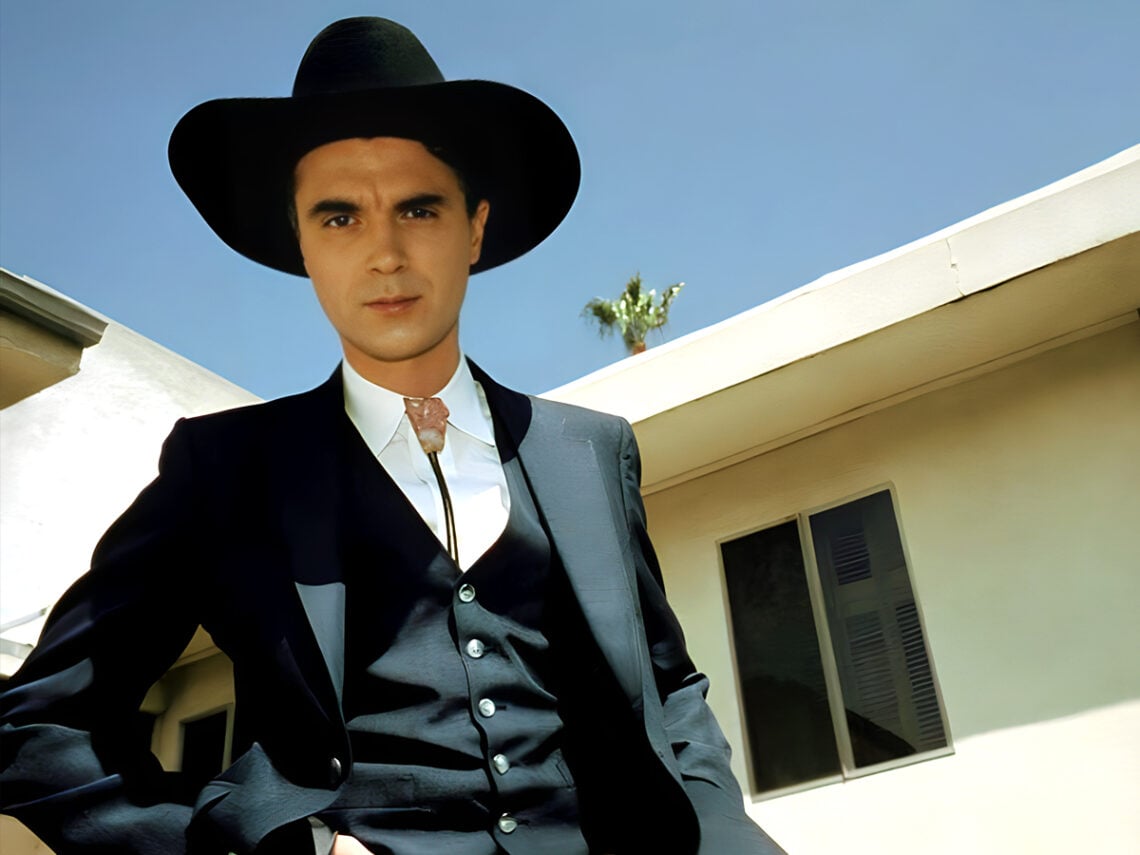
David Byrne feared his solo debut might ruin his career, but he had to do it anyway

“I changed musical directions”. Yeah, no shit, David Byrne. That was probably the biggest understatement he ever made with regards to the start of his solo career.
Of course, we now understand that one of the biggest aspects of sonic appeal when it comes to the former Talking Heads frontman is that he never stays in one place. There’s always more than a sprinkling of experimentation, a smattering of new sound, to keep the interest permanently piqued. That’s not just in the interest of selling more records – it’s genuinely how Byrne’s mind works.
Yet having spent the better part of the 1970s and ‘80s building the foundations of a sparkling new wave catalogue, it was fair to say that fans only really wanted more of the same. They wanted synths, they wanted slick pop, they wanted joy. It wasn’t a lot to ask for. But the blunt truth of the matter is that Byrne simply wasn’t bothered by that.
As such, in an almost petulant move to blow everything the Talking Heads stood for out the water, his first solo record, fully emancipated from the band, Rei Momo, released in 1989, truly turned everything on its head, if you’ll pardon the pun. It was fuelled by Afro-Caribbean, Afro-Hispanic, and Brazilian stylings, in a mood that was as seemingly perplexing as it was multicultural.
And so, we return to the statement, “I changed musical directions.” Byrne may well have been saying this with an element of tongue-in-cheek during his 2023 episode of 60 Minutes, keenly aware of the ironic understatement of his words. “It alienated some of the fans” – well, of course it did, Sherlock, but did you want it any other way?
In his typical fashion for his whirlwind world, Byrne had a very simple explanation. “It was what I loved. For my well-being, that music was very inspiring. It was liberating.” He didn’t have to say that twice. In swapping synth for samba, the former frontman was making an emphatic proclamation that he was throwing all caution to the wind.
You could say that an album like Rei Momo still stands as the ultimate testament to the fact that Byrne is in the music business for the sheer love of the art form, not for commerciality. It possibly goes without saying, but the record wasn’t exactly his biggest success, reaching number 51 in the UK and 74 in the US.
But in the grand scheme of things, that really didn’t matter to Byrne. It was his first step in a new chapter, a fresh beginning, and even more promising horizons than the Talking Heads ever offered. We say his mind is kaleidoscopic now, but that was really where it all started. It was a case of letting the games begin.
