


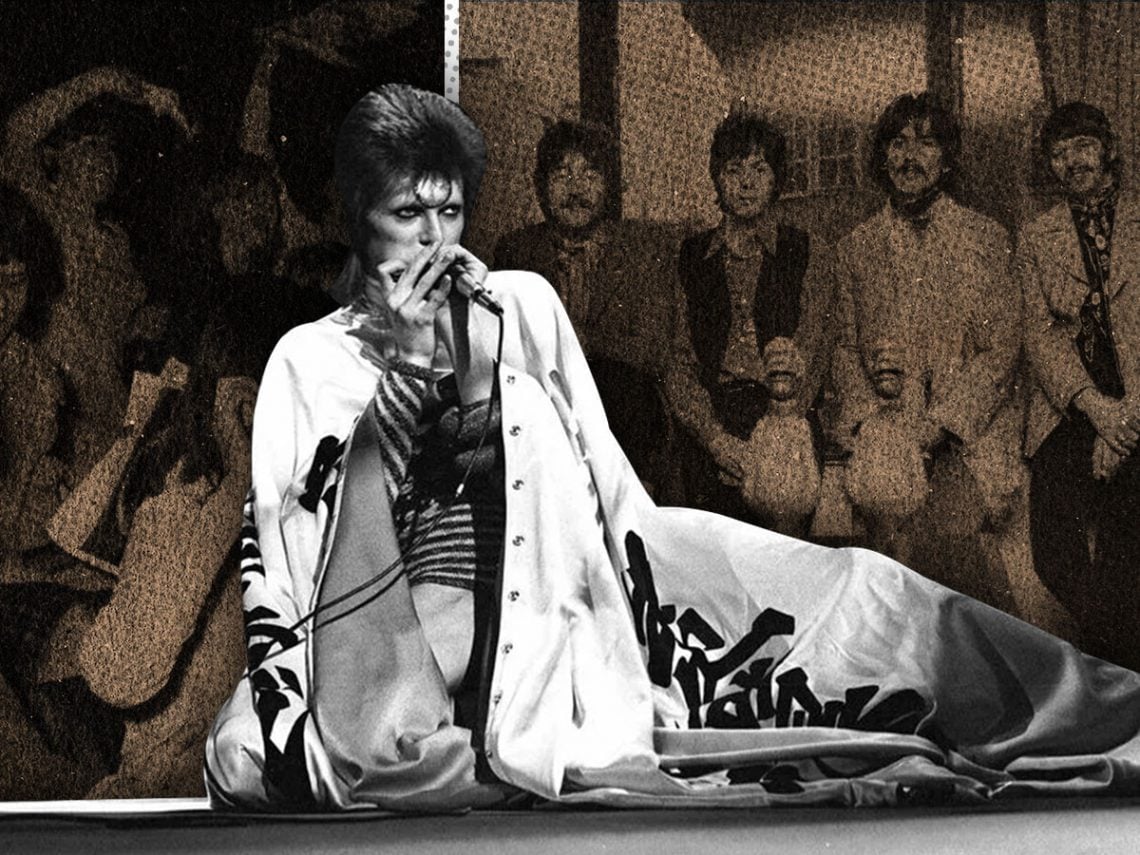
“This was our Sgt. Pepper’s”: The David Bowie album Tony Visconti compared to The Beatles

Tony Visconti and David Bowie first began their lifetime friendship and collaboration the year after The Beatles and George Martin advanced stereo sound at the speed of a sonic bullet with Sgt. Pepper’s Lonely Hearts Club Band. The first single they worked on is an underrated early Bowie masterpiece: ‘In the Heat of the Morning’, a single complete with the less memorable flipside of ‘London Bye Ta-Ta’. A lack of coherence upended the seven-inch. Needless to say, the duo initially proved less successful than the Fab Four.
However, over the course of the iconic pair’s career, Visconti and Bowie would work together on fourteen records, 12 in the studio and two live albums. This all places the producer at a unique vantage point from which to survey the work of the Starman. From Young Americans to The Next Day, Visconti resided over many of Bowie’s very best efforts. Notably, each time they hooked up, they were always striving to emulate one particular album.
Speaking to Hollywood record store, Amoeba Music, Visconti declared: “[Scary Monsters (And Super Creeps)] is my favourite Bowie album, Heroes would be my second favourite.” And frankly who can blame him, the record is an absolute triumph that features some of Bowie’s biggest ever hits in ‘Ashes to Ashes’ and ‘Fashion’, as well as a soaring sleeper, and a personal favourite, ‘Teenage Wildlife’.
From top to bottom, the record captures what Bowie was all about: a menagerie of weird and wonderful influences coming together to produce a blistering cacophony of unrivalled creative sound. 13 years earlier, The Beatles did much the same as they poured over every detail of acetate on their album and introduced orchestras, background noise and everything else they could think of as they played with the fabric of rock ‘n’ roll with the concept of the mystic Sgt Pepper holding the experiment together.
This explains the science behind Visconti’s choice. The monomaniacal producer regales that before every record they made together, they would pronounce, “Let’s make this our Sgt. Pepper’s! We’re going to take nine months and we’re going to do everything we want to do.” But for one reason or another, the pair never quite found the time. Visconti adds that Heroes was recorded in “just four weeks”, so it’s not like months were needed for Bowie to reach brilliance, but there was still the nagging doubt that they could potentially unearth more with a few months on their side.

With Scary Monster (And Super Creeps), however, they managed to catch a break in the calendar and, thanks to the relative success Bowie enjoyed in the ’70s, the resources were there to finally make their own painstaking epic, “This was our Sgt. Pepper’s,” Visconti proudly proclaims. With Bowie in a sweet spot, many of the melodies were already in place and he cut them with a band rather effortlessly.
The songs recorded during this period were then whisked away by Bowie and Visconti to squirrel away, working on melodic structure and lyrics, “We didn’t even know whether sections were verses or choruses, that was for us to find out.” Even this same patchwork approach is similar to The Beatles’ take a scrapbook to the studio ethos.
Similarly, part of the beauty of Bowie’s daring artistry is that it came from all corners. He collated influences from anywhere and everywhere, and ‘Scary Monsters (And Super Creeps)’ is the perfect paradigm for that. The title track itself might seem on the surface like something akin to the sonic equivalent of the Vladimir Nabokov novel Bend Sinister, but at its heart is an old Kellogg’s Corn Flakes ad campaign.
It was from the blandest cereal on the market that the title for the song and album was taken. The twist was that the cereal went with the slogan “Scary Monsters and Super Heroes”, but Bowie’s lurid whims had him thinking of a cunning way to subvert that commercial notion while keeping its sloganistic catchiness. Rather than pit villains and heroes against each other, Bowie delved into the psychology of a perpetrator, explaining that the song is about “a criminal with a conscience who talks about how he corrupted a fine young mind.”
When it comes to Sgt. Pepper’s, it was the morning papers that John Lennon was moved by when it comes to albums zenith ‘A Day In The Life’. As Bowie once said: “What I really adore about music is the stuff that starts on the edge.”
For him, this was epitomised by Lennon on songs like ‘A Day In The Life’. As he once said, “I felt such kin to him as much as he would rifle the avant-garde and look for ideas that were so on the outside on the periphery of what was the mainstream and then make them apply in a functional manner to something that was considered populist and make it work.” So, it’s not a surprise that he aspired to match him in some way.

Never Miss A Beat
The Far Out Beatles Newsletter
All the latest stories about The Beatles from the independent voice of culture.
Straight to your inbox.