


“Confront a corpse at least once”: exploring David Bowie’s obsession with death as an art form

From the moment he broke onto the scene, David Bowie sparked a spectral dance with the concept of mortality. He spun a web of lyrical and sonic reflections on death, creating a hauntingly beautiful tapestry that challenges everything we know to be real about the afterlife. Even in life, he moulded the concept of death like a plaything, concocting a visual viscera where life and death were inextricable.
Bowie’s fascination with the end of things—be it the celestial drift of Major Tom or the stark inevitability of his final, enigmatic tracks—revealed a lifelong preoccupation with the transient nature of existence. In Bowie’s world, death was not merely an end but a rich, transformative force that coloured his artistic vision with a poignant, almost ethereal light.
This journey through his discography offers a window into a mind perpetually engaged with the shadows, crafting an evocative and ever-evolving meditation on what it means to face the unknown. “Confront a corpse at least once,” the ‘Starman’ told Esquire in 2004. “The absolute absence of life is the most disturbing and challenging confrontation you will ever have.”
Much of what we associate with Bowie touches on his otherworldly persona, relentless in his quest for improvement and genuine reimagining of his roles. When you strip away the layers and delve into the deeper meaning of his work, it becomes clear that the theme of mortality was a constant undercurrent. Whether through direct depictions of crossing to the afterlife or metaphorically through ideas of reincarnation and otherworldly transformations, Bowie’s work consistently reflected an underlying intrigue about mortality.
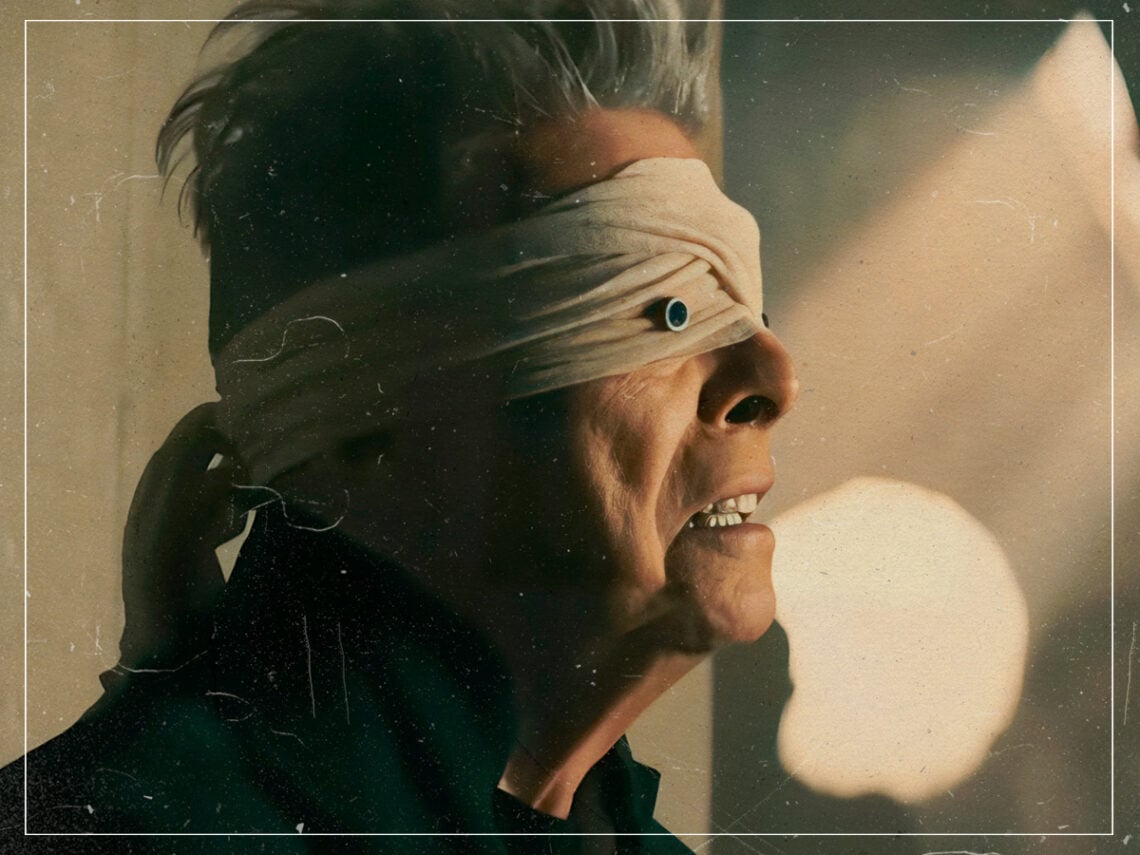
The musician’s most obvious grapple with death came at the very end of his career via his most poignant memento mori Blackstar, a danse macabre that brought his obsession with making death out of art to its pinnacle. With this album, the maestro of mystery curated a swan-song that not only allowed a glimpse into the final moments of music’s most mystical thinker but brought his long-standing interest in death to its conclusion.
To understand Bowie’s fascination, however, his dance with the dark side began a few years before Major Tom became stranded in space in 1969, with a series of songs that addressed death in various, albeit direct, ways. For instance, his earlier tracks ‘Please Mr Gravedigger’ and ‘We Are Hungry Men’ showcase his affiliation with exploring the darker sides of the human condition, the former of which deploys a narrative about a child murderer who plots to kill a gravedigger.
Following 1969’s Space Oddity, Bowie had established himself as a forerunner in transforming the exploration of mortal intrigue into art, with concepts and characters that existed outside the realm of realistic, cognitive thinking. The Man Who Sold The World had a heavier edge than its predecessor, but its lyrics were also considerably darker, with themes that tackled deathly mystery, violence, possession, and other aspects of existing without inhibitions.

The following Ziggy Stardust and Diamond Dogs incorporated metaphors for the fickle nature of fame and life, approaching the theme in distinct but interconnected ways while reflecting different stages of Bowie’s artistic vision. While one record traced the downfall of a fictional rock star who rises to fame as Earth’s saviour, the other presents a dystopian vision of a post-apocalyptic world where societal norms have collapsed.
Influenced by George Orwell’s 1984, Diamond Dogs also presents death and destruction as constant, often in a way that beckons submissiveness and acceptance of its inevitability. In ‘We Are The Dead’, for example, Bowie sings: “Oh, dress yourself, my urchin one, for I hear them on the rails / Because of all we’ve seen, because of all we’ve said / We are the dead”.
Even during the singer’s most flamboyant and popular incarnation of stardom, his deathly intrigue never waned. It remained an important feature throughout his body of work, even Let’s Dance, which addressed the theme in more abstract, indirect ways through intense and dark atmospheres. All of which leads up to his opus Blackstar, an endearingly frightening resignation of the concept with hearty force.
However, although the entire feel of Blackstar articulated Bowie’s demise in every sense, there’s also some hope to be discovered in some of the music, including ‘I Can’t Give Everything Away’. Bowie understood that his death would cause an influx of speculation and rumination, so much that happens between the first and end notes of Blackstar’s attempt to deliver both desolation and illumination in a raw and completely authentic manner.
Musicians incorporating death into their work isn’t new, but Bowie’s was so immensely consistent and at the fore of everything he created that it’s impossible to ignore the amount he contributed to the multifaceted phenomenon. On the surface, death in art often seeks to understand and express the complexities of human mortality, providing a powerful avenue for exploring deep emotions such as grief, loss, and reflection.
However, Bowie’s fixation served as a metaphor for complex existential and societal themes, a muse for various phases or states of being, and a conduit for his abstraction. Bowie knew how to play with seemingly one-dimensional themes, and what’s more one-dimensional than death when it comes to categorising what it means to experience life? Death, in Bowie’s world, represented the ultimate dichotomy: dark and light, condemnation and redemption.
It also reflected one theme that could be used to summarise his entire artistic vision—resurrection. Death infiltrated a lot of Bowie’s theatrical aesthetics and his interest in gothic worlds, but it also reflected his deep appreciation for rebirth. Whether as himself, Ziggy Stardust, Major Tom, Aladdin Sane, or Dr. Lazarus, Bowie’s various deaths meant reinvention and the possibility of exploration beyond the naked eye.
