


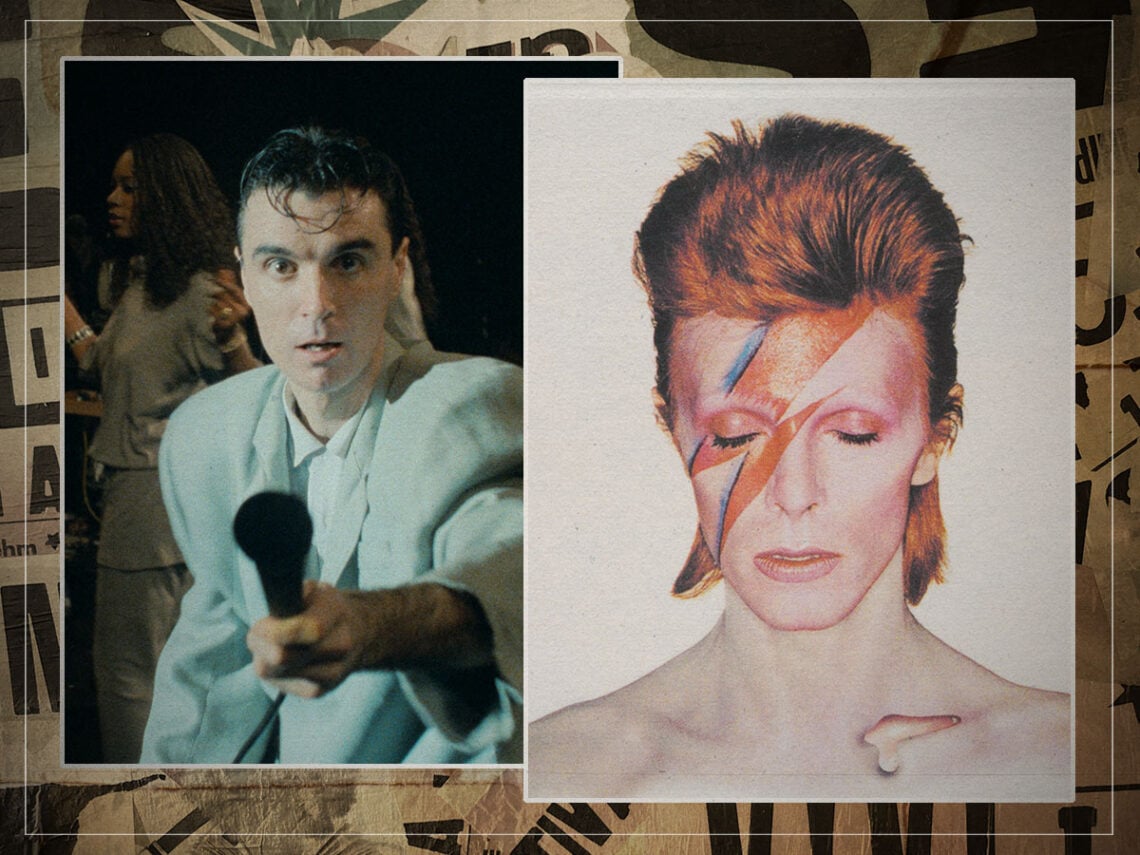
‘Life on Mars’ and ‘Once in a Lifetime’: the anthems that took on capitalist absurdity

A young, disillusioned woman finds solace in digitised absurdity, straying away from the mundanity of everyday life just to feel something. Her drive comes from immense dissatisfaction—a likely villain in the 1970s—painting a vivid portrait of contemporary capitalism and its failure to present anything meaningful beyond the alluring sheen. This forms the basis of David Bowie hit ‘Life on Mars’, a perspective echoed almost a decade later with the release of Talking Heads number ‘Once In A Lifetime’.
“And you may find yourself in a beautiful house, with a beautiful wife / And you may ask yourself, ‘Well, how did I get here?'” David Byrne preaches in ‘Once In A Lifetime’, capturing the absurdity of capitalism and materialism in the modern age with a string of relatable disorientations that question our place in the broader oversaturation. Inspired partially by American radio DJs and the new age of information overdrive, ‘Once In A Lifetime’ saw Byrne channelling what he described as the “cauldron of impassioned voices” where it feels like people are “shouting at you, pleading with you, and seducing you”.
As a result, he sings with the same fervour, echoing the kind of overstimulated confusion created by digital-age discomfort that defined Bowie’s earlier hit, with the protagonist looking for something that far exceeds the realm of the extraordinary to establish something actually meaningful. In Bowie’s world, the woman seeks feeling and belonging through profound questions and yearning, having become overwhelmed by a world fixated on intense spectacle.
In ‘Once In A Lifetime’, the existential musings become the central driving force even if they don’t immediately make any sense. In many ways, the lack of coherency drives the point home, with Byrne delivering his signature stream of consciousness to reflect the viscera of modern-day disillusionment perfectly. This disconnection infiltrates ‘Life On Mars’, with Bowie exploring the human strive for connection in a world ill-equipped to deliver it.
This also comes through with Bowie’s conceptualisation of the spectacular, setting the scene with a fixation with the silver screen as the backdrop for broader comments on capitalism: “Now she walks through her sunken dream,” he sings, “To the seat with the clearest view / And she’s hooked to the silver screen.” In this scenario, Bowie details the different absurdities through visualisation (“It’s on America’s tortured brow / That Mickey Mouse has grown up a cow”), placing reality through a surrealist lens to highlight the ongoing distortion of existing in modernity.
While there are obvious differences between both tracks, the theatricality carried by both Byrne and Bowie also seeks to oscillate between the grotesqueness of capitalism and the desire for authenticity, playing into absurdity from a satirical and storytelling standpoint. In Bowie’s song, this manifests in more traditional structures with his use of a central protagonist, while in Talking Heads’ song, it appears through Byrne’s mimicry, reflecting the warped and unsettling nature of the world around.
Ultimately, the existential unease echoes between the lines of tension, capturing personal alienation through their distinctive artistic visions. While the girl in Bowie’s story appears adrift in bizarre Hollywood imagery and lofty ideals, Byrne projects his discontent not just in his vocal delivery but in how it has fragmented his own sense of identity, leaving him feeling as disoriented as everybody else in the race to shun the infinite emptiness of a life defined by inexplicable yearning.
