


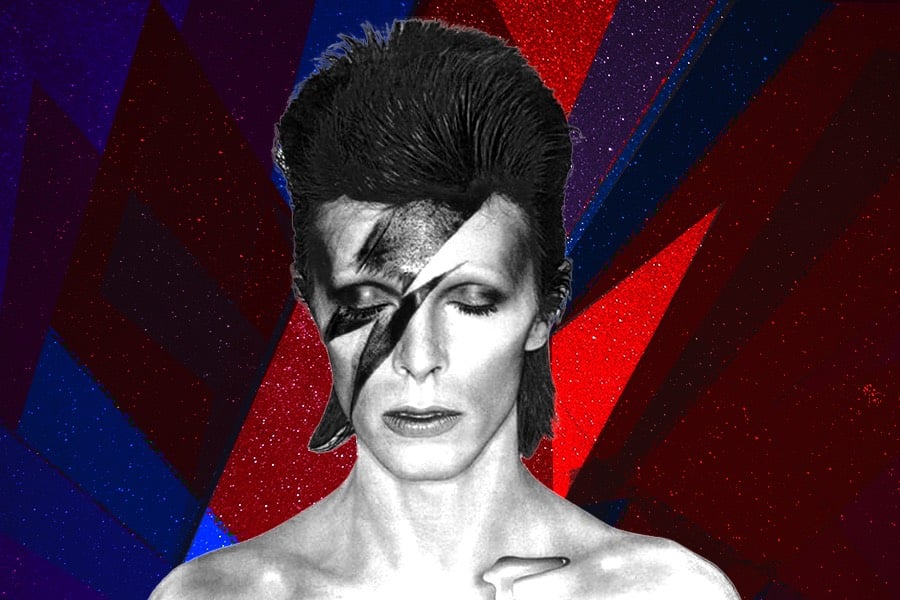
David Bowie’s 50 greatest songs of all time

When trying to reduce an artist’s entire career into one list, it’s usually relatively safe to assume that their entire catalogue can be distilled into 50 fantastic songs. For someone like David Bowie, an architect of pop music, the likes of which we will never see again, picking just 50 songs is incredibly limiting. Although we’re sure to receive countless trolls making their displeasure known about the contents of our selection, one thing the 50 tunes does is remind us just how potent and impressive the Starman really was.
As a musician and a writer, Bowie is largely unparalleled. His continuous pursuit of creative evolution has become a marker of his life both within and outside the music industry. It’s something that can be seen across all of his albums as he always intends to push himself forward. It’s also something that can be heard in each of his songs, making picking just 50 incredibly difficult.
With a career that spans almost six decades, it’s impressive enough that Bowie stayed relevant throughout his career. It’s all well and good to note Bowie as an exciting innovator, the chameleon of rock — always changing persona, style and sound at will — but, if you don’t have songwriting skills then you will fall flat. Bowie shows that he was always capable of creating an anthem.
Not just songs, but poetic rock operas, confounding folk ditties, obtuse and original soundscapes and moments of pure pop bliss. It’s a canon of work that confirms David Bowie as an artist, singer, songwriter and human of extraordinary talent, warmth and kindness.
Below, we’ve pulled together our 50 favourite Bowie songs and provided a perfect playlist too.
David Bowie’s 50 greatest songs:
50. ‘God Only Knows’
It may seem odd to start a list of the best songs of a seminal songwriter with a cover, but this track still reeks of Bowie’s star power. Featuring on his 1984 record Tonight, the Starman adds a heavy dose of his dulcet tones to this harmony-driven classic. It’s one of the greatest songs ever written, which are some pretty big shoes to fill, unless, of course, you’re David Bowie.
The song, originally written by Brian Wilson and Tony Asher, would later lay the foundations for popular music because of Wilson’s use of an unorthodox and pioneering selection of instruments during its period of recording.
Brian Wilson’s impeccable writing is given yet another lease of life by Bowie here who adds not only another layer of vocal purity but the sultry and sexy nonchalance of an artist who knows exactly what he’s doing.
49. ‘Lady Stardust’
Mick Ronson proves that he wasn’t only a guitar man and delivers some beautiful piano moments on the side two opener for Ziggy ‘Lady Stardust’. Originally demoed as ‘He Was Alright (Song For Marc)’ lyrically, the song saw Bowie dip his toe into the gender-blurring future as he set out his stall as an icon.
As you might expect, the song was seen as an admission of Bowie’s flirtations with glam rock counterpart Marc Bolan before the singer changed it up for Ziggy and highlighted his persona’s pansexuality. Bowie at his finest.
48. ‘The Bewlay Brothers’
Largely seen by many as one of the most challenging songs of Bowie’s to navigate, it was one of the last tracks to be written for the 1971 record, Hunky Dory. Its dense texture and rock hard exterior make it somewhat impenetrable, however such dedication to find the jewel at the centre of this boulder would see Bowie fans find veins of gold in everything he did.
‘The Bewlay Brothers’ has taken on a life of its own in recent years as a new generation discovers the singer. These are the artistically driven moments in Bowie’s career that have always seen him on the sharper side of the cutting edge.
47. ‘Up The Hill Backwards’
The fourth and final single to be released from Scary Monsters, ‘Up The Hill Backwards’ was one of the most unconventional releases from the record. Unlike the three which had come before it, ‘Up The Hill Backwards’ was Bowie flexing his artistic muscle.
By the time the song was released, it had already been available on the album for six months. It led to the single stalling at number 32 in the charts but didn’t stop it from becoming a deep cut favourite. Written about his divorce from Angie Bowie, the song muses about the double-edged sword of fame and celebrity. It’s a Bowie classic in waiting.
46. ‘V-2 Schneider’
It’s not often that largely instrumental pieces are included so far up our list of rankings. But then again, this isn’t your everyday instrumental. Inspired by the Kraftwerk co-founder, the late, great Florian Schneider, whom Bowie acknowledged as huge inspirations at the time, and the V-2 rocket, Bowie makes a serious statement on this piece.
The V-2 rocket designers played a large hand in designing the American space programme and Bowie’s keen to highlight this duality of life. The distorted phrasing of the title is the only lyrics and the song also includes some off-beat saxophone from Bowie himself. Add it all together and you’ve got some of Bowie’s most derange and yet wonderful work.
45. ‘Scream Like A Baby’
A song about a political prison in the future is about as classic Bowie as the Starman ever gets. It sees the protagonist alongside the narrator stuck without anywhere to go, though it is set in the future the tense of the song is in the past or as Bowie describes it, “future nostalgia… A past look at something that hasn’t happened yet.”
The song was actually composed in 1973 and reworked for Scary Monsters. It’s one of the hybrid moments of the record as it blends rock ‘n’ roll with the new wave synth sound that was soon going to dominate the decade. Once again, Bowie is leading the way.
44. ‘Cygnet Committee’
While I’d be more than happy to espouse the ingenuity of ‘Cygnet Committee’ myself, the highest praise for the song comes from Bowie himself. “I wanted this track out as a single but nobody else thought it was a good idea,” he told Disc and Music Echo upon the release of the record.
Adding: “Well, it is a bit long I suppose. It’s basically three separate points of view about the more militant section of the hippy movement. The movement was a great ideal but something’s gone wrong with it now. I’m not really attacking it but pointing out that the militants have still got to be helped as people – human beings – even if they are going about things all the wrong way.” He eventually concluded that his poignant societal lambast was even better than ‘Space Oddity’.
43. ‘Sons of the Silent Age’
According to Brian Eno, who worked as a producer and collaborator on the album Heroes, this was the only song of the recording session that was composed outside of the studio. It’s clearly a song that was close to Bowie’s heart as he had earmarked it to be the titular track of the LP.
The song is another showing of Bowie’s internal battle. So desperate to make himself artistically credible (the doom-laden sax notes) interplay with the pursuit of fame and fortune being seen in the somewhat cheesy choruses where Bowie employs his best impression of Major Tom. The song, meanwhile, takes on the idea of psychotic withdrawal, something Bowie had already become familiar with on Low. What transpires is a piece of performance art that perfectly summarises Bowie at the time.
42. ‘Kooks’
An anthem for the outsiders of this world, ‘Kooks’ may not be the most famous of the album’s incredible tracklist, but for many fans, it resonates most strongly. The song, written for his son Zowie, is the track that recognises not only Bowie’s own ‘kookiness’ but the effect that will have on him as a parent and Zowie as a child.
“I bought you a pair of shoes, a trumpet you can blow and a book of rules on what to say to people when they pick on you,” sings Bowie. “‘Cause if you stay with us you’re gonna be pretty kooky too.”
It’s a song that has transcended its intended target and instead hangs around the shoulders of all those who hear it as a comforting cradle of emboldening creativity. It’s forgiveness for the errant character traits and odd affectations. It’s Bowie signing off on your weirdness and recognising it for the unique beauty it is.
41. ‘Joe The Lion’
‘Joe The Lion’ is one of the hidden gems on Heroes. The song, often overlooked as one of Bowie’s finest, is listed by the mercurial guitar sound of Robert Fripp and underpinned by Bowie’s incessant groove. Of course, lyrically the words are nonsensical but compiled together with the music and this track becomes a winner.
Whether it is Fripp’s tonal guitar sound or the gobbledygook backing vocals, there’s something beguiling about this abuse of your eardrums. It sounds like Bowie has left his bonkers bunker and spouted the first few things that came to his mind. It’s an absolute joy.
40. ‘Wild is the Wind’
Bowie was never afraid to take on a big song or, indeed, a big singer. One such moment occurred when he decided to cover Nina Simone’s mammoth vocal on ‘Wild is the Wind’.
Originally written and recorded for the titular 1957 film, Simone would make the world pay attention to the track with her powerful 1966 rendition of the song. There is no artist better at capturing the soulful loss of hope than Simone, and her cover is the kind of song to make one’s hairs stand on end. Bowie was one of those people who were left with chills, admitting that the song “really affected me… I recorded it as a homage to Nina.”.
Bowie met Simone in 1975 and, in 1976, he picked up the track as a tribute to the singer. It’s a sparse and gorgeous arrangement and does well to match Simone’s powerhouse rendition where Bowie’s vocal maybe doesn’t quite reach.
39. ‘Absolute Beginners’
“I absolutely love you,” Bowie proclaims in this upbeat single, and he bashes the nail of lyrical devotion right on the head. Subtlety is overrated in art and there is something profoundly brilliant about the simple sincerity that rings out with the edifying absolutely amid the three most famous words in culture. Simply put, it elevates the tired trio to the level of a paean that needs nothing else to act as a crutch.
The track, which was written for a film of the same name based on Colin MacInnes’ novel, charts an embryonic love and Bowie skilfully rams the head-over-heals feeling home. For the most part, it’s a standard love song, but Bowie being Bowie ensures it comes with bells on it. For all his singular flourishes, he was always brilliant at being right on task.
38. ‘A New Career in a New Town’
One of the greatest aspects of David Bowie’s celestial stardom was that despite being discreetly singular, he welcomed so many people into his oeuvre that he created his own little bohemian world. It is, without doubt, one of his greatest attributes as an artist that he wasn’t unhinged by his own sense of individualism and was happy to celebrate the artistic vision of others.
Low was a marvel of cacophonous artistry, and seemingly on many tracks, he handed over the reins to Brian Eno. With the instrumental ditty ‘A New Career in a New Town’, Eno’s ambient sounds mingle with the inherent energy that Bowie brings to everything to create a toe-tapping jam that always seems to be over too quickly.
37. ‘Letter to Hermione’
This early track from his self-titled 1969 record is about as exposed as Bowie’s naked vulnerability ever allowed itself to be. The song’s origination came from Bowie deciding that rather than writing a love letter to Hermione Farthingale, he would compose a song, once declaring: “That’s me in a maudlin or romantic mood. I’d written her a letter, and then decided not to post it. ‘Letter To Hermione’ is what I wished I’d said. I was in love with her, and it took me months to get over it. She walked out on me, and I suppose that was what hurt as much as anything else, that feeling of rejection.”
This desperate bridge over troubled water is touched with a bottomless welter of emotion. There is a touch of reconciliation in the mix, a sense of loss, a sense of love and a sense that life is moving on. Bowie was once in a folk trio with Farthingale and the late guitarist John ‘Hutch’ Hutchinson, and that simplistic style of timeless acoustic songwriting is fittingly reprised here.
36. ‘Cat People (Putting Out Fire)’
Of all the adjectives associated with Bowie’s music, cinematic would certainly rank highly. When Quentin Tarantino brilliantly made use of this glitzy piece of sonic bravado in Inglorious Basterds it seemed like the song had been written especially for that moment.
Bowie himself once said, “Me and rock ’n’ roll have parted company. Now I’m going to be a film director. I’ve always been a screenwriter. My songs have just been practice for scripts.” That may have been in jest, but there is no denying that his songs couple the striking visuals and atmosphere in the same way that the best movies do.
35. ‘Five Years’
While there may be more poetic or poignant lyricists in the world of music, few have Bowie’s brilliant ability to conjure imagery into his tunes. Coupled with the moody melody and gathering storm of the song, the gorgeous lines, “And it was cold and it rained, so I felt like an actor, And I thought of Ma and I wanted to get back there” are among the most visceral in any back catalogue.
The main triumph of ‘Five Years’, however, is Bowie’s uncanny knack of being able to impart something universal from a tale as creative as they come. The song might be the brilliant set-up of his sci-fi masterpiece but with the aforementioned little couplet, there is a wonderful touch of everyday realism–even freaks from outer space are prone to a piece of the lost-feeling of yearning.
34. ‘Beauty and the Beast’
Derived from a place of madness, this schizophrenic anthem is a force to be reckoned with. It fractures and tessellates musical form like a mad scientist has stumbled into the studio. The result is a piece of music with atom-splitting energy, that seems to luridly leak from your headphones and makes for terrifying walks in the dark.
It is almost unnerving that such brilliance came from an equally frantic place, but it is a mark of those involved that madness was tamed for a track that verges on a masterpiece. The perfect paradigm for this is Robert Fripp’s slapdash involvement. “I got to the studio and asked to hear something they’d been working on,” Fripp told Mojo of his impromptu contribution. “Brian [Eno] said, ‘Why don’t you plug in?’ They hit the tape, ‘Beauty And The Beast,’ and what you hear on record is what I played after hearing it for the first time without anything being said.”
33. ‘We Are The Dead’
In George Orwell’s classic novel 1984, the last words that the protagonist Winston Smith says to Julia as the Thought Police descend are, “We are the dead.” Bowie was so enamoured with the book that Diamond Dogs is just about a musical remake, but nowhere does the literary prose land with quite as much brilliance as on the chronically underrated ‘We Are the Dead’.
There is clout and genuine poetry to Bowie’s transposition. From the colourful turn of phrase of “urchin one” to the building grandeur of the final line, Bowie swirls through a lyrical kaleidoscope that only he is capable of, all riding on a fractured track with notes of eerie dissonance and sudden emotive symphony.
32. ‘Station to Station’
While the mood-building intro may be a bit long in our overly busy age, when the song finally pulls out of the station it embarks on a sonic journey that offers up a dose of adrenaline and hurtles so fast and confoundingly that it seems to reach its destination before it even left. Most of us can’t remember our logins on a Monday morning after a few beers on Saturday night, somehow Bowie was living on nothing but milk and bell peppers at this stage, and yet, he still transposed the sound of the future in a wandering epic that sounds like a William S. Burroughs novel has burst into animated life.
Just when you think the atmosphere of the claustrophobic verse is getting a bit much, Bowie delves into a mystic alluring middle eight, then the chorus bursts into brilliance and suddenly everything you’ve ever heard before seems obliquely banal.
31. ‘Teenage Wildlife’
When Tony Visconti was reflecting on his work with Bowie, he told Amoeba Music, before every record they made together they would pronounce, “Let’s make this our Sgt. Pepper’s! We’re gonna take nine months and we’re gonna do everything we want to do.” But for one reason or another the pair never quite found the time, as Visconti adds that Heroes was recorded in “just four weeks.”
With Scary Monster (And Super Creeps), however, they managed to catch a break in the calendar and, thanks to the success Bowie enjoyed in the ’70s, the resources were there to finally make their own painstaking epic, “this was our Sgt. Pepper’s,” Visconti proudly proclaims. Within the album, tracks like ‘Teenage Wildlife’ soar as a result of the filigree work that has gone into them. The fuel of nostalgia might seem to be burning this anthem bright, but such searingly loose guitar work takes a lot of effort.
30. ‘I Can’t Give Everything Away’
More than an album closer, ‘I Can’t Give Everything Away’ was the last line of an entire back catalogue. And that wasn’t a matter of happenstance either; David Bowie was well aware that this track would be his last, and, in the most Bowie way possible, he made art out of death and parted with a sparkling statement.
With refrains from his career gone by he wrote his own epitaph. It sums up his life and works with courageous finality, however, as the title of the track suggests, there is still restless creativity despite the comfort of the now, he was always spiritually seeking out ‘A New Career in a New Town’.
29. ‘China Girl’
When Bowie and Iggy were holed up in Berlin penning songs together, the crumbly industrial world around them was feeding into the process. Over a tape-loop of industrial noise, the landscape of Iggy Pop’s The Idiot was crafted by two of the greatest musical architects ever. It was this gritty, urbanised, creative expanse that resurged Pop’s artistry, as he once told Bowie, “I admired the beauty of the American industrial culture that was rotting away where I grew up.” Thus, the pair set about crystalising that in song.
This notion of recapturing youth became the lifeblood of the record, much in the same way the Stooges’ visceral energy is built on youth’s passion. This upsurge led to a slew of songs, which were later taken back to Berlin to be polished up at the legendary Hansa Studio’s where Tony Visconti would assist with the final mixes. Bowie would later repurpose Iggy’s original into a gentrified version that had all the same sex appeal with the benefit of a shower.
28. ‘Lady Grinning Soul’
When looking back on this track in The Mail on Sunday in 2008, Bowie wrote: “Mike Garson’s piano opens with the most ridiculous and spot-on re-creation of a 19th Century music hall ‘exotic’ number. I can see now the ‘poses plastiques’ as if through a smoke-filled bar. Fans, castanets and lots of Spanish black lace and little else. Sexy, mmm? And for you, Madam?”
That grandiose timeless appeal makes for a song that proves hard to place in the pantheon of rock. Bowie was forever defying labels, and if this was the first song that you had ever heard by him you wouldn’t have a clue whether he was a rock star or a remastered pioneer from the early days of recorded music. With a healthy dose of his hero Scott Walker in the mix, his bravura is palpable and the mystic chord structure is so unfathomable that he’s basically showing off.
27. ‘Oh! You Pretty Things’
The tales of David Bowie’s performance at the 1971 incarnation of Glastonbury Festival are enshrined with a mist of retrospective myth. As the legend goes, the little-known extra-terrestrial protégée took to the stage at 5 am as the full furore of night acquiesced to the beckoning of tents, and the sun rose to the orchestration of chirping birds amid the sanguine dawning of new blue daybreak on June 23rd.
Following the opening track ‘The Superman’, Bowie performed ‘Quicksand’ and debuted the empyrean pop wonderment of ‘Changes’, in what is surely the most fantastical alarm clock that has ever been set, or for the foolhardy all-nighter’s a beguiling clutch of lullabies. With the aura of a crystalising zeitgeist beginning to embalm the set and the sleepy on-lookers with a sense of ordained awe, Bowie performed his best-known single ‘Oh! You Pretty Things’. It went down so riotously well that his future in music was secured and the song has retained a sense of that celebratory vibe ever since.
26. ‘Rock n Roll Suicide
Some songs need explaining, some songs need a little extra investigation, but David Bowie’s ‘Rock n Roll Suicide’ from the legendary album Ziggy Stardust needs just one thing: to be heard.
The track not only directly deals with the ideas of overwhelming loneliness but does so in the most sumptuous and spotlit way imaginable.
Bowie kicks the song into gear after a build of slow-paced acoustic musings when he yells, “Oh no, love, you’re not alone!” in desperation. Like Ziggy, Bowie was always keen to connect with his audience and deliver his message; for an artist as ubiquitously unique as Bowie, that message was that being different was finally a good thing.
25. ‘Buddha of Suburbia’
Released by Bowie in 1993 and working as the TV theme tune for the programme of the same name, Bowie has always been one star that can traverse the line of commerciality and still be able to return to the upper echelons of artistry, and he does so with this track too.
Not often will songs from Bowie’s notoriously anti-Bowie period from the nineties find themselves in the top tiers of the singer’s work. Still, there’s something wholly brilliant about this number. Something that confirms it, and Bowie, as titans of their field.
24. ‘Scary Monsters (And Super Creeps)’
The title track for the album is easily one of Bowie’s best. The third single from the 1980 LP was released a few months after the album had arrived. It’s on this song that the crux of the album really lies. As well as featuring the snorting dragon of Robert Fripp’s guitar it also came complete with synthesised drums as Bowie kept his feet in the past and future.
The song itself focuses on a woman’s descent into madness, and with Bowie’s vocal feeling particularly imposing, the track has a dystopian quality that is hard to achieve without sounding cheap. It thunders ahead and brings a certain closeness that can feel both encompassing and then claustrophobic. It’s a vision enacted by Bowie which shows off his always advantageous artistry.
23. ‘Moonage Daydream’
‘Moonage Daydream’ is one of the singer’s most iconic tracks of all time, neatly typifying everything that Bowie was and remains to this day. The song may well be the archetypal Ziggy Stardust tune, but it was the Spider from Mars who stole the show on this one.
Across the entire record, Ziggy Stardust, Mick Ronson’s guitar sound is formidable, but there’s one moment which typified Ronson’s work — the solo on Bowie’s iconic track ‘Moonage Daydream’.
Perfectly capturing the bizarre and crazed intensity of the song, Ronson’s sonics mirror that of a terrifying yet beguiling robot from another world. It would not be a ludicrous notion to think that the song would struggle to land as heavily as it did and continues to do without it. It’s a searing moment not only in Bowie’s iconography but the entire rock world.
22. ‘Blackstar’
There is no single artist who could have pulled off the way Bowie departed this earth quite like the Starman. The singer’s 2016 release isn’t only a shuddering piece of art but also a working epitaph written by the deceased. Released around the singer’s tragic death, the song is a piece of the artist himself, left behind on the physical plane as he descended upon a new one.
It’s a hard song for the diehard Bowie fans to listen to and has, therefore, become a bit of a sore point when reflecting on his career. But, is there really a more fitting end to the esteemed career of David Bowie than in a self-referential note delivered, largely, from the beyond? No. We don’t think so either.
21. ‘Hallo Spaceboy’
The track, which was originally written by Bowie and his partner in crime Brian Eno, was born out of a prolonged jam session after being inspired by the Nine Inch Nails. “I adore that track,” Bowie later said of the song. “In my mind, it was like Jim Morrison meets industrial. When I heard it back, I thought, ‘Fuck me. It’s like metal Doors.’ It’s an extraordinary sound.”
Given the hard rock direction Bowie was attempting to take the song, it came as a major surprise to his fans when a special remix by The Pet Shop Boys—who added a disco edge to the track with additional lyrics sung by Neil Tennant—was given an exclusive release. Bowie later performed the song alongside Dave Grohl as part of his 50th birthday celebrations.
20. ‘Fashion’
Quite possibly one of Bowie’s most famous songs, and often regarded as one of his best, ‘Fashion’ has been littered across our airwaves since its release. It was the last track to be recorded for the Scary Monsters album sessions and is wonderfully rendered with all the peacocking-glory of the decade to come.
Many people suggested that this song was Bowie making a point about the new totalitarianism of the disco dancefloor, something he saw intently in the New Romantic movement that was flourishing throughout the eighties.
Bowie later clarified that he was trying to “move on a little from that Ray Davies concept of fashion, to suggest more of a gritted-teeth determination and an unsureness about why one’s doing it”.
19. ‘Queen Bitch’
Allegedly written in tribute to Lou Reed and The Velvet Underground, the former of which Bowie would introduce too much of the British audience in 1972 with his work on Reed’s Transformer, the latter, Bowie had adored right from the beginning.
First port of call is Mick Ronson’s decidedly thrashier guitar work, which pulls this song apart from the rest of the 1971 Hunky Dory and turns a genteel folk ditty into pure rock ‘n’ roll. The track’s arrangement, featuring a melodic bass line, a tight, pulsating disco drum pattern, choppy fuzzy guitar chords, and an understated vocal performance by Bowie, all add up to glam rock gold.
It would be a template for The Rise and Fall of Ziggy Stardust and the Spiders from Mars, the 1972 introduction to Ziggy Stardust. This may well have been the birth of glam rock.
18. ‘Golden Years’
It was the first song he recorded for his 1976 record Station to Station, and it remains one of his most purposeful vocal performances. Drenched in a gentle groove and the warm hues of the seventies, Bowie is at the top of his game.
The song is largely thought to have been written about Elvis Presley, an icon with which Bowie has always shared an affinity. Bowie’s ex-wife Angie has often claimed that the song may have been written for Elvis but it was about her and their relationship. “Don’t let me hear you say life’s taking you nowhere, angel, come get up my baby, look at that sky, life’s begun, nights are warm and the days are young,” sings Bowie, apparently about the pair’s ‘golden years’.
Whether he did write the song for Angie or The King, the facts remain that Bowie delivers one of his most iconic songs in ‘Golden Years’.
17. ‘Toy (Your Turn To Drive)’
Sometimes one has to simply assume the role of the muso and accept it. We may pretend to not fall folly of only liking something because of its perceived rarity, but it’s hard to ignore the purity of hearing a song that may or may not have been meant to be released, the same can certainly be said of ‘Your Turn To Drive’.
The track was recorded as part of the Toy album sessions at the turn of the millennium. The record would never be released but this track somehow squeaked out still. The album was meant to be Bowie refreshing some of his lesser-known songs but this original piece is the crowning jewel.
Listen below and confirm the song’s brilliance.
16. ‘Young Americans’
By 1975, David Bowie’s continuous devotion to artistic evolution had seen him once back travel back to America for his inspiration. The country, and New York City, may have inspired the street culture of Ziggy Stardust but there was no clearer adaptation of US traditions than Bowie’s own version of soul music — or blue-eyed soul, as he called it.
The best moment from the singer’s flirtations with the mainstream’s soul and disco scene has to be ‘Young Americans’. A song which is guaranteed to have feet-tapping and hips swaying from the very moment the needle drops. Bowie effectively toes the line of cheesiness to deliver one of his crowning moments on record.
It’s a simple party-starter that should be a part of every party playlist from now on.
15. ‘Suffragette City’
Turned down by Mott The Hoople (the band choosing ‘All The Young Dudes’ instead—not a bad choice) the song remains one of Bowie’s most iconic songs of all time. Super-charged with the electric riff that Ronson conjured up this was Ziggy and his Spiders in top gear. It’s one of the fiercest moments on the album and saw Bowie transcend into a fearsome rocker.
Often thought of as the kind of songs the band would sing, a notion punctuated by the final shrieks of “Wham, bam thank you ma’am!” and gilded by the glitter of glam rock glory that rings out with every note.
It’s about as perfect a moment in Ziggy’s career as you’ll find.
14. ‘The Jean Genie’
The track itself is a powerhouse of splashing blues and rock influences against a starry-eyed backdrop of a misspent youth. According to Bowie, it was “a smorgasbord of imagined Americana”, with a protagonist inspired by Iggy Pop, and the title is an allusion to the acclaimed author Jean Genet.
One of Bowie’s most famous tracks, it was the lead single for the album Aladdin Sane. The track is one of Bowie’s sleaziest songs, most cherished by his fans and undoubtedly a powerful track in his discography; it oozes underbelly cool.
But with it, Bowie showed his ability to write personal songs, deeply entrenched in friendship, lust and infatuation, and somehow marry that with rock and roll anthems people never got tired of. It was what made him an icon
13. ‘Fame’
Bowie wrote the song alongside Lennon and former James Brown guitarist Carlos Alomar as a direct middle finger to the business of rock and roll and, more notably, the middlemen at Mainman Management—Bowie’s former management company. To cap it off, the song would top the Billboard Hot 100 and go down as one of Bowie’s best, highlighting that one way to the top is to always aim for the peak.
‘Fame’ was released in 1975 to quickly become Bowie’s best selling single (to that point) in the US and allow Lennon another chance to rattle the music business. Featuring on Bowie’s Young Americans album, though allegedly Bowie’s least favourite song on the record, it became the flagship of the album’s sound.
It’s a sonic landscape Bowie described as, “the squashed remains of ethnic music as it survives in the age of Muzak rock, written and sung by a white limey”. ‘Fame’ acts as a reminder of the real person behind the mythology of David Bowie and how the singer was always his harshest critic
12. ‘The Man Who Sold The World’
One of the Starman’s most beloved songs, most famously covered by Nirvana when Kurt Cobain gave the track a new audience during the group’s MTV Unplugged performance. Bowie once said this of Nirvana’s cover: “I was simply blown away when I found that Kurt Cobain liked my work, and have always wanted to talk to him about his reasons for covering ‘The Man Who Sold the World’” and that “it was a good straight forward rendition and sounded somehow very honest.”
He added: “It would have been nice to have worked with him, but just talking with him would have been real cool.” There’s good reason Cobain picked up the track, a subverted pop sound is something he resonated with most deeply and was enacted on his own seminal record Nevermind.
Arguably the moment the rock world really paid attention to the new artist Bowie, the song remains one moment of Bowie’s career that will never be forgotten.
11. ‘Ziggy Stardust’
The anthemic song introducing Bowie’s listener to the persona he had created in the fullest detail could have easily been lost to the cutting room floor. As the idea for the basis of a pop song, the idea of telling the tale of a well-hung, snow-white, alien rock lifeform is a little out there, but somehow Ronson and Bowie bring it all back down to earth.
In the end, the song becomes a cautionary tale as Ziggy arrives on earth in the middle of the final five years of the planet’s existence. He comes with a message but is soon too wrapped up in his own ego and alienates everyone around him.
Bowie’s vocals are near perfection and Mick Ronson has his hand on one of the greatest riffs in rock.
10. ‘Modern Love’
‘Modern Love’ was the second song that Bowie recorded for the album after its title track ‘Let’s Dance’, recorded in the first few weeks of January 1983. By the time ‘Modern Love’ was issued as a single, one of Bowie’s most notable tours, the Serious Moonlight Tour was underway, and a new era of Bowiedom had begun. The title track of the 1983 album Let’s Dance had re-launched Bowie with a new audience, and he was happy to cash in.
That didn’t mean, however, that he would compromise his attitudes. He still crafted pop songs with purpose and while ‘Modern Love’ is as close to pop fodder as Bowie ever got, the singer delivers all the swaggering groove one had come to expect from the singer.
‘Modern Love’ also has a pretty impressive backline behind one of the most notable artists in rock and roll. Supporting Bowie was Stevie Ray Vaughan on guitar, with Nile Rodgers on production, making it one of the most bombastic songs in his canon.
9. ‘Sound and Vision’
Appearing on Bowie’s seminal 1977 album Low, ‘Sound and Vision’ remains one of Bowie’s most notable songs. A permanent fixture in some people’s top ten lists, the song is an archetypal piece from the Thin White Duke as he uses abstract lyrical constructs shaped by incessantly groove-filled instrumentals to bamboozle and entrance.
The song had originally been composed as an instrumental track, something Visconti and Bowie had agreed upon when creating the Berlin trilogy LP but was soon flourished by some of the singer’s more abstract lyrics.
It’s a song that showed Bowie was always an artist before he was a pop star and, when it could’ve been so easy to conform and write pop ballads forevermore, he showed that artistic evolution was always paramount.
8. ‘Starman’
The song is finely crafted with lyrics that are perfect for the album and keep a pop audience engaged. Musically, Ronson and Bowie’s vision is perfectly enacted but perhaps the song’s shining moment is that fabled octave-leap on “Star-MAN”.
Bowie discussed the album with William S. Burroughs back in 1973 and explained the track: “Ziggy is advised in a dream by the Infinites to write the coming of a starman, so he writes ‘Starman’, which is the first news of hope that the people have heard. So they latch onto it immediately. The starmen that he is talking about are called the Infinites, and they are black-hole jumpers. Ziggy has been talking about this amazing spaceman who will be coming down to save the earth.”
Aside from the concepts and the intergalactic time travel, the real note of this song is that it added yet another moniker to the growing list of ways David Bowie was becoming an icon. Arguably only after ‘Starman’ was Bowie as we know him born.
7. ‘Rebel Rebel’
Taken from 1974’s Diamond Dogs, the lead single provided all the glittered grime and glitzy gore that had made Bowie a star over the previous years. Considering in the early moment of 1970, Bowie was a comparative nobody, only four years later he was a global superstar, and it was songs like this that propelled him into the stratosphere.
The song is all attitude and bravado, never deterring itself from providing the cocksure swagger of a rock star, the track is perfect teenage fodder. Released with a stellar B-side of ‘Queen Bitch’, the song is a crystalline moment of why Bowie was so adored and how he would evolve to become so much more.
Simply put, this song is a near-perfect rocker that really requires no more explanation.
6. ‘Ashes to Ashes’
The lead single from Scary Monsters will almost certainly go down in history as one of Bowie’s best. The lyrics see Bowie reprise the character of Major Tom in a brand new decade and in a new darker sphere.
Bowie described the song as “very much a 1980s nursery rhyme. I think 1980s nursery rhymes will have a lot to do with the 1880s/1890s nursery rhymes which are all rather horrid and had little boys with their ears being cut off and stuff like that.”
The song contains a whole posse of secret messages and hidden lyrics meaning that it is one of Bowie’s fans’ greatest loves. Full of self-referential moments and clever lyrics, the track is balanced by hard-edged funk bass and art-rock credentials, flecked with new wave.
5. ‘Changes’
One of the songs that, for many people, is one of the best that Bowie ever wrote. It’s equally a song that Bowie admits “started out as a parody of a nightclub song, a kind of throwaway”— we think it’s fair to say that we’re all glad he didn’t ball it up and send it into the rubbish bin.
What transpires instead is a song drenched in optimism and guarded enthusiasm for life and art. As well as being an indictment of the previous generation’s lack of control, Bowie stating in 1968: “We feel our parents’ generation has lost control, given up, they’re scared of the future. I feel it’s basically their fault that things are so bad.” The song is also an anthem for evolution and tolerance, two pillars of the singer’s legacy.
It’s a mark of Bowie’s character and his artistic destination. It’s a manifesto for his career as a rock and roll chameleon, for his life as a patron of the arts and creativity, and his legacy as one of the most iconic men in music.
4. ‘Let’s Dance’
No song typifies the pop career of David Bowie more accurately than ‘Let’s Dance’. Released in 1983 as part of the singer’s resurgence on the pop charts, this track proved that Bowie was not an artist who would be restricted by the musical fashion of the time or by the dwindling of time. He would ensure that he was always at the cutting edge of creating music.
Using the acclaimed producer Nile Rodgers, the musical maestro behind chic, Bowie confirmed himself to the new decade as a relevant pop star once more. While it’s easy to dismiss this song, it’s damn well impossible to resist its charms.
The fact remains if someone puts on the cracker ‘Let’s Dance’ and flicks the volume past a socially acceptable level, then, chances are, you won’t be able to stop yourself from having a little boogie. And, after all the artistic merit, isn’t that really what Bowie was all about? Having a good time? We think so.
3. ‘Space Oddity’
Undoubtedly the song that launched Bowie’s career, to this day it remains a stunning piece of songwriting. For many, the track has come to represent a zeitgeist moment in world culture having been released so close to the moon landing in 1969, but in fact, the track was born out of something a little more off the wall. Bowie may have still been a struggling artist during the performance below, but there’s a sparkle in his eye that suggests he’s already a star.
Bowie explained: “In England, it was always presumed that it was written about the space landing, because it kind of came to prominence around the same time. But it actually wasn’t. It was written because of going to see the film 2001, which I found amazing. I was out of my gourd anyway, I was very stoned when I went to see it, several times, and it was really a revelation to me.”
Instead, the track would forever be associated with the exploration of space, “It got the song flowing. It was picked up by the British television, and used as the background music for the landing itself.” The singer continued, “It wasn’t a pleasant thing to juxtapose against a moon landing. Of course, I was overjoyed that they did. Obviously, some BBC official said, ‘Oh, right then, that space song, Major Tom, blah blah blah, that’ll be great.’ ‘Um, but he gets stranded in space, sir.’ Nobody had the heart to tell the producer that.”
David Bowie’s ‘Space Oddity’ will go down in history as one of the singer’s most iconic songs. After a string of disappointing singles, Bowie finally grabs the public’s attention with this effort. When it was tied in with the moon landing the track took on a whole new level of fame and gave Bowie the taste of what being a pop star was like.
2. ‘Life on Mars?’
Without doubt one of the most powerful and poignant songs, Bowie has ever written. Likely to be as powerful in a rock opera as on a pop record, with ‘Life On Mars’ Bowie really changed the game and made artistically-driven music hit the heights of pop stardom despite never being released as a single.
Compositionally the song is near-perfect. Piano work provided by Rick Wakeman, Bowie reflected that it was actually an effortless creation: “[The] Workspace was a big empty room with a chaise longue; a bargain-price art nouveau screen (‘William Morris’, so I told anyone who asked); a huge overflowing freestanding ashtray and a grand piano. Little else. I started working it out on the piano and had the whole lyric and melody finished by late afternoon.”
While lyrically, it ranks among the most surreal and deliberately difficult to ascertain any real concrete truth from, it is in the series of tableaux that Bowie provides his creative genius. Not comfortable providing a searing narrative that the music warrants, instead Bowie shares a disjointed and designed medley of vignettes from the museum to the modern—asking the listeners to create their own tale.
For us, if you can write a song filled with lyrics as non-sensical as ‘Life On Mars’ while still having the audience sing those mysterious lyrics back to you with passion and drive—then you’ve truly succeeded as an artist.
1. ‘Heroes’
It would be almost irresponsible for us not to put this ultimate anthem of Bowie’s at the top of the tree. Though there are moments across the singer’s incredible canon that are more artistically pure or perhaps more daring and, therefore, in keeping with Bowie’s drive, there’s something about this song which is just utterly arresting, captivating and sparkling in all manners of speaking.
The LP’s title song, and perhaps one of Bowie’s most loved songs, was written after the Starman caught a glimpse of Visconti and his mistress hugging on the wall itself. It was a startling message of unity written about something so divisive and became part of the reason Bowie performed it in the city over a decade later, even pointing the speaker toward East Berlin.
It is a song which has seen not only people connect to and enjoy one another but also to hold hands while bringing down those who oppress them. It has become the montage sequence of Bowie’s entire career.
The real reason we’ve landed it in the number one spot is that the song is such a universal anthem. Ubiquitous and emboldening, its crowning moment came when Bowie sang the track back in 1987 and, for many people, sang straight to East Berlin and helped instigate the very removal of the Berlin Wall. While it may be a touch far-fetched, it’s also not hard to imagine that an artist and a song such as Bowie and ‘Heroes’ could do whatever they wanted.
