


Dark Tourism: the Werewolf of Dole

Once the capital of Franche-Comté, Dole is picture-perfect right down to the last dragonfly. The match-narrow streets of this tiny town in France are filled with cafes, timber-framed houses and fromageries bursting with regional cheeses. There’s the sun-dappled convent with its many blossoms, the ancient spring concealed beneath the old bridge, and Les Place aux Fleurs, where a bronze sculpture looks out towards the Collegiate Church of Notre Dame and the vineyards beyond. It’s a bonafide French idyll but one with a dark and complex history. Because as well as being one of the most beautiful towns in Jura, Dole was once home to a medieval hermit executed for, of all things, lycanthropy.
Sometime in the 1570s, children started going missing from Dole. The first to be found was a girl of around ten or 12, whose body was found in a vineyard with the flesh torn away. For a while, nobody could say what had killed the girl, but it wasn’t long before rumours began to spread of a werewolf stalking the woods. At this point, it’s worth remembering that for the people of Dole, nefarious magic was an essential aspect of everyday life. In a world where the devil was believed to walk among men, the idea of a man taking on the shape of a wolf to devour small children really wasn’t that implausible. Of course, if there really was a werewolf in Dole, then where was he hiding?
Born in nearby Lyon, Gilles Garnier had always been regarded as something of a foreigner. A strange and reclusive character, he lived in the forests north of Dole with his wife and child. Shortly after Gilles married his Appalonia, eastern France experienced an incredibly harsh winter. Without livestock or land of his own, Garnier struggled to provide for his family and was forced to wander the fields scavenging for food. Local farmers knew his face well, as it was one they’d seen growing thin and wild as the months wore on. It was at the height of his desperation that Gilles was approached by the devil. During his subsequent trial, he confessed that the hooded figure had handed him a magic ointment, one which gave him the power to take on the shape of a wolf.
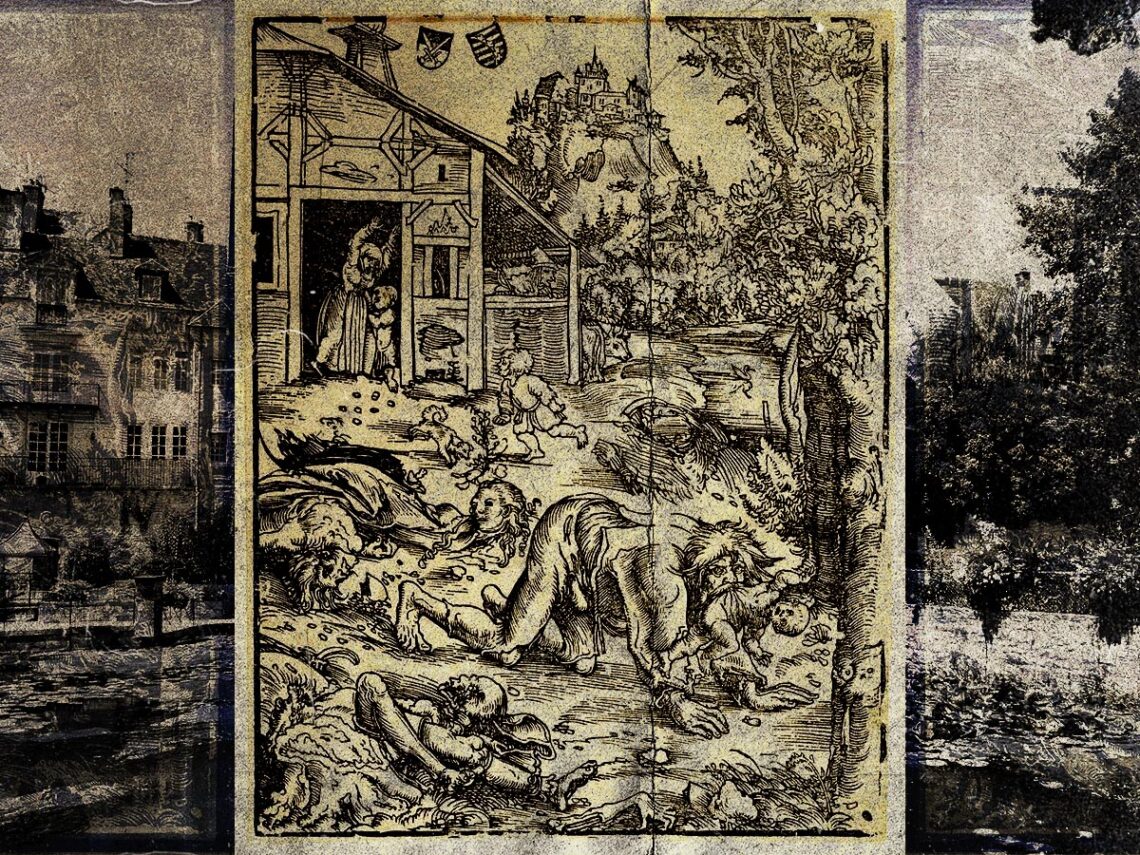
Eight days after the body of the first child was discovered, another girl was attacked in broad daylight – her throat gouged and her abdomen torn open. The witnesses to the attack would later testify that they’d come across Gilles feasting upon the girl’s body in his wolf form, though they didn’t know it was him at the time. A week later, a ten-year-old boy was killed while walking through a vineyard. Like the first child, the boy was strangled, the flesh torn from his arms. Unlike the first victim, however, the boy was found with both of his legs missing. Then, another week later, the screams of a fourth victim were heard coming from the woods. A group of local men followed his cries for help and soon found Garnier – in his human form this time – pulling the flesh from the boy’s body. They managed to apprehend Gilles, but the boy, just 12 years old, was already dead.
Some say Garnier confessed willingly; others that he was tortured for days on end. Either way, he was found guilty of witchcraft and burned at the stake on January 18th, 1573. Today, most inhabitants of Dole aren’t even aware of Gilles Garnier or his story. But if you visit the town’s Musée des Beaux-Arts, you will see a fountain decorated with what everyone will tell you is a lion’s head. To my eyes, it looks remarkably like that of a wolf. To read more about the landscapes and history of France, check out our article on one of its oldest pilgrimage sites: Mont-Saint-Michel.
