


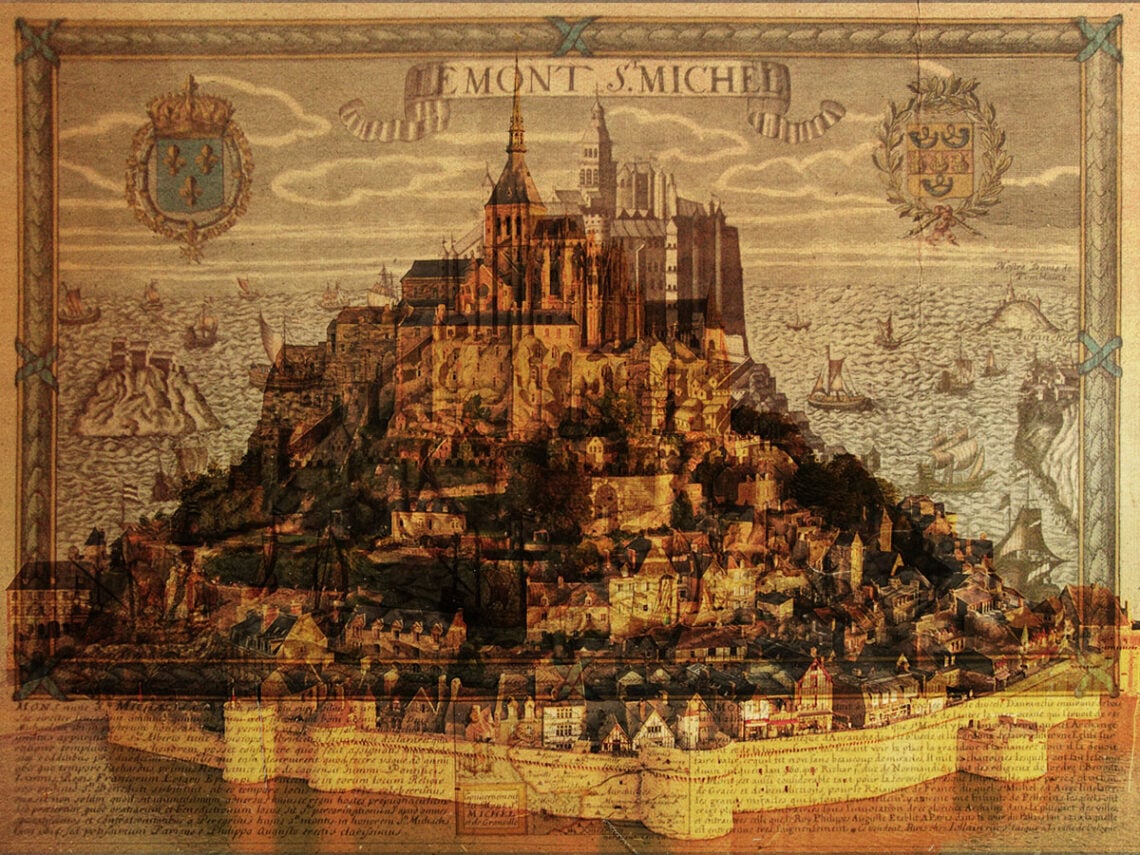
Modern Pilgrimages: the passage to Mont-Saint-Michel, Normandy

The idea of going on a pilgrimage might seem rather Christian, but even birds can be pilgrims. The word stems from the Latin noun peregrinus, which means stranger, foreigner or traveller. The peregrine falcon, a bird capable of dropping from the sky at 390km, is so named because she will travel widely to find her prey. Humans, it would appear, are equally irrepressible. Being a nomadic species by nature, we are quite literally made to move. It’s no surprise, then, that the act of travelling has, throughout the centuries, bought many people a sense of clarity and purpose. In this series, we’ll be tracing ancient and modern pilgrimage routes, offering you a breakdown of what to expect and – hopefully – some inspiration for your own trip. This week: the passage to Mont-Saint-Michel in Normandy, France.
This ancient stone church, located on a remote tidal island, is one of the most beautiful sites in all of France. There are countless ways to reach it, but the most common route begins in Rouen and winds through Barneville-sur-Seine and Vimoutiers before ending up in Avranches or Genêts. You can also travel from Caen, Cherbourg and even Paris.
There are also countless ways to experience the journey. Traditionally, Christian subjects undertook pilgrimages to deepen their connection to god, but many modern-day pilgrims are going for secular reasons.
Whether you’re looking to overcome a personal obstacle, develop resilience, grieve, or just immerse yourself in nature, the best thing to do is to start putting one foot in front of the other.
The History of Mont-Saint-Michel
Since the 12th century, pilgrims from all over Europe have been flocking to the abbey, crossing great distances through sun-dappled woodland and bustling market towns to reach the enormous expanse of sand and salt marsh that encircles the islet.
The crossing is far from easy, but it was even more complicated in the Middle Ages. That was when the island was located much further out in the bay, meaning pilgrims had to wait until low tide and then dash across seven kilometres of quicksand and mud to reach the sacred spot. The Bayeux Tapestry of 1066 depicts Harold, Earl of Wessex, pulling two Norman knights from the Mont’s quicksand. They were by no means the last to be consumed. In 1318, 30 pilgrims drowned before reaching the island. No wonder St Michael’s Abbey – built under the order of Angels, so it goes – was once known as “St. Michael in peril of the sea”.
Those pilgrims, or miquelots, who successfully made it to Mont-Saint-Michel were rewarded with one of the most spectacular sites in Medieval Europe. The first sanctuary on the island was erected in 708 AD by Bishop Aubert on the instruction of Archangel Michael, who apparently burned a hole in the cleric’s skull before he agreed to the endeavour. Benedictine monks arrived in 966 and, under the authority of the Abbot, transformed the remote spot into a centre of culture and learning. Known as the ‘City of Books’, Mont-Saint-Michel became a major pilgrimage site in the Christian West, attracting royals from all over Europe.
During the Hundred Years War, the English army besieged the island twice but never managed to penetrate its stone walls. The abbey’s fortifications proved useful in keeping people in as well as out. During the French Revolution, the dungeons were filled with political prisoners, earning the Island the nickname ‘Bastille of the Sea’, and during the Second World War, it became an important lookout post for the Luftwaffe, with some servicemen taking up residency in the abbey itself.
The Route
For the medieval pilgrim travelling from the quiet pastures of Flanders or Picardy, walking into Rouen, the old capital of the former Duchy of Normandy, must have been a dizzying experience. A centre of trade, the town experienced a huge economic boom from the 13th century onwards, giving rise to the monuments, churches and elegant timber-framed townhouses that speckle the city today. It is here, on the same soil Joan of Arc was burned at the stake, that many choose to begin their journey.
There are a number of possible routes from Rouen to Mont-Saint-Michel. Most modern pilgrims tend to follow the old medieval pathways, which will take you through the Roumare Forest in Val-de-la-Haye and across the River Seine at La Bouille. From there, the path meanders through the ancient forests of Montford and to the Abbey of Le Bec Hellouin, where it cuts through the Risle valley and across one of the Charentonne rivers.
Historically, it was at this point that most pilgrims found themselves walking alongside fellow wanderers. At LePont de Vie near the town of Vimoutiers, the route was already well known in the eleventh century and was already being referred to as “the path” to Mont-Saint-Michel. Modern pilgrims use the same route today, arriving at the coastal fortress of Falaise – a taste of the grandeur to come – before embarking on the last stretch to Avranches.
From here, you should be able to see Mont-Saint-Michel and the surrounding bay from the botanical garden. Now all that remains is to take off your shoes, roll your trousers up to your waist and make the crossing. Keep an eye on the tide.
You can learn more about pilgrimages to Mont-Saint-Michel here.
