


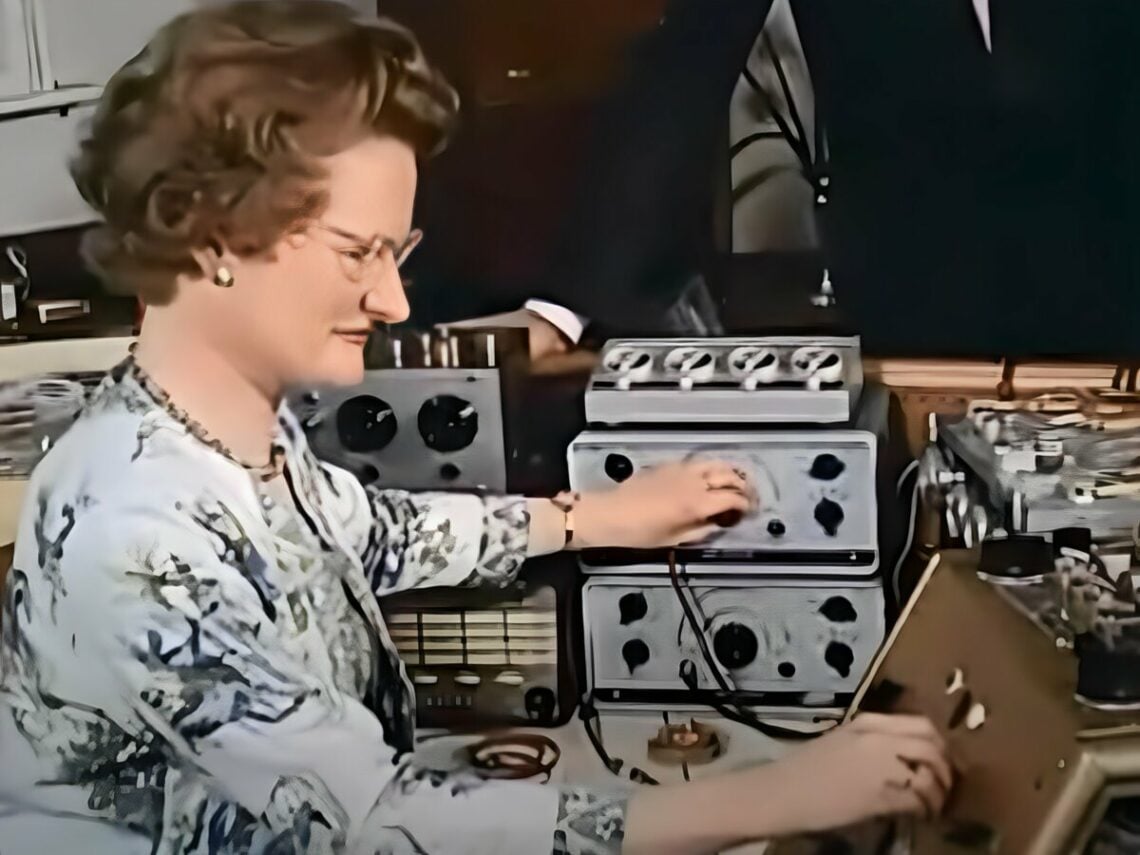
Daphne Oram: the ghostly Godmother of modern music’s home studio revolution

The music industry may have been a very different place today if it hadn’t been for the meddling ways of a medium named Leslie Flint. This oracle to the underworld was all the rage during the Second World War. Understandably so, some 80million lives were in the process of being lost, and the proximity of death was never closer, so it made perfect sense that we’d try to contact them in some way. However, this was an act that completely turned Daphne Oram‘s life on its head.
She was planning to be a nurse. However, when she was 16, her father invited Flint round to perform a séance. “Flint employed the ‘independent voice’ form of mediumship, in which voices of the dead speak aloud as objective sonic manifestations without any physical apparatus,” Dan Wilson writes based on James Oram’s transcription notes of the event. At this particular séance, a nun decided to make her voice heard. The nun was suitably vague until she proclaimed that Daphne should take up music for a “great musician” from the beyond, which would help to propel her to a seminal status.
The hints to Flint that this ghostly pronouncement would excite the family were readily apparent, Daphne’s keen interest in music was scattered around the household. Ever since the age of ten, she had wanted to construct a ‘super instrument’ that created an array of sounds no current acoustic apparatus could imagine. Thus, the questionable edict of an unknown nun was enough to convince everyone present that she should forego nursing and instead look to enlist her services to the BBC’s radio department and soon become the conduit for Chopin in his coffin.
She was very gifted, intelligent, and if Flint’s nun was to be believed, she had supernatural assistance to boot. Thus, she rose through the ranks quickly. At first, her role was to stand by a back-up vinyl on a turntable and drop the needle if the radio’s live performer was killed by enemy fire. Then, she balanced the studio sounds and steadily became more involved in the production side of radio. Surrounded by cutting-edge equipment, she began to experiment after hours, and suddenly, her childhood dream of a super instrument didn’t seem so silly.
By 1949, she was ready to unveil her masterpiece, ‘Still Point’. Her complex arrangement took music in a futurist direction. Composed for two orchestras, electronics, and dual turntables, it paired man and machine. It turns out it was a little too futurist, particularly for a woman in a stilted age. So, it was rejected by the BBC, but at least the dexterity behind her ambitious project was recognised, and Daphne was promoted to the position of studio manager. Once again, she was a woman, so her salary for such a lofty position wasn’t what it might have been, but she was still relatively flush and surrounded by all kinds of tools.
This created a strange confluence of factors—she was wealthy, and had an arsenal of technology at her disposal, and she was also brimming with ideas (who knows, maybe Chopin the friendly ghost was proving two minds were better than one), but the powers that be were preventing her from reaching her true creative potential via typical channels. It was this tricky disposition, coupled with an already slightly off-kilter view of the world, that led Daphne to become a sort of secret scientist of music—Dr Frankenstein looking to coax music out of thin air.
Thus, in 1959, she left the BBC behind for good to set up her own home studio. While there she created their first electronic music commission piece and set up the BBC Radiophonic Workshop. Now, in her home studio, she invented Oramics, a device that allowed users to draw their own music. Flint might claim that this was the ‘independent voice’ rendered electronic. But what it did do was render Daphne, the great musical pioneer he had predicted.
However, her legacy goes beyond that machine. Her weird and wonderful machine’s exposure in dispatches after its 1959 completion created a culture of shed-based sonic experimentation. In many ways, she was an indie DIY star whose rejection of the BBC signposted new possibilities for would-be musicians struggling to make it via typical channels and relishing the potentials of innovating on your own time. Not only were the technologies and set-up she established influential when it came to home studios and subsequent streamlining incarnations like GarageBand, spiritually, she illuminated an indie future.
Furthermore, the Radiophonic Workshop she left behind led the BBC to create synthesised soundtracks for radio programmes, and individuals who would otherwise fail to find a place in an orchestra had an outlet for their creativity. Once again, the parallels between this and the modern climate of home-bound musicians are readily apparent.
As she put it herself: “Once the composer can write without the limitations of performance, his palette is extended enormously… Rhythms become anything the composer can visualise without them having to be playable. Timbres have no registration, and theoretically, any sound, musical or otherwise, is within his grasp.” Just a few days ago, while fooling around on a brand-new app, I realised these possibilities myself on Daphne’s home studio-made miniature: a laptop.
She would go on to have a huge bearing on the development of music in the 20th century, even if her impact was under-recognised because of her sex. And in 2018, 15 years on from her passing, her opus ‘Still Point’, channelling the sounds of nature through electronics in the perfect collision of classical and futurism, was celebrated at her old haunt, the BBC and performed in full at the Proms.
The beauty of all of this is that beneath it all, there was still the lingering quirk of the ghostly night that spawned it all. As her official biography hints: “In the late 1970s, Oram began a second book, which survives in manuscript, titled The Sound of the Past – A Resonating Speculation. In this manuscript she speculates on archaeological acoustics, and presents a theory backed by research that suggests that Neolithic chambered mounds and ancient sites like Stonehenge and The Great Pyramid in Egypt were used as resonators. She said that her research suggested that the ancients may have possessed acute knowledge about the properties of sound in long distance communication.“
