


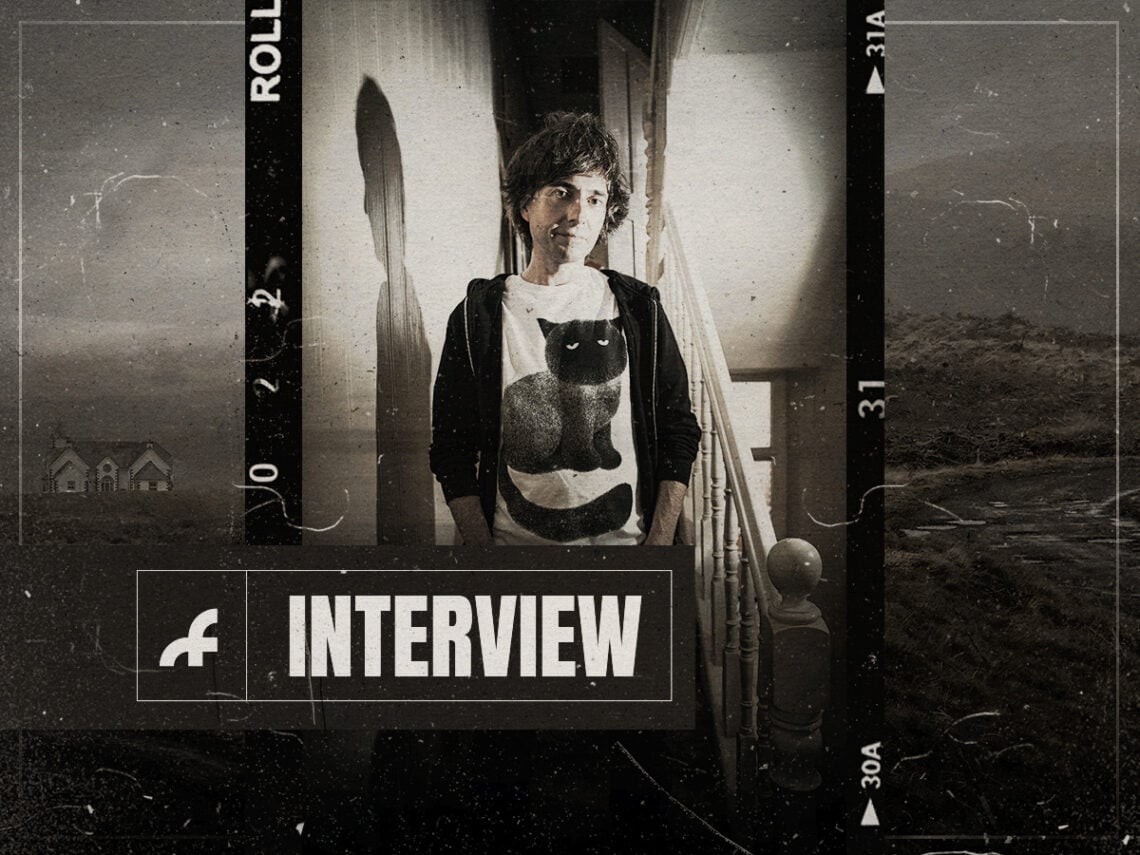
Danny Robins picks the scariest film of all time and its harrowing pivotal scene

Over the last few years, Danny Robins has transformed the underworld. For too long, the realm of ghosts and ghouls had been beset by a cheapness that really had little to do with the genuine lure of the seemingly unknowable. In these trying times where everything else is argued as defiantly knowable and death lingers perturbingly close, Robins has not only raised his monocle to mystery like the Basil of Baker Street made human but also created a comfortingly converseable space for considered discussion. Like the great figures of the past, Daphne du Maurier and Shirley Jackson, he takes his literary time to set a scene and revels in the nuanced world of spooks therein.
Consider this scene: Venice, in its brief winter solstice, assumes an inherent strangeness. First and foremost, like many places that find themselves in a season that doesn’t fit, there is an incongruity to coats and calmness in cafés much more used to befitting bustle that renders them somewhat internally puzzled, like a usually raucous stadium during a meaningless midweek game. Then there’s the strange, uncertain descent of darkness casting a sudden, unfamiliar cloak of secrecy as the shrouding fog lifts from the watery arteries of the city. But above all, there’s a sense of an empty school about the usually heaving streets rendered temporarily desolate. It’s here where Robins’ favourite horror takes place.
“The moment in a horror movie that sticks in my head the most has inspired me in lots of different ways. The film is Don’t Look Now.” The classic 1973 movie was directed by the acclaimed Nicolas Roeg – also known for the likes Walkabout and David Bowie’s otherworldly adventure, The Man Who Fell to Earth – and is loosely based on the du Maurier short story of the same name. It pairs the pains of grief with the unsettling world of ghosts in a fashion that makes it just about the only movie that can be classed as both tear-jerking and terrifying.
This empathetic approach to the paranormal is profoundly present in Robins’ work, right down to aesthetic easter eggs. “It provided the inspiration for the red coat I wear in Uncanny,” he gleefully divulges over Zoom. “It’s probably the most terrifying use of a red coat in any recorded medium. I don’t know how widely known the film is these days, but it’s a classic from the 1970s, and it is a piece of art. It’s a really beautiful, amazingly shot, artistic movie, and yet, it still manages to be really bloody scary.”
“There’s a recurring motif in the film of this red coat,” he continues. “The couple at the heart of the film that Donald Sutherland and Judie Christie play lost their child, their daughter drowned, and she was wearing a red coat when she drowned. So, you have some very evocative and moving early scenes of her death wearing this red mack, then Donald Sutherland’s character keeps seeing this red coat in different instances throughout the movie, and it builds. Then they’re in Venice off-season, this depressing, dark, wintery Venice, and he keeps seeing this character in a red coat.”
For the next two paragraphs, there are spoilers, so beware of that ghastly shock, too. “There is a moment where he catches up to a character in a red coat which he thinks is going to be the ghost of his daughter, and when this character turns around, it turns out to be something very different and very, very terrifying,” Robins recalls, tactfully hinting at the decrepit figure Sutherland is faced with. “I think, for me, it nails that moment that is just a great horror movie technique of that thing we think is familiar to us that turns out to be very unfamiliar and frightening. There is something terrifying about feeling that you’re with somebody comforting and familiar to you who turns around to be something totally different.”
However, it isn’t the only movie that nails this, as he continues: “There’s also that shot in the Blair Witch Project – the moment at the end where he’s standing with his back to us, and there is something about being behind someone, not knowing what you’re going to get when they turn around that is terrifying and is very effective in horror movies. I think the moment in Don’t Look Now is probably the best cinematic rendering of that.”

Vitally, it isn’t just a shock that Roeg creates but a moment that proves emotionally confounding. When the shriek subsides from your eardrum, you’re left mulling over the horror for a while. This is something Robins has beautifully captured in his Uncanny-verse too. “Don’t Look Now is a movie that plays with the ambiguity of whether the paranormal is real or not, and that unsettling thing of not being able to trust what you are seeing. It is a movie that stuck with me for a long time,” he says.
“I first watched it as a student for an aspect of my degree course, and it really stuck with me in a big way,” the Ken confounding espouser explains. “Just that red coat became so ingrained in my mind as something synonymous with horror. Then I had an experience recently where I actually met the guy who wrote the movie; a guy called Alan Scott, who is one of the co-writers. And I said to him, ‘My coat in Uncanny is a homage to your film’. It’s a brilliantly written movie. I read the original Daphne du Maurier short story that it is based on recently, and what the screenwriters managed to achieve there to adapt it for film was really clever. They moved it on and took it into even more terrifying and emotionally moving territory. For me, it is definitely a real inspiration point.”
It is easy to see this in the world of ghosts that Robins has created. Typical tropes are transfigured with a lashing of evident empathy. As he wonderfully puts it, “If you’re a believer, it’s a whodunnit, and if you’re a sceptic, it’s a howdunnit.” After all, as Don’t Look Now proves, nothing is more terrifying than a sane mind suddenly tortured into a questioning disposition, for that besiegement doesn’t care about your previous stance of belief.
As Robins says of the film, but could just as easily be describing his own work: “It takes very ordinary, recognisable and believable characters, and it is frightening to us because we believe in the people, I think. I’ve always felt that the things that scare me most are the most real. I don’t get scared by CGI ghosts or fantastical daemons or werewolves. I get scared by real people being in extraordinary and unsettling situations.”
However, while that might have been a nice note to leave things on, there is one brushstroke to Robins’ work that Roeg also tries to muster: it has great charm and an indie sense of artistry. This is typified by his endearing aesthetic on the new BBC series Uncanny. “There’s a lot of coat lust going on at the moment,” he laughs. “There’s a lot of people asking where I got it. And the people who made it have stopped making it now. I tried to get a new one because mine is falling apart a bit, and they don’t make them anymore.” So, a note to the designers: surely there’s a bespoke one on the way, then?
Danny Robins is currently on tour with Uncanny Live, with plenty of shows still remaining. The BBC series is also currently airing, and his brilliant book relating to the series is out now.
