


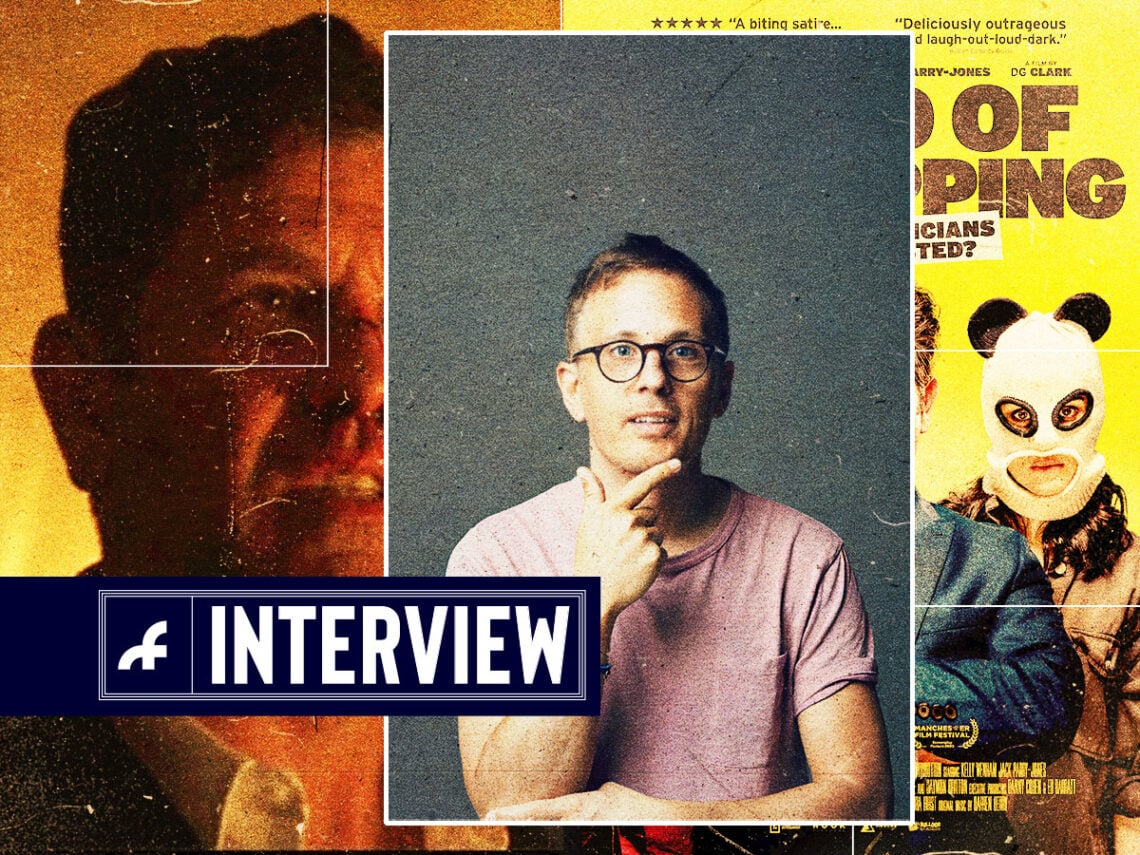
Dan Clark talks politics, comedy and his new film ‘A Kind of Kidnapping’

I had wondered where Dan Clark had been for the better part of a decade. Unsurprisingly, the creator and star of the cult British comedy How Not to Live Your Life has been busy with different endeavours. Not long after the show ended in December 2011, he had a brief appearance in Noel Fielding’s Luxury Comedy and a fleeting music career, but after this, Clark seemed to disappear from the public eye. So, when it materialised that under the moniker DG Clark he had written and directed a new feature-length film entitled A Kind of Kidnapping, there was an opportunity to chat, and it wasn’t a chance to be spurned.
Starring Patrick Baladi, Kelly Wenham, Jack Parry-Jones, Olivia Poulet, and Clark’s How Not to Live Your Life co-star Leila Hoffman, A Kind of Kidnapping is a darkly comic tale. It follows a 30-something couple, Maggie and Brian, who are struggling to get by, with one a failing actor and the other a taxi driver, respectively. When the opportunity arises to escape financial dire straits, they pounce and kidnap slippery London politician Richard ‘Dick’ Hardy, demanding a ransom.
As expected of Clark’s brand of comedy, nothing goes to plan for the pair. No one wants to pay Hardy’s fee, so he forces himself into the situation. In an intelligent interpretation of the most egregious characters in modern British politics, Hardy wonders how to exploit the kidnapping and use it to his advantage. What ensues is a tragicomedy of the finest sorts, with the main characters complex individuals and the stars doing excellent jobs in bringing the script to life.
“I’ve been on a very bizarre journey as I’ve got to here,” Clark tells me as we embark on a journey into his career, the state of British comedy, politics, and his new film. Within an instant, we were discussing the cost of living crisis, the most popular topic engulfing this sceptred isle. This was fitting, given that it plays a prominent role in A Kind of Kidnapping.
After waiting in the Zoom call for around 15 minutes, Clark popped up on the screen. Instantly amiable, he apologised and explained he was expecting a phone call until he realised it was a video chat instead. Swiftly moving on, the comedian said he was in his native south London, but that might soon be changing. He and his wife Kelly Wenham – who steals the show as the complicated but ultimately loathable actor Maggie in the movie – plan to relocate to Spain for a few months to change pace and, more importantly, stop “annihilating money”.
“It’s just become a very odd time, and it’s not like I’m on the breadline or anything like that. There are people who are really struggling, but I’m just at that age where for the first time ever, I’ve thought about the future,” he explains. “I never used to be that person. I’m like, ‘Oh, I don’t want to be the guy that just always lived day to day, and now I’m an old person with absolutely fuck all to show for it’.”
This outlook arrives after Clark, now in his mid-40s, has stopped going to the upmarket restaurants and members clubs as he would in his 30s, a time in his life that he recognises wasn’t thinking about the future. This is understandable, I think to myself. After all, he had just written a successful sitcom. “I’m not doing anything like that,” he maintains of his former lifestyle, “And yet, it’s still so expensive just to survive. And we just thought, like, what are we going to do? Are we going to look back and go, we spent probably 60 grand a year just to say we live in London?”
This segued into comparing today’s state of play with the era when Clark was in his teens and 20s – between the mid-1990s and mid-2000s. We spent a fair while contemplating whether people not fixating on the future had led to a golden age of sorts of British comedy and the arts, as society allowed people the freedom to spend their time doing as they please, without being forced into a serious job, or to spend all their time worrying about paying bills. After all, the Cold War had ended, it was Blair’s Britain, and for a time, things were exciting. Reflecting on how times have changed, Clark says: “There isn’t freedom to go, ‘I’m just going to experiment and try this little thing here, and it doesn’t matter if it doesn’t make money’. We definitely had that luxury.”
As Maggie is a character of genuine value and plays such a dominant role in the film, I was keen to understand whether she was based on Clark’s actual experiences or the current malaise affecting the millennial and similar population brackets. “I mean, it is,” he starts, before outlining the attitude with which he approached A Kind of Kidnapping and his general take on comedy. The Bromley native maintains that none of the main characters are likeable, as they all do “really bad things”. Even Maggie’s boyfriend, Brian, who Clark explains is the closest thing to “semi-decent”, sex shames his partner, nullifying any hope the audience has for him.

Despite their individual complexities, Clark intended for his characters to be deplorable. He continues: “I’ve read one review that said that, ultimately, they found the characters too unlikable, and I’m like, well, that’s fine because that was my intention. I wasn’t trying to write likeable people. The way I see the film is it’s a sort of tragedy. We’re not really rooting for them. We’re watching the situation play out, the car crash happen and seeing who will get hurt the most. And I’m OK with that. Rik Mayall was my comedy hero when I was young before my tastes changed in my later teens. He had always been my idol, and he relished in playing horrible people; that was his thing.”
Clark maintains that while Mayall had an impact on his youth, this isn’t the only approach he appreciates when watching comedy, mentioning rom-coms and even Friends among his tastes. Regarding the American sitcom, he understands the characters are all “ridiculously likeable – if you like those sorts of people”. However, something about more elaborate, shadier characters appeals to him most.
Clark used Jesse Armstrong’s series Succession – a huge cultural hit – as an example of comedy that utilises flawed characters to make its point. Words don’t do it justice, but the conversation suddenly took a jocular turn when the comedian stumbled on the show’s title a couple of times before acknowledging, “I’ve turned into Sean Connery”. Following this, he purred “Succession” through his teeth, just like the James Bond star. This was the kind of thing you’d expect from How Not to Live Your Life protagonist Don Danbury. The character was full of movie references.
Of Succession, Clark resumed: “I remember when it started, people struggled to get on board, but I loved it immediately. And I think of whoever wrote that review. I’m like, ‘Well, did you like Succession?’ If they didn’t? Then you go, ‘Well, you just don’t like characters that are that flawed. Like, you need an element of redeemability to enjoy something, which is fine”.
He adds: “The things I really love are when characters are really flawed”, before using Netflix’s Beef as an example of a recent comedy that makes the audience work for their dividends.
It was put to Clark that this individual was clearly uninformed about his style of comedy, as Don Danbury was a particularly flawed character and achieved cult status by being so. Interestingly, some people’s inability to separate him from his character was something Clark initially struggled with until How Not to Live Your Life started to gain traction after the BBC repeat aired the first season. This led to two more seasons, increased viewership and a Christmas special. Eventually, Clark became at ease with the parameters of his comedy. He knew what he wanted to do, and it didn’t matter what people thought. He was lucky, too, as many people loved it. While Clark knows his work didn’t cross into the mainstream, those who valued it were “fanatical” about the 29-year-old Danbury’s journey from man-child to a genuine human being. “It felt like a secret amongst mates,” he reflects.
This was the perfect opportunity to enquire about what happened to his series. Ironically, Clark struggled to take his career to the next level because How Not to Live Your Life was such a cult show and never fully pierced the mainstream. Things didn’t fall apart; it’s just his overlords moved the goalposts. After cancelling the show, the BBC offered Clark the opportunity to attempt a BBC One version of his comedy with a new show distinct from How Not to Live Your Life. He couldn’t do it, though. BBC One humour is too safe and clean, and that’s not him.
Would this have been Clark’s version of When the Whistle Blows? He laughs, and it was unsurprising to hear that it would have been. He even aimed to film it in front of an audience. But, this was because he believes titles such as Only Fools and Horses, Porridge and Men Behaving Badly, and many mainstream 1970s and 1980s comedies were refined in how they appealed to a mass audience whilst having a subtle edge of darkness.
Naturally, Clark was intrigued by the challenge of seeing if he could present his work in a BBC One format and subtly slip in the edge, oddness and quirks of How Not to Live Your Life. He rightly believed it would have been a feat if he could achieve this, but “they just would not go for it. I mean, the notes I was getting were, you basically want me to write Mrs. Brown’s Boys, which is fine, but I don’t do that”.
There was one last thing to ask him about his cult series: the dressing gown. As fans of the show will remember, Danbury frequently wore his dead grandmother’s robe, a polyester number composed of different shades of pink and a kitsch floral pattern that fell just below the knees like a parka. This became the show’s most identifiable aspect and appeared to symbolise Danbury’s refusal to grow up, with him constantly moping about the house in it, eating sweets and singing songs about copulating with mermaids.
However, it was all an accident. “That thing was awful. It was like a polyester nightmare, just trapping heat and itching. We actually sold it for charity,” Clark says. “The crazy thing was that there was only one. When you’re filming, you have this thing called ‘Repeats’. So, if you’re doing a scene with blood or liquid, you have to have an identical version of that costume. But we never did because we got it from a charity shop when we did the pilot. I didn’t even write it into the script that he wears the dressing gown. When we were shooting, I grabbed it and said, ‘It would be funny if he puts that on and answers the door in it’. And then it stuck. It became the thing, but we never had a repeat of that. If ever I was doing a scene in that dressing gown, and there was mud, liquid or red wine or whatever, you saw the wardrobe department freaking out, they were sweating, going, ‘Please. Don’t get anything on it’.”

For the final juncture, Clark needed to explain the motivations behind the slippery politician Dick Hardy in A Kind of Kidnapping. Did he base him on anyone in particular, or was he an amalgamation of general political sleaze? “He is an amalgamation,” Clark explains. At first, Hardy wasn’t even intended to be a politician. Clark knew he wanted the script to be “deeper than just fun comedy”, and one day he stumbled across the idea of the character being an MP, as currently, politicians want “to be noticed” like celebrities. Their only desire is to trend on Twitter and get hits on social media like everybody else.
Touching on the tangible charm and consequence of A Kind of Kidnapping, Clark gets profound: “Everyone wants the same thing now,” he says. “Regardless of their profession, even multi-billionaires are not happy. They now want to be celebrities and fly to the moon. So, it’s basically that the left-wing actress and the right-wing politician are actually much more similar than you would think.”
Getting more specific, Clark says that Boris Johnson has always been a presence, but when he became Prime Minister in 2019, things started to get too close to the bone, particularly with the behaviour of acolytes such as Matt Hancock working to stick the boot in. The film was shot two summers ago, and due to the uncertainty of the revolving door of Prime Ministers and the talk of an early election, he admits he was worried that his “cynical movie about the state of our country” might lose its impetus as there might be no “horrible Tory government” when it arrived.
However, you can always count on those in power to pull us back down. At the end of last year, Matt Hancock took part in the reality TV show I’m a Celebrity… Get Me Out Of Here! and entered the jungle in an alleged bid to raise awareness for his dyslexia campaign. However, his real motivations could not have been more explicit. Clark asserted that he was not bashing the Conservatives and maintained that some are probably alright, but of Hancock, he said: “I don’t think anything he did on that show was at all likeable. He seemed so insincere and disingenuous.”
The comedian then cited a car crash of an interview that Hancock gave after appearing on the reality show, where he was interrogated on his supposed efforts for the dyslexia campaign. This moment confirmed that Hancock was just a “total charlatan” all along. Whilst it was not a pleasant experience watching the MP reveal his true colours in front of the nation, Clark recalls thinking, “Yes, we’re back in the game,” with a laugh. Explaining why Patrick Baladi was perfect for playing Hardy, Clark adds: “Baladi’s got a real charm to him and is good-looking, and Hancock isn’t.”
Regarding the ending of A Kind of Kidnapping, which leaves a sour taste because of how realistic it is, Clark concludes: “It’s a nod to what Trump started, and Boris continued, which is: It doesn’t matter how bad the thing is that people are accusing you of. If you can spin it into some form of entertainment, you’ll get away with it. They’re saying Trump will still run for President when he’s an out-and-out criminal. There are no two ways about it.”
I get the sense that Dan Clark has entered a different phase with A Kind of Kidnapping. Whilst he will always be remembered for the brilliance of How Not to Live Your Life, times have changed, and comedy such as his new film is more vital than ever as a tool for analysing our flaws. A stellar reflection of British independent cinema, his latest offering is a parable, demonstrating that if we really want to escape the clutches of this current juncture, there’s work to be done – even on the supposedly righteous side. It’s good to have him back. But please, call him by his new name; DG Clark.
