


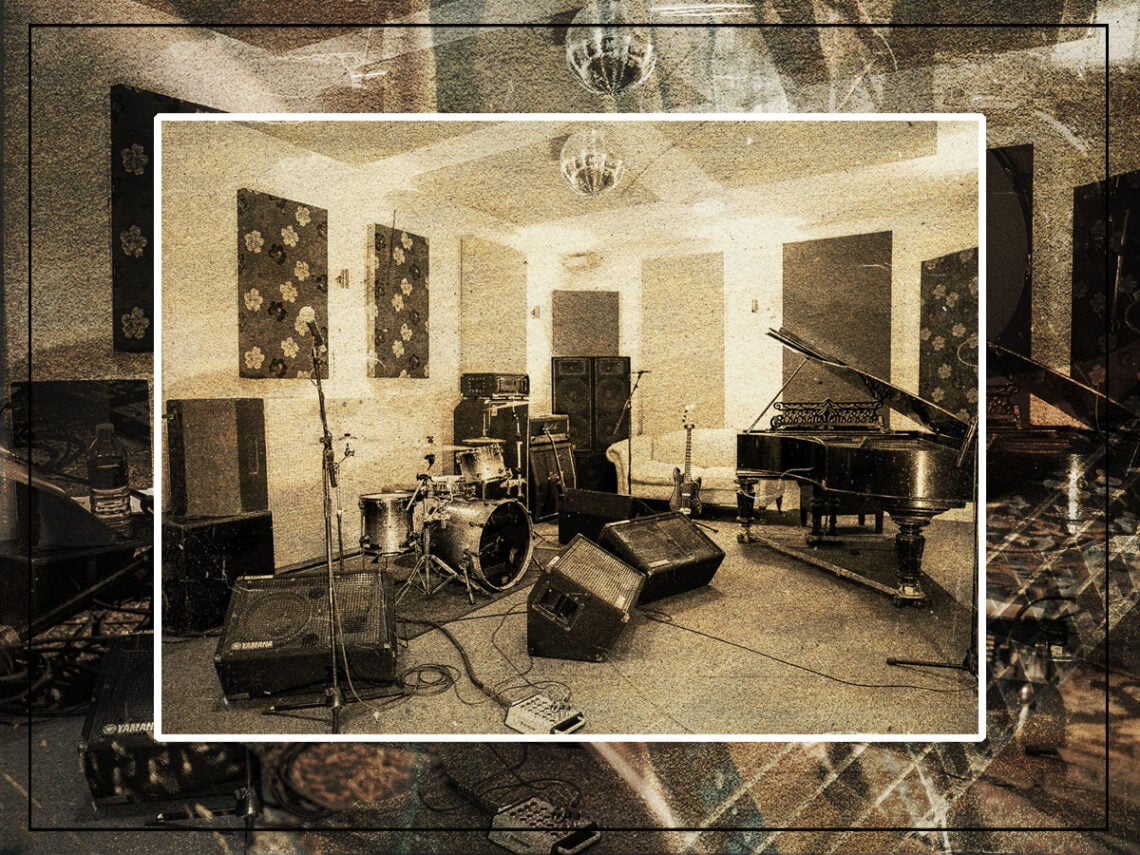
Save Brixton Hill Studios: Vital South London rehearsal space discuss fight to stay open in the face of unbridled profiteering

Another week, another cultural institution under threat of closure. The latest quarry in the crosshairs of the outlandish British economic configuration is Brixton Hill Studios, a recording and rehearsal space that’s been a pillar of the South London community for almost ten years. Providing a personable and tailored space for people of all backgrounds to practice their craft, ranging from children to professionals such as Black Midi and The Orb, it’s an environment run by musicians and for musicians, with genuine care underpinning everything they do.
Brixton Hill Studios is a vital creative hub, yet due to an eye-watering 133% rent hike by a landlord unwilling to negotiate, the beloved institution and nurturing ground is now threatened with permanent closure. This troubling reality arrives despite the space’s importance to the local community and the fact that they’ve already successfully outmanoeuvred the pandemic, an incredible feat that counts for nothing in the face of such rampant greed.
On June 6th, a petition was started by Brixton Hill Studios to show Lexadon Property Group what the studio means to the community. Aiming to break the 2000 signatures mark, the petition closed today on 5800, with many more joining the fight after the fact, evidencing the studio’s significance. The campaign made such an impact that on Thursday, Lambeth Councillor Olga Fitzroy, local Labour MP Bell Ribeiro-Addy and the Mayor of Lambeth, Sarbaz Barznji, met with the owner and staff of Brixton Hill to discuss the matter. As the petition is now closed, it will be presented to the landlords and Ribeiro-Addy, with a final decision to be taken. Now is crunch time.
Highlighting the importance of Brixton Hill Studios to the community, many prominent names from the music industry have supported the petition. On June 13th, Black Midi took to Twitter, urging people to sign: “Brixton Hill Studios, where we rehearsed on the day of our first show and countless times since now faces closure due to an extortionate rent increase by its landlord. This kind of story is far too common, please take a moment to sign if you have a moment.”
Elsewhere, Tom Robinson, Steve Lamacq, John Kennedy, Graham Coxon, Dinosaur Pile-Up, Big Joanie and Jim Bob have all supported the cause. Brixton Hill Studios have received such an encouraging volume of backing that even Tony Visconti, the eminent producer famed for his work with David Bowie, Paul McCartney and Marc Bolan, took a moment on Twitter to back it. He wrote: “Stop closure takeovers in Brixton. My dear friend Stephen Gilchrist has a wonderful recording studio there.”
I spoke to Brixton Hill Studios founder and director Stephen Gilchrist to discuss the juncture they now find themselves at. We commenced by touching on what happened when they met the local politicians yesterday. Although he was tired and didn’t elucidate what transpired, Gilchrist appeared somewhat hopeful about the situation.
He says: “We had a really good but emotionally tiring day yesterday. I don’t know what else to say, really. It was just an emotionally tiring day. But it was good. We had a visit from our MP and councillors. The Mayor of Lambeth came and visited us as well. And the support we’re getting from people in the community up to the council is just fantastic. It’s brilliant. It’s very touching.”
Reflecting on how his staff and prominent supporters have been vital in spreading the word, Gilchrist continues: “There have been a few people, you know. The members of staff here are just really great, and they care, so they’ve been doing a lot. But people like John Clay, whose nom de plume is Clark Kent, does a lot of videography and has done it here. He’s also a singer in Colossus, who’ve reformed recently. He’s just been going at it hammer and tongs. I think we’ve had a few friends in high places. Tony Visconti being one, his retweet ended up in the London Standard yesterday.”
“It highlights how important we are to people. I think we knew that we are an important resource, because we knew what we did. But it’s almost like you didn’t really know how they felt. It’s almost like one of those things where you meet somebody, and you like them, and they like you back, and you’re bowled over by it. It’s been really great,” he explains.
So what does the future hold for Brixton Hill Studios? Unsurprisingly, Gilchrist nor anyone, bar perhaps the landlord, knows at present. Accordingly, this was his opportunity to tell us how his business and the landlord came to the current impasse. He provided us with his side of the story, painting a picture of a commercial entity unwilling to communicate, let alone negotiate, in a story that’s all too familiar. Gilchrist maintains that he’s been trying to open a conversation since September, but only recently received an answer.
The Brixton Hill Studios boss says: “All I can say is that there are people who are fighting our corner, and if anything can be done, these are the people that can do it. But ultimately, it’s all about persuading the landlord to give us extra time. I appreciate the property is his business and developing property is his business. And that’s what he wants to do, so good luck to him with everything. I don’t have a problem with him doing that. But I asked back in September what was going to happen, and he said to me that they wanted to retain us and that we could come to some kind of arrangement, and then in March, I still hadn’t heard anything. And I had to say, ‘Look, I’ve got staff; I need time to work out what to do. Can you let us know?’ – thinking it would be time for negotiation.”
Further outlining the attitude of the other end, he explains: “He sent somebody briefly, who then came back with this astronomical rent rise, and it was just not achievable. Now, it’s well over double what we’re paying – we’re paying a very good amount at the moment. But there are places in the area that are between £12 and £14 per square foot. And then there’s another one that my landlord has that was £18.50 but has been empty for five years – this is an industrial unit, the one opposite us.”
“They claim someone’s moving in, which I’m sure they are. But it was empty for five years, and they want £22.50 per square foot. That’s not the market average, that’s not the market rent, that’s them sticking it up. I’ve argued several valid points with why this shouldn’t be more expensive; if anything, there are reasons why it would be slightly cheaper with the estate agent, but it’s almost like arguing with a contrarian; he had an answer for everything that’s not necessarily substantiated,” Gilchrist reveals.
Highlighting the damning stranglehold that landlords have in this situation, he continues: “They may think otherwise, but as far as I’m concerned, I have to play devil’s advocate with this and be reasonable about it. I have tried to negotiate. There is no room for negotiation. I have been entirely honest with our situation from the beginning. I’ve tried to appeal to my landlord, I’ve written to him directly, asking for more time so we can relocate, and he won’t even acknowledge the letters. I don’t know what to do.”
Strangely, Gilchrist and his team were just about to pull the plug on the business by announcing it on social media when they finally got a response from the landlord. As we know, it wasn’t the news they had been hoping for since September: “So, we heard nothing, and we were at the point of, ‘Well, that’s it’. Then, we got the email saying he wouldn’t even let us stay until January. So he wouldn’t even give us three extra months to sort things out. We were literally about to press send on the Facebook post to say, ‘I’m really sorry to say this guys, but it looks like we’re gonna have to close.'”
Despite the pressure from the landlord, Gilchrist is over the moon at the positive response Brixton Hill Studios has received, which makes him and his team feel much better about their leap into the unknown. The owner tells me that councillors who weren’t necessarily from their ward have got involved, adding to the groundswell. Additionally, Gilchrist believes that when a final decision is taken, and even if it’s not the one they’re after, at least they’ve done everything they can to stem the tide.
“I was just bowled over immediately. The response was we’ve got to do something about this – the whole community – and that made us feel strong. I’d already written to my MP who’d come to visit us, and then to local councillors. Other councillors in Lambeth also got in touch, not necessarily in our ward, just going, ‘This isn’t on; we need this’. The Mayor himself said to me, ‘We’re aware of what you do here and the impact it has on the local community, and we want you to be here for many years to come’. Even if nothing happens, if it comes to October and this place has gone, at least we can all go, ‘We tried our best’,” he says.
“But whatever happens, we’ll be back,” he maintains. “We need this here. This is a home, it’s its own thing, and we need it. Yeah, it was my vision, it was my idea, but it’s gone beyond me. It’s not my thing; it’s everybody’s thing. I’ve got certain members of staff who I never see go home. They’re just here the whole time, and if they’re not working, they’re making music.”
“We have kids coming here learning instruments for the first time, and they see a member of Black Midi or The Orb walking down the corridor – not they know who The Orb are – but they’ll see this adult with a purpose in life that is beyond nine to five. It’s inspirational. I love the fact that we have such a cross-section of members of society. This ranges from the jazz lawyers that come in with their nice Custom Shop Fenders to the kid with their Poundstretcher guitar,” he expresses in a telling account of the space’s broad reach.
Adding: “One of the reasons I started this was because I was fed up with places that were miserable and run by miserable people, and the things that get said about my staff are about how great they are. Obviously, I think that, but hearing from others is brilliant; that’s mission accomplished. You might come in, and maybe an amp goes wrong or something like that, but we don’t bodge it. It’s sent out, we get it serviced. Not only do we make sure that we’ve got good gear to play through and that you sound good, but that it’s regularly serviced and looked after. Plus, we have the best studio dog in London and, possibly, the world.”
Concluding, Gilchrist explains that this November, Brixton Hill Studios would have been at the site for ten years and that he hopes they’ll be able to celebrate such a milestone in their long-time home: “This is our 10th year. So if we were here till November, it would be ten years. I just hope we get to celebrate that.”
While the petition to save Brixton Hill Studios might now be closed, there are still things to be done. Write to Lexadon Property Group, Bell Riberio-Addy, and share the story on social media. If Gilchrist and his team were to lose out, it wouldn’t only be a loss for the local community but our cultural status as a whole. There has to come a point when a line is drawn between property and profit and everyday life. Literally and symbolically, it would be a considerable loss if the landlord got his wishes here, and a damning blow to the UK’s profitable arts scene that seems increasingly neglected.
