


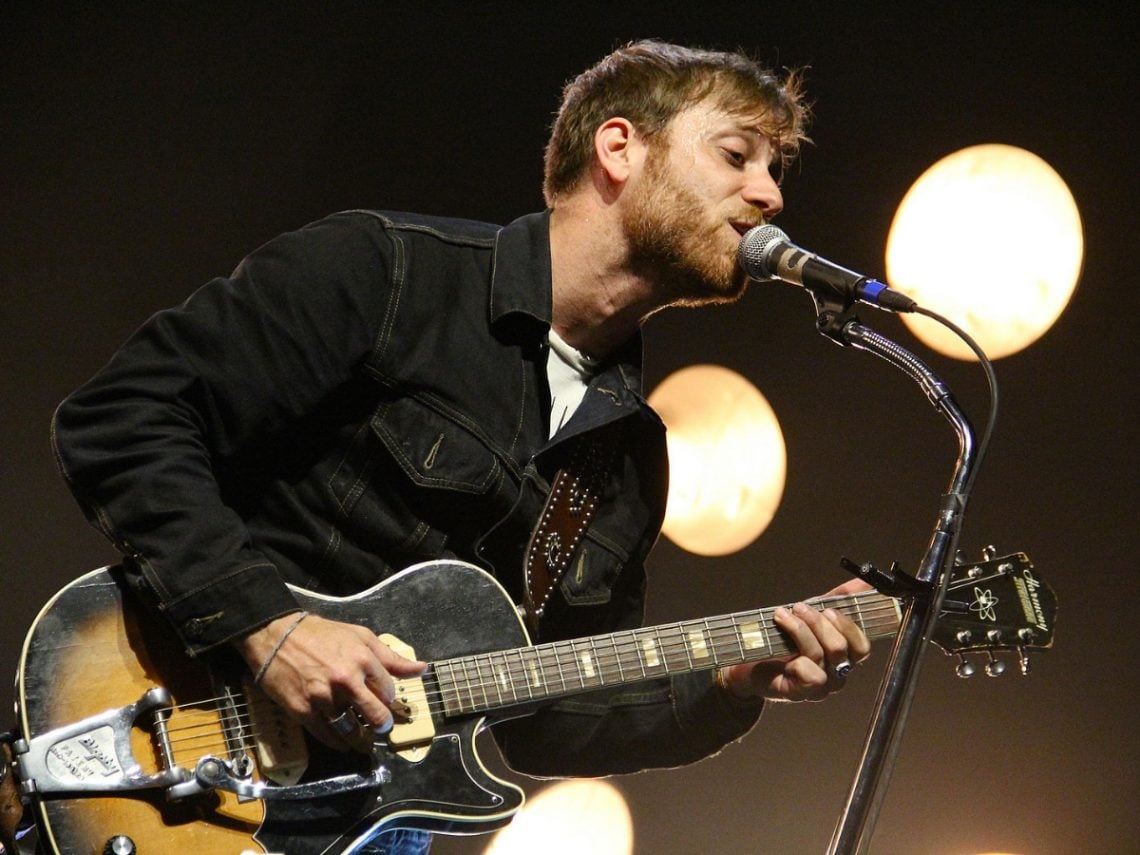
‘Revolution’: Dan Auerbach’s favourite song by The Beatles

“There’s no way to explain how much of an impact a song has had on you, but I think when you’re impressionable and young when you hear music, and you don’t know anything about music, that’s the most important time.” Having released 12 studio albums as singer, songwriter and guitarist with The Black Keys, Dan Auerbach can certainly take some time now to reflect on the songs that made him fall in love with music.
The Black Keys’ two-man lineup was the result of fortuity. In 2001, Auerbach was scheduled to record song demos in producer and drummer Patrick Carney’s basement studio in Akron, Ohio. On the date of the recording session, however, Auerbach’s backing musicians did not show, so of course, as you would expect from two talented musicians with time on their hands, Auerbach and Carney began to jam together. Here lies the moment The Black Keys were born.
With a hint of serendipity reminiscent of that early 2000s encounter, The Arcs were formed out of sessions for what was initially envisioned as a new solo album by Auerbach. He was joined by Leon Michels, a member of the 2010 touring edition of The Black Keys, alongside his boyhood friends and longtime band mates Homer Steinweiss and Nick Movshon. Multi-instrumentalist and vocalist Richard Swift, noted for his work in The Shins and his production of such artists as Nathaniel Rateliff, Damien Jurado and Valerie June, came on board to complete the lineup for what ultimately became a new band. Sadly, Swift passed away in 2018.
“I don’t think they made me want to pick up the guitar, but they made me know that I love sounds,” Auerbach says of some of the standout tracks that proved formative to his musical and artistic development. He revealed in an interview with The Line of Best Fit that one such song is ‘Revolution’ by The Beatles.
Explaining, “The Beatles are such a part of my DNA. I know every one of their songs. I don’t even know which records they came off because I would just listen to all the songs. I know all of them in my heart; I can always find something I like in a Beatles song.”
Auerbach goes on to recall a time he was writing with songwriter L Russell Brown in Nashville when he feared one of their compositions sounded a little too much like The Beatles, to which his co-writing partner responded, “It doesn’t sound enough like The Beatles!”
‘Revolution’ features heavy distortion, particularly in the twin fuzz-toned guitars plugged directly into the Abbey Road desk. As George Martin detailed in their anthology, “We got into distortion on that, which we had a lot of complaints from the technical people about. But that was the idea: it was John’s song, and the idea was to push it right to the limit. Well, we went to the limit and beyond.”
Drawing comparisons to ‘Foxy Lady’ by The Jimi Hendrix Experience, Auerbach continues: “It was so bombastic and catchy, and it was the combination of the two that made my 14-year-old brain explode – I don’t know what it was. I didn’t know what John Lennon was talking about, didn’t know what he was saying – I probably had a lot of the words wrong because I was learning it phonetically. First and foremost, it’s how it made me feel initially.”
Understandably, what Auerbach, in his young teenage years, wasn’t hearing on the ‘Hey Jude’ B-side was the doubt John Lennon expressed regarding some of the tactics used by the 1968 protests surrounding the Vietnam War.
The song was originally recorded as the calmer, bluesier ‘Revolution I’, but Paul McCartney and George Harrison felt it was too slow to follow Lennon’s suggestion to use it as a single. Thus, ‘Revolution’ was re-recorded as a distortion-heavy hard rock track.

Never Miss A Beat
The Far Out Beatles Newsletter
All the latest stories about The Beatles from the independent voice of culture.
Straight to your inbox.