“Spectacular misfires”, lost Britpop battles, and understanding Damon Albarn’s politics: Does nuance always come second?

The Britpop Battle of 1995 could barely have been more polarised. On the one hand, you had ‘Roll With It’, an unflinching song of swaggering working-class resilience. On the other hand, you had ‘Country House’, a ruminative song of dour middle-class retreat.
While Oasis sang of picking your chin up and striding forth, Blur sang of disappearing with your head down. Both, to some extent, are different sides of the same coin, tackling “the century’s anxiety”, but as Damon Albarn crafted intellectual nuance, Noel Gallagher plonked for populist instinct.
The latter came out on top as Albarn conceded just a few days ago: “I think we can officially say that Oasis won the battle, the war, the campaign, everything.”
Interestingly, a matter of days later, Albarn also commented on Bob Vylan’s bold chant at Glastonbury, calling it a “spectacular misfire“. He followed this by saying his musical collective, Africa Express, “Could go into Palestine”.
The Blur frontman continued, “It’s not about politics, it’s about culture. And so I would also want to go to Israel and bring people together. If I was asked to go to Russia, I would go. I’d go to Ukraine too”.
While his comments might seem notably naive considering the UN have confirmed blockades and the deaths of at least 430 aid workers in Palestine since 2023, if we’re not to take his remarks as literally a ludicrous bid to tour in wartorn military zones, then they abide by the call for measured nuance and collective unity that he has always promoted in his art.
While Albarn’s comments might appear frustratingly out of touch with the severity of the brutal conflicts he mentioned, if granted the liberty of being read figuratively, then they suggest a call for cultural diplomacy. This is the idealism that underpins his Africa Express project: that shared culture and creation can be a bridge while aggression only further exacerbates conflict. But in 2025, does this approach still resonate? In fact, has his soft political gesturing ever truly made an impact?
This is, of course, an impossible question to answer, but somewhere amid Albarn admitting defeat to a less nuanced force, his harsh take on Bob Vylan, and the politics he has applied throughout his career, there is plenty of ambiguous food for thought. By contrast, the Bob Vylan chant he condemned offered no ambiguity whatsoever. It was so startling that the BBC were so shaken they forgot to cut the feed.
Only a year earlier, Albarn was at the very same Glastonbury Festival as Bombay Bicycle Club’s special guest, and he used his platform to comment, “Three things, and you have to show me how you feel about them: Palestine. Are you pro-Palestine? Do you feel that’s an unfair war? OK.“ His questions were met with resounding affirmative cheers.
He then continued: “The importance of voting next week? Now, I don’t blame you for being ambivalent about that, but it’s still really important. And thirdly, maybe it is time we stopped putting octogenarians in control of the whole world.“ In some ways, Vylan might argue that they simply said the same thing, but their more startling and performative manner of speaking it had a greater impact. You don’t have to have been all that observant to see that it seems to have galvanised protest and brought about greater discussion of the crisis.
In times of great humanitarian urgency, it is easy to see why a bold, striking and profoundly punk message might pack a mightier punch than Albarn’s soft politics that can easily be dismissed as ‘old, rich man thinks he can save the world with nice songs’. In a time of beheaded babies, lines like ‘it’s complex’ and ‘we need to see both sides even if we don’t agree with one of them’ seem like exhausted deflection that hasn’t gotten us anywhere to such an extent that it is tantamount to being complicit.
Furthermore, surely Bob Vylan’s chants should also be interpreted as figurative, too. Surely, their own remarks shouldn’t be taken as literally as the BBC, Glastonbury, and the powers that be seem to be taking them, framing two young artists as a threat to an entire military division. Is this reaction, in itself, not a loss of nuance? Has the censorship, active defanging, and authoritarian response to acts like Kneecap and Bob Vylan not highlighted that governments enforce a limit on the extent to which free speech can go against their chosen narrative?
After all, as Kneecap put it, “We just want to stop people being murdered”.
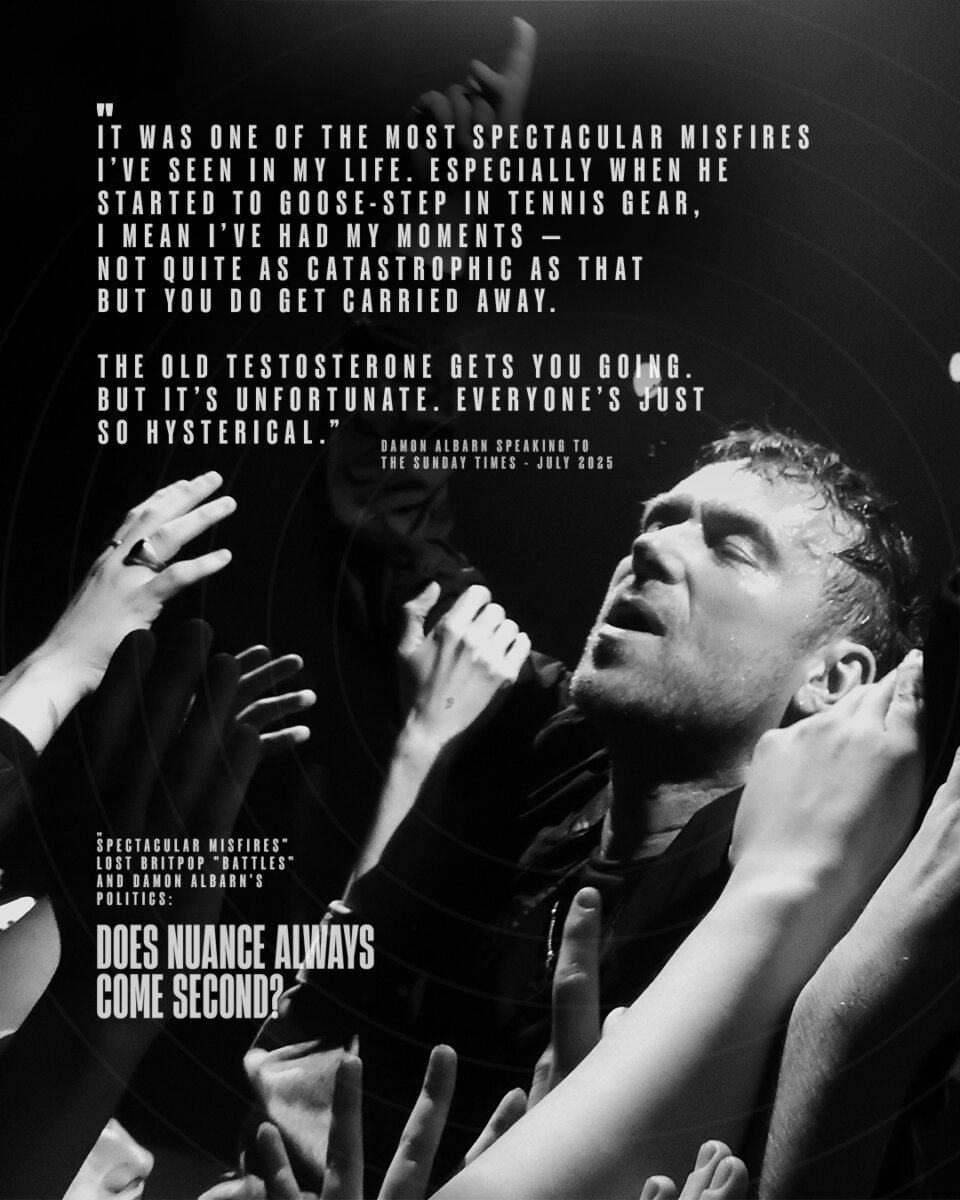
With over 17,000 children being murdered in Palestine, and 81 civilian deaths occurring the day before Bob Vylan’s performance, it was more than understandable that they were ”hysterical” as Albarn unfortunately phrased it. While Albarn called their performance ”catastrophic”, their obvious comeback would be that they actually brought attention to the genuine catastrophe that continues to unfurl unchecked. But did they? How do you measure the weight of causing a stir and genuine substance-led subversion?
Therein lies the impossible paradox of our times. The next day at Glastonbury, Nadine Shah orchestrated her set into a fully considered political protest. She took to the stage and explained that Artists for Palestine UK had given her permission to read their open letter in support of Palestine Action, which has recently been proscribed as a terrorist organisation by the UK government. Shah called Palestine Action “an incredible group” and stressed that they were ”intervening to stop a genocide”.
She continued, ”We deplore the government’s decision to proscribe it, labelling non-violent direct action as terrorism is an abuse of language and an attack on democracy.”
She then continues, “The real threat to the life of the nation comes not of Palestine Action but from the Home Secretary’s efforts to ban it. We call on the government to withdraw its proscription of Palestine Action and to stop arming Israel.”
Shah concluded: “If I read this out after July 4th, I could potentially be prosecuted for that. Thank you, Glastonbury.”
Shah is not being investigated. She was not condemned by the festival organisers, unlike her peers. And her considered, nuanced protest failed to garner a fraction of the column inches or discussion that others have. It seems there are two clear reasons for this: her performance was never scheduled to be televised, and she made her remarks in a more measured, far less incendiary way to her peers. So, was her intelligent and erudite protest more or less effective?
This question says a lot about our present society. The very notion that something needs to be extreme and incendiary to be worthy of attention has been systemically driven by mainstream media, especially in an age where algorithms actively look to prompt a sense of indignation more than any other response, according to Geoffrey Hinton.
Ironically, it took a parody of the BBC in the form of This Time with Alan Partridge for Sidekick Simon to nail the plight, “I just think wheeling out people at the extremes sounds like balance, but it’s just a way of starting a fight, isn’t it? It doesn’t illuminate anything. It just makes people angry.” With that in mind, at what point does the call for peace presented as a spectacle stand as a necessary means to draw attention, and at what point does that attention become a distraction?
The engineered polarisation of present society, driven by modern mainstream media has created a space where subtlety, complexity, and good-faith nuance are drowned-out and dumbed-down. This has created an environment where figures like Donald Trump have thrived. His shouted simplicity is simply louder than subtle sophistication by a landslide.
So the question is: does that justify Bob Vylan’s approach? Is it better to shout something incendiary and have it heard? In the face of mass suffering, is Albarn’s ludicrously softly-softly outlook simply not fit for purpose? And does Nadine Shah’s more robust and fitting call for peace going unheralded highlight the issue that George Orwell brought attention to when he wrote: “The enemy is the gramophone mind, whether or not one agrees with the record that is being played at the moment.”
In a strange twist of fate, the debate is pretty much a radicalised version of the battle of Britpop. Blur offered nuanced commentary. Oasis gave people a potent feeling. And people, overwhelmingly, chose the feeling. In times of trouble, the bold, the brash, and the emotionally bombastic have a visceral appeal that scores number one hits, wins elections, and rallies the masses. That appeal plays out in Britpop as much as it does in politics and protest.
In the end, measured critique may well, once again, come second. Perhaps if society was as it should be, that wouldn’t be the case. But it isn’t as it should be, and until it is, we’ll always be trapped in this troublesome tug of war where the centre struggles to hold, and the unanswerable questions about noise and nuance, provaction and progress remain.