


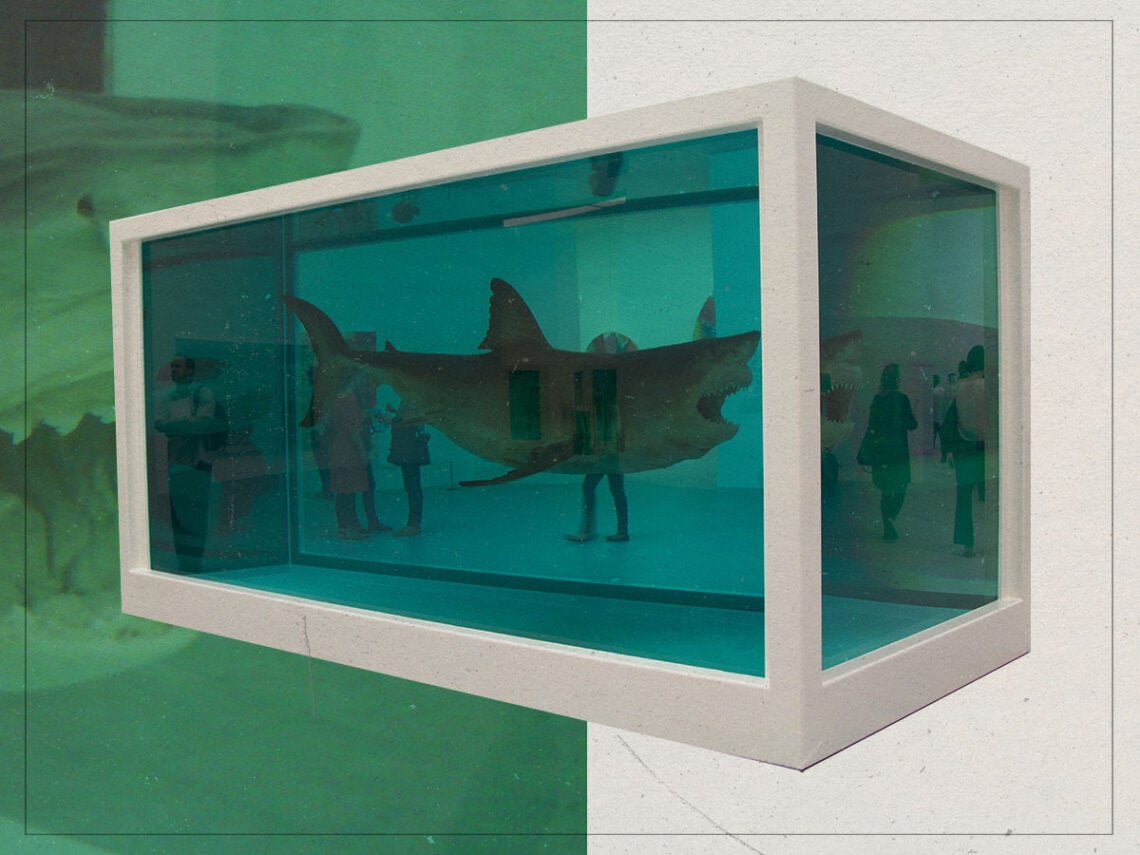
How did Damien Hirst get his hands on a shark?

Making his most controversial piece for artist-provocateur Damien Hirst was no easy task. It’s difficult to decide which of Hirst’s works caused the most outrage. Many find him vulgar and provocative for the sake of it, but his infamous shark piece might be the most mind-boggling.
So, what is the story of how Hirst got his hands on this 14-foot Australian tiger shark? In 1991, Charles Saatchi, one of the wealthiest British businessmen and a prolific art collector, offered to sponsor Hirst in a project that consisted of a real shark that was “big enough to eat you”, no matter the budget and expenses.
So Hirst set out to find a fisherman who could carry out the bloody task of killing a shark. He landed upon an Australian fisherman who caught the shark that we know of today in Queensland’s Hervey Bay. He shipped it to Hirst in London for a mere $20,000 in exchange.
The shark had to be carefully preserved so that it would not rot, so Hirst placed it in a vitrine with a formaldehyde solution. This became the centrepiece of the ground-breaking Young British Artists exhibition at the Saatchi Gallery and the Royal Academy. The shark came to symbolise the bewildered, jaw-dropping faces of people who came from across the world to see it.
The name of the spectacle is The Physical Impossibility of Death in the Mind of Someone Living. It is pompously ambiguous, but upon reflection, it could refer to a variety of things. Hirst wanted to challenge the viewer to make them think about the terrifying experience of death, something very challenging to do while alive, since it’s an unknown experience. Given that millions of people fear death, Hirst wanted to prove that not even money can buy immortality. As the richest living artist, he can say this.
However, even the public uproar of the exhibition, both positive and negative, wasn’t enough to keep the shark intact. It started to rot, its skin growing wrinkly, the tank getting murky, emitting a fetid smell. So Saatchi’s curators decided to remove the shark’s skin and stretch it on a fibreglass mould, but this didn’t give quite the same effect.
The almost decomposed nature of the shark didn’t stop billionaire Steven Cohen from throwing $8million at it in 2004. Hirst decided he should probably give him a new, fresh shark, given the money he paid, so he bought a smaller female shark, again from Australia.
This time, she was transported in a better-quality freezer to ensure maximum coolness. Working alongside fish scientists at the Natural History Museum, Hirst and his team soaked the shark for two weeks in a stronger formaldehyde solution and injected it with it to ensure it lasted longer than the last one.
Hundreds of thousands of pounds and thousands of wildlife species killed later, Hirst continues to create this type of art, despite the criticism. Studies have declared that he is responsible for having killed one million animals (many of which are bugs and butterflies) for his art.
Even with all the protests by animal rights activists, negative press reviews and public disapproval, Hirst continues to be the richest artist alive, and no one seems to be able to stop him.
“It’s amazing what you can do with an E in A-Level art, a twisted imagination, and a chainsaw,” he declared, accepting the Turner Prize in 1995.
